
Scierotium Poriae Cocos Sclerotium of Tuckahoe, China Root, Poria, Hoelen
Also known as Yun Ling, Bai Fu Ling, Fang Ling Kuai
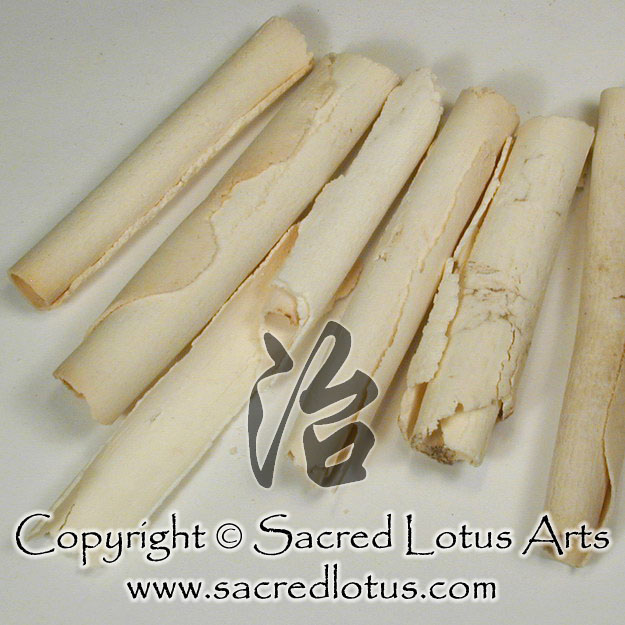
Materia Medica Data
- Temperature
- Neutral
- Nature & Flavour
- Sweet, Bland, Neutral
- Channels Entered
- HT, SP, LU
- Latin (pharmaceutical)
- Scierotium Poriae Cocos
- Chinese
- 茯苓
- Tone Marks
- fú líng
- Also Known As
- Yun Ling, Bai Fu Ling, Fang Ling Kuai
Chinese Herb Actions
What is Fu Ling (Poria) used for in Chinese medicine?
Fu Ling is a gentle, neutral herb that drains dampness and promotes urination, strengthens the Spleen, and calms the Heart/shen — a combination of actions unusual enough that it appears in 48 of the 257 formulas in this reference, making it one of the most widely combined herbs in the entire materia medica.
Its main traditional actions:
- Drains dampness and reduces swelling — for edema of any etiology.
- Promotes urination — for difficult or scanty urination due to damp-heat.
- Tonifies Spleen qi — for loose stool, lethargy, and low appetite.
- Transforms phlegm and calms the Heart — for Spleen deficiency with congested fluids moving upward: dizziness, palpitations, and a thick, greasy tongue coating.
Source: existing Sacred Lotus reference content (Chen & Chen, Chinese Medical Herbology and Pharmacology), cross-checked against Bensky, Materia Medica (3rd ed.); formula count computed from this site's own herb–formula database. Traditional-use framing; not medical advice.
Chinese Herb Dosage
What is the typical dosage of Fu Ling?
Roughly 9–15 g in decoction — the existing reference entry (citing Chen & Chen) gives 10–15 g, consistent with the standard 9–15 g materia medica range; doses toward the higher end are more typical when the herb is used mainly to drain more pronounced edema.
Fu Ling is also traded/dispensed as distinct sub-products with slightly different traditional emphases: Fu Ling Pi (the dark outer peel) is favored specifically for edema, and modern pharmacology research (below) reports the peel layer shows stronger diuretic activity than the whole sclerotium — a nice concordance between the classical differentiation and current lab findings. Fu Shen (the portion of the sclerotium that has grown around a pine root) is favored instead for calming the shen (palpitations, insomnia).
Source: existing Sacred Lotus reference content (Chen & Chen); Bensky, Materia Medica (3rd ed.) for sub-product distinctions; PMID 39482471 (below) for the peel/diuresis finding. Reference only — not a prescription.
Chinese Herb Contraindications & Cautions
Are there cautions for Fu Ling?
Fu Ling is one of the gentler, food-grade herbs in the materia medica, but the existing reference entry flags one specific caution: copious and frequent urination due to deficiency-cold. Because Fu Ling promotes urination, using it in a pattern where urination is already excessive from underlying cold/deficiency (rather than dampness) risks further depleting fluids and qi rather than helping.
Source: existing Sacred Lotus reference content; consistent with standard materia medica differentiation of dampness-draining herbs. Reference only, not medical advice.
Chinese Herb Toxicity & Overdose
Very low. Fu Ling (Poria cocos sclerotium) has a long history as both a food (used in Chinese soups, congee, and desserts) and a medicinal, and no significant toxicity is reported at standard traditional doses. A 2011 pharmacology review notes, however, that despite this long history of use, dedicated clinical safety/toxicology research remains limited — the reassurance comes mainly from extensive traditional dietary and clinical experience rather than formal toxicology trials.
Source: PMID 21347995 (Riós, Planta Medica, 2011 — chemistry/pharmacology review). Reference note, not a safety guarantee.
Herb-Drug Interactions
No well-established clinical herb–drug interactions are documented for Fu Ling. Because it has a mild diuretic action, practitioner awareness is reasonable for patients on prescription diuretics or lithium (whose clearance is diuretic-sensitive) — this is a precautionary, theoretical consideration based on its known pharmacology, not a demonstrated clinical interaction. (Flagged for practitioner confirmation.)
Western / Biomedical Research
Chinese Herb Clinical Studies & Research
Provided as research context — a summary of published biomedical study, not a therapeutic or medical claim.
Is there modern research on Fu Ling (Poria cocos)?
Yes — a large and growing preclinical literature on its polysaccharide and triterpenoid constituents, with modern human-trial evidence still limited to combination products rather than Fu Ling alone. A 2026 narrative review (Frontiers in Nutrition) summarizes recent findings across renal protection, digestive function, sleep quality, immune regulation, antioxidant effects, and anticancer activity.
- Chemistry/pharmacology (foundational review) — the widely cited 2011 Planta Medica review describes Poria's two main compound classes: triterpenes, which inhibit phospholipase A2 and suppress cytokine secretion (relevant to inflammatory conditions such as rheumatoid arthritis and psoriasis in preclinical models), and polysaccharides, which stimulate immune activity and show antitumor effects via NF-κB-related pathways in lab studies; the authors conclude clinical research is still insufficient to fully establish efficacy and safety.
- Renoprotective triterpenoids (2025 review) — a review in Acta Pharmacologica Sinica reports Poria triterpenoids acting through TGF-β1/Smad, Wnt/β-catenin, NF-κB, and Nrf2 pathways in models of acute kidney injury, chronic kidney disease, diabetic kidney disease, and nephrotic syndrome, and specifically notes that the outer peel layer (Fu Ling Pi) shows stronger diuretic activity than the whole sclerotium — a modern echo of the classical Fu Ling Pi/Fu Ling distinction. Preclinical.
- Polysaccharide pharmacology — a 2022 review (International Journal of Biological Macromolecules) catalogs antitumor, antioxidant, anti-inflammatory, immune-regulatory, and hepatoprotective activities of Poria polysaccharide fractions; cell and animal evidence, not clinical proof.
- Pachymic acid / anticancer mechanism — a 2026 study reports pachymic acid (a Poria triterpenoid) inhibiting proliferation and invasion of colon cancer cell lines and in nude-mouse xenografts by suppressing glycolysis via the PPARγ/ENO1 pathway; cell/animal research only.
- Human trial (combination product, not isolated Fu Ling) — a randomized, double-blind, placebo-controlled trial (n = 70, 4 weeks) of a supplement combining Poria cocos, Suan Zao Ren (Ziziphus spinosa), and GABA reported significantly greater improvements in sleep duration, PSQI score, and several skin parameters versus placebo. Because Poria was one of three active ingredients, this cannot be attributed to Fu Ling alone — though the Poria + Suan Zao Ren pairing mirrors classical shen-calming combinations (Suan Zao Ren Tang, Gui Pi Tang) already used in this reference's formulas.
- Ongoing trial (protocol only, no results yet) — a 2022 published protocol describes a pilot randomized, double-blind, placebo-controlled trial of a Fu Ling–Ze Xie decoction for asymptomatic hyperuricemia; only the trial design has been published, not outcome data.
Overall: strong and expanding mechanistic/preclinical evidence for Poria's triterpenoid and polysaccharide constituents, but direct human clinical evidence for Fu Ling used alone remains sparse.
Note: The current Sacred Lotus records the pharmaceutical Latin as “Scierotium Poriae Cocos,” which appears to be a typographical slip for “Sclerotium Poriae Cocos” (the standard form used across the materia medica literature, alongside “Poria”/“Poria cocos”). Left unchanged in the identity field pending owner confirmation; flagged for the data-quality list.
Sources: PMID 41693937 (Guo et al., Frontiers in Nutrition, 2026, narrative review); PMID 21347995 (Ríos, Planta Medica, 2011); PMID 39482471 (Guo et al., Acta Pharmacologica Sinica, 2025); PMID 35843404 (Xu et al., Int J Biol Macromol, 2022); PMID 41390134 (pachymic acid/colon cancer, 2026, cell/animal); PMID 38873452 (Hao et al., combination-product RCT, 2024); PMID 35725639 (Fuling-Zexie hyperuricemia trial protocol, Trials, 2022). Research context, not a therapeutic claim.
Chinese Herb Notes
How is Fu Ling different from Zhu Ling, Ze Xie, and Bai Zhu, and what does it commonly combine with?
All four herbs drain dampness through urination, but Fu Ling is the only one that also tonifies the Spleen and calms the Heart/shen — the others specialize in draining alone (or, for Bai Zhu, in drying rather than draining).
- Zhu Ling — a stronger, more purely draining diuretic than Fu Ling; does not tonify the Spleen and has no calming action.
- Ze Xie — also promotes urination and drains dampness, but is cooling in nature (better suited to damp-heat) and likewise does not tonify.
- Bai Zhu — dries dampness rather than draining it through urination, tonifies Spleen qi more strongly, and stops sweating; classically paired with Fu Ling (each covering what the other doesn't).
- Fu Ling — the mildest and most multipurpose of the four: drains dampness, tonifies the Spleen, and calms the Heart/shen, which is why it recurs across so many unrelated formula categories.
Common combinations / formulas in this reference (48 total): with Ren Shen, Bai Zhu, and Gan Cao as the foundational Spleen-qi tonic in Si Jun Zi Tang (and its many derivatives, e.g. Shen Ling Bai Zhu San, Ba Zhen Tang, Shi Quan Da Bu Tang); with Zhu Ling, Ze Xie, Bai Zhu, and Gui Zhi in Wu Ling San, the classic dampness-draining combination; with Gui Zhi, Bai Zhu, and Gan Cao in Ling Gui Zhu Gan Tang for phlegm-fluid patterns with dizziness; and with Suan Zao Ren and/or Yuan Zhi in shen-calming formulas such as Gui Pi Tang, Suan Zao Ren Tang, and Tian Wang Bu Xin Dan. It also appears in major Kidney formulas (Liu Wei Di Huang Wan, Jin Gui Shen Qi Wan), where its bland, draining nature is traditionally said to offset the cloying richness of Shu Di Huang. (Traditional formula context, not treatment advice.)
Source: Bensky, Materia Medica (3rd ed.) for herb differentiation; Sacred Lotus formula links for combination list.
Sources & References
Compiled and edited by Thomas Dehli, Founder & Editor, Sacred Lotus Updated
The information here is referenced from numerous sources — teachers, practitioners, class notes from Five Branches University, the books below, and the published research literature, with citations given as resolvable PubMed identifiers. Where sources disagree, I have flagged the discrepancies directly. If facts couldn't be verified, I have left them out. How we source our content.
Reference information for students and practitioners — not medical advice. Consult a qualified practitioner. Terms of use.
Chinese Herbs Books & References
 https://amzn.to/3WfB3DK
 https://amzn.to/3DR1VUh
 https://amzn.to/42aMz73
 https://amzn.to/3PuD4bt