

Si Jun Zi Tang (Four Gentlemen Decoction)
Si Jun Zi Tang
Four Gentlemen Decoction
- Category
- Formulas that Tonify
- Subcategory
- Formulas that Tonify the Qi
- Ingredients
- 4 herbs
Actions
What does Si Jun Zi Tang do?
Si Jun Zi Tang (Four Gentlemen Decoction) tonifies Spleen and Stomach Qi, restoring the digestive system's capacity to transform and transport food into Qi and Blood, without the heaviness or cloying richness of stronger single tonics.
- Tonifies Qi — Ren Shen (Radix Ginseng), the chief herb, strongly boosts Spleen and Stomach Qi and the body's overall source Qi.
- Strengthens the Spleen, dries dampness — Bai Zhu supports Ren Shen's tonifying action while drying the dampness a weak Spleen tends to generate.
- Percolates dampness, settles the Stomach — Fu Ling leaches out dampness and calms a Stomach disturbed by underlying deficiency.
- Harmonizes and moderates — honey-fried Zhi Gan Cao harmonizes the other three herbs and adds a mild Qi-tonifying effect of its own.
Source: Bensky & Barolet, Chinese Herbal Medicine: Formulas & Strategies; Chen & Chen, Chinese Herbal Formulas and Applications.
Indications
What is Si Jun Zi Tang used for?
Si Jun Zi Tang treats the basic pattern of Spleen and Stomach Qi deficiency — someone who tires easily, eats little, and has loose stool — and serves as the foundational base formula from which most other Qi-tonifying prescriptions are built.
- Poor appetite and reduced food intake
- Loose stool or watery, undigested stool
- Sallow or pale complexion
- Weak limbs, general fatigue, and low energy
- Soft, low voice and disinclination to speak
- Mild epigastric fullness after eating, without pain
Source: Bensky & Barolet, Chinese Herbal Medicine: Formulas & Strategies; Chen & Chen, Chinese Herbal Formulas and Applications.
Western Uses:
What conditions is Si Jun Zi Tang used for in modern practice?
Si Jun Zi Tang is the foundational Spleen-qi tonic (fatigue, poor appetite, loose stools, a weak voice and pale complexion), so it is referenced across digestive and deficiency conditions: chronic gastritis, gastric and duodenal ulcer, nervous exhaustion (neurasthenia), irritable bowel syndrome, diabetes mellitus, periodic paralysis, uterine fibroids, and shortening recovery time after gastric surgery.
The thread is the Spleen-qi-deficiency pattern, not any one diagnosis. Ulcers need medical treatment (including H. pylori testing), diabetes requires medical management, and periodic paralysis and fibroids need diagnosis. This base tonic is a traditional adjunct, not a substitute. Traditional-use correlates only, not a treatment claim.
Source: Sacred Lotus sources & references (pattern) + Bensky & Barolet, Formulas & Strategies; biomedical correlates as reference only. Not medical advice.
Ingredients
4 substances in Si Jun Zi Tang — each links to its full herb monograph.
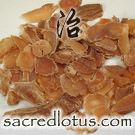 Ren Shen3-9 gTonify Qi
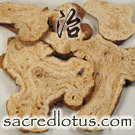 Bai Zhu6-9 gTonify Qi
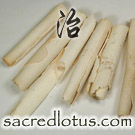 Fu Ling6-9 gRegulate Water and Drain Dampness
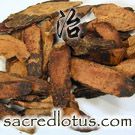 Zhi Gan Cao3-6 gTonify Qi
Preparation & dosage
How is Si Jun Zi Tang prepared?
The four herbs are combined as a water decoction (tang) — Ren Shen 3-9g, Bai Zhu 6-9g, Fu Ling 6-9g, and honey-fried Zhi Gan Cao 3-6g — simmered together and taken warm, traditionally in divided doses through the day.
- Zhi Gan Cao — the licorice is honey-fried (mì zhì) before use, which moderates its raw property and enhances its Spleen-tonifying, harmonizing action.
- Ren Shen substitution — in modern practice Ren Shen is frequently replaced with Dang Shen (Radix Codonopsis) at roughly two to three times the Ren Shen dose, a common substitution for cost and availability rather than a change in classical composition.
- Classical method — early sources describe the coarsely cut herbs decocted with a few slices of fresh ginger, which supports digestion of the tonics but is not counted among the formula's four namesake ingredients.
Source: Bensky & Barolet, Chinese Herbal Medicine: Formulas & Strategies; Chen & Chen, Chinese Herbal Formulas and Applications.
Safety — read before use
What are the cautions for Si Jun Zi Tang?
Si Jun Zi Tang is not appropriate for excess-heat or deficiency-heat patterns, and should be reassessed if signs of heat or stagnation appear, since its warming, tonifying herbs can aggravate these conditions.
- Avoid in cases of excess heat or deficient (Yin-deficiency) heat.
- Avoid when irritability, thirst, abdominal bloating, and constipation occur together — a pattern of heat or stagnation rather than plain Qi deficiency.
- Prolonged use may cause irritability and dry mouth in some individuals; discontinue or reassess if these appear.
Source: Bensky & Barolet, Chinese Herbal Medicine: Formulas & Strategies; Chen & Chen, Chinese Herbal Formulas and Applications.
Originally Appeared In:
- Imperial Grace Formulary of the Tai Ping Era (Tai Ping Hui Min He Ji Ju Fang)
Notes:
What is the classical source of Si Jun Zi Tang?
Si Jun Zi Tang is first recorded in the Taiping Huimin Heji Ju Fang ("Formulas of the Peaceful Benevolent Dispensary"), the Song-dynasty imperial pharmacy formulary compiled in the late 11th to early 12th century, where it appears as a core Qi-tonifying prescription.
How does Si Jun Zi Tang differ from related formulas?
- Si Wu Tang — the Blood-tonifying counterpart (Shu Di Huang, Bai Shao, Dang Gui, Chuan Xiong); the two combine as Ba Zhen Tang ("Eight Treasure Decoction") to tonify Qi and Blood together.
- Li Zhong Wan — shares Ren Shen, Bai Zhu, and Zhi Gan Cao but replaces Fu Ling with warming Gan Jiang (dried ginger); it targets Spleen-Stomach Yang deficiency with internal cold, not plain Qi deficiency.
- Yi Gong San — Si Jun Zi Tang plus Chen Pi (tangerine peel), for Qi deficiency with mild Qi stagnation, poor appetite, and abdominal distension.
- Liu Jun Zi Tang — Si Jun Zi Tang plus Chen Pi and Ban Xia, extending the base formula to also transform phlegm-dampness; used for Qi deficiency with cough, copious sputum, nausea, or vomiting.
- Xiang Sha Liu Jun Zi Tang — Liu Jun Zi Tang plus Mu Xiang and Sha Ren, adding Qi-moving and dampness-transforming action for epigastric distension, belching, and poor appetite from combined Qi deficiency and Qi stagnation.
- Shen Ling Bai Zhu San — Si Jun Zi Tang expanded with Shan Yao, Bai Bian Dou, Lian Zi, Yi Yi Ren, Sha Ren, and Jie Geng, formulated as a powder for Spleen Qi deficiency with more pronounced dampness and diarrhea; Jie Geng also guides the formula's benefit upward to the Lung.
Source: Bensky & Barolet, Chinese Herbal Medicine: Formulas & Strategies; Chen & Chen, Chinese Herbal Formulas and Applications.
Clinical Studies & Research:
Is there modern research on Si Jun Zi Tang?
Modern studies on Sijunzi Decoction focus on gastrointestinal and gut-microbiota effects broadly consistent with its traditional Spleen/Stomach-Qi indication, though this research is exploratory laboratory and clinical-trial work and does not establish the formula as a treatment for any disease.
- A 2024 meta-analysis of randomized trials found modified Sijunzi Decoction combined with standard care improved symptoms and Helicobacter pylori eradication rates in chronic atrophic gastritis compared with Western medicine alone.
- A 2024 proteomic and metabolomic study reported that Sijunzi Decoction affected oxidative phosphorylation pathways in a gastric precancerous lesion model.
- A 2024 mouse study found Sijunzi Decoction reduced inflammation, preserved intestinal epithelial barrier integrity, and shifted gut microbiota composition in a colitis model.
- A registered randomized, double-blind, placebo-controlled trial protocol was published to evaluate Sijunzi Decoction for chronic fatigue syndrome with a Spleen-deficiency pattern.
Sources: PMID 38669406, PMID 37467821, PMID 38650625, PMID 31807568.
Sources & References
Compiled and edited by Thomas Dehli, Founder & Editor, Sacred Lotus Updated
The information here is referenced from numerous sources — teachers, practitioners, class notes from Five Branches University, the books below, and the published research literature, with citations given as resolvable PubMed identifiers. Where sources disagree, I have flagged the discrepancies directly. If facts couldn't be verified, I have left them out. How we source our content.
Reference information for students and practitioners — not medical advice. Consult a qualified practitioner. Terms of use.
Chinese Formulas Books & References
 https://amzn.to/4fYI3f8
 https://amzn.to/4j55NRA
 https://amzn.to/4gMROyv
 https://amzn.to/4h7msSK