

Bai Zhu (White Atractylodes Rhizome)
Rhizoma Atractylodis Macrocephalae White Atractylodes Rhizome
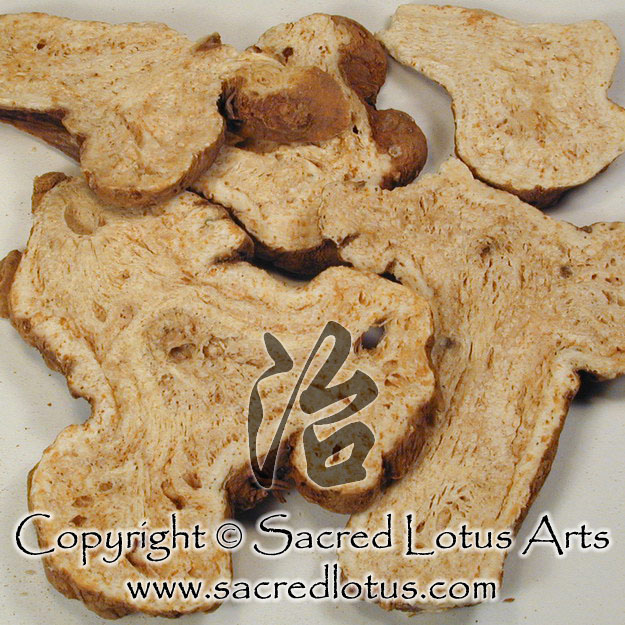
Materia Medica Data
- Category
- Herbs that Tonify Qi
- Temperature
- Warm
- Nature & Flavour
- Bitter, Sweet, Warm
- Channels Entered
- SP, ST
- Latin (pharmaceutical)
- Rhizoma Atractylodis Macrocephalae
- Chinese
- 白术
- Tone Marks
- bái zhú
Chinese Herb Actions
What is Bai Zhu used for in Chinese medicine?
Bai Zhu (White Atractylodes Rhizome) is a core Spleen-qi tonic — it is the classic choice for Middle Jiao (Spleen/Stomach) qi deficiency presenting with loose stools, fatigue, shortness of breath, a sallow complexion, and poor appetite, and it also dries dampness, stabilizes the exterior against sweating, and calms a restless pregnancy.
Its main traditional actions:
- Tonifies the Spleen and augments the qi — for Middle Jiao (Spleen and Stomach) qi deficiency with loose stools, diarrhea, fatigue, shortness of breath, a sallow complexion, and reduced appetite.
- Dries dampness and moves/transforms water accumulation — for edema caused by Spleen-qi deficiency, where the Spleen fails to transform and transport fluids and dampness accumulates.
- Strengthens the wei (defensive) qi and stops sweating — for spontaneous sweating caused by qi deficiency.
- Stabilizes pregnancy and calms a restless fetus — for restless-fetus patterns arising from Spleen-qi deficiency failing to nourish the fetus.
Source: Sacred Lotus reference notes, cross-checked against Bensky & Chen & Chen-style materia medica consensus for the Qi-tonic category. Traditional-use framing; not medical advice.
Chinese Herb Dosage
What is the typical dosage of Bai Zhu?
Roughly 5–15 grams in decoction, the standard range for this herb in materia medica references and the Sacred Lotus.
Processing changes emphasis, per standard materia medica convention: raw (sheng) Bai Zhu is favored when the dampness-drying and diuretic action is wanted most; dry-fried or bran-fried (chao) Bai Zhu is milder and gentler on digestion, favored for straightforward Spleen-qi tonification and to help stop sweating; a scorched (jiao) preparation is sometimes used for diarrhea. (Preparation nuance for practitioner reference, not a self-dosing instruction.)
Source: Sacred Lotus (dosage range); standard TCM processing (pao zhi) conventions per materia medica consensus. Reference only — not a prescription.
Chinese Herb Contraindications & Cautions
Are there cautions for Bai Zhu?
Bai Zhu should be combined cautiously in Yin-deficiency patterns with heat and fluid depletion, since its warm, drying nature can aggravate dryness, and it is generally avoided where Qi stagnation manifests as a feeling of oppression or distension in the chest/abdomen, since a tonifying herb can worsen a stagnation pattern.
- Yin deficiency with heat/dryness — use cautiously or combine with yin-nourishing, moistening herbs.
- Qi stagnation with distension/oppression — not appropriate as a standalone tonic in this pattern.
Source: Sacred Lotus reference notes (legacy cautions), consistent with standard Qi-tonic category cautions in materia medica consensus.
Chinese Herb Toxicity & Overdose
Low. A 2021 pharmacology review reports that acute toxicity testing shows Bai Zhu has only minor toxicity, that water-extract preparations show relatively low acute toxicity with low cytotoxicity and no genetic toxicity in the models tested, and that three-month rat studies with the volatile oil (100–300 mg/kg) did not reveal significant harm. The same review notes a lack of direct human safety trials, so this is preclinical/traditional-safety evidence, not a clinical guarantee.
Source: PMID 34803677, DOI 10.3389/fphar.2021.727154 (comprehensive pharmacology/toxicology review). Reference note, not a safety guarantee.
Herb-Drug Interactions
No well-established clinical herb–drug interactions are documented. The main pharmacology review of Bai Zhu does not report interaction studies with conventional CYP450-metabolized drugs. Preclinical work has found a hypoglycemic effect (improved insulin sensitivity, GLUT-4 upregulation), so practitioner awareness is reasonable for patients on antidiabetic medication — this is precautionary, based on preclinical pharmacology, not a demonstrated clinical interaction. (Flagged for practitioner confirmation.)
Western / Biomedical Research
Chinese Herb Clinical Studies & Research
Provided as research context — a summary of published biomedical study, not a therapeutic or medical claim.
Is there modern research on Bai Zhu (Atractylodes macrocephala)?
Yes — a substantial preclinical literature plus limited formula-level clinical evidence. Bai Zhu's characteristic constituents are sesquiterpenoid atractylenolides and polysaccharides, and most of the pharmacological support for its traditional uses comes from cell and animal studies rather than human trials of the single herb.
- Gastrointestinal / mucosal repair (preclinical) — an extract of Atractylodes macrocephala was shown to stimulate intestinal epithelial cell migration through a polyamine-dependent mechanism, supporting its traditional role in Spleen-deficiency digestive complaints (PMID 25446597).
- Pregnancy / gastrointestinal barrier (preclinical, animal) — in pregnant mice with induced Spleen-deficiency diarrhea, Bai Zhu improved gastrointestinal barrier and water-metabolism markers, reduced intestinal damage, and improved pregnancy-hormone levels, offering a mechanistic angle on the traditional fetal-stabilizing use (PMID 38403003, DOI 10.1016/j.jep.2024.117971).
- Polysaccharides and gut microbiota (preclinical) — Atractylodes macrocephala polysaccharide improved Spleen-deficiency constipation in mice by shifting gut-microbiota composition and downstream serotonin (5-HT) signaling in the colon (PMID 39077771, DOI 10.1111/nmo.14875).
- Broad pharmacology review — a 2021 review catalogs anti-inflammatory (TNF-α/NO inhibition, TLR4 antagonism), immunomodulatory, antitumor, antioxidant, and hypoglycemic activity reported across preclinical studies, alongside the toxicology findings above (PMID 34803677, DOI 10.3389/fphar.2021.727154).
- Formula-level clinical evidence (not the single herb) — a meta-analysis of 24 randomized trials (n = 3,768) evaluated Bai Zhu–Bai Shao "class formulas" (e.g., Tong Xie Yao Fang-type combinations) for irritable bowel syndrome, finding higher symptom-relief rates than placebo and than Western medication, though most outcomes were graded low-to-very-low certainty (PMID 38186470, DOI 10.7759/cureus.49997). This evidence concerns multi-herb formulas containing Bai Zhu, not Bai Zhu given alone, and should be read as formula-level, not single-herb, support.
Overall: mechanistic and animal evidence for Bai Zhu's traditional Spleen/digestive/fetal-stabilizing roles is fairly extensive; direct human clinical trials of the single herb are lacking, and the one relevant clinical meta-analysis is at the level of multi-herb formulas.
Sources: PMID 25446597 (Journal of Ethnopharmacology, 2015); PMID 38403003, DOI 10.1016/j.jep.2024.117971; PMID 39077771, DOI 10.1111/nmo.14875; PMID 34803677, DOI 10.3389/fphar.2021.727154; PMID 38186470, DOI 10.7759/cureus.49997. Research context, not a therapeutic claim.
Chinese Herb Notes
How is Bai Zhu different from Cang Zhu, and what does it combine with?
Bai Zhu (Atractylodes macrocephala) and Cang Zhu (Atractylodes lancea) come from the same genus but are treated as distinct herbs in Chinese medicine — Bai Zhu is the gentler, more tonifying of the two, prized for strengthening Spleen qi with a milder drying action, while Cang Zhu is more strongly drying and dispersing, better suited to heavier dampness and exterior-dampness patterns and considered too harsh for a deficient Spleen used alone. They are sometimes combined when both tonification and stronger damp-drying are needed.
- Bai Zhu — sweet, bitter, warm; tonifies Spleen qi first, dries dampness gently; the standard choice for Spleen-qi-deficiency patterns.
- Cang Zhu — acrid, bitter, warm; dries dampness more forcefully, moves the Spleen rather than tonifying it; used for damp-obstruction and exterior dampness (e.g., Wind-Damp Bi patterns).
Common combinations (drawn from the Sacred Lotus formula database): with Ren Shen, Fu Ling, and Zhi Gan Cao as the foundational Spleen-qi combination in Si Jun Zi Tang, which underlies larger tonic formulas such as Ba Zhen Tang and Shi Quan Da Bu Tang; with Huang Qi and Fang Feng to strengthen the wei qi and stop spontaneous sweating in Yu Ping Feng San; with Ren Shen and Sha Ren in Shen Ling Bai Zhu San for Spleen deficiency with dampness; with Bai Shao and Chen Pi in Tong Xie Yao Fang for Spleen-deficiency diarrhea with Liver-Spleen disharmony; with Fu Ling, Gui Zhi, and Zhi Gan Cao in Ling Gui Zhu Gan Tang for Spleen-yang deficiency with phlegm-fluid; and with Dang Gui and Bai Shao in formulas such as Dang Gui Shao Yao San and Xiao Yao San. It also appears in fetal-stabilizing and gynecological formulas including Wan Dai Tang and Zan Yu Dan. (Traditional formula context, not treatment advice.)
Source: Bensky & Chen & Chen-style materia medica consensus (Bai Zhu vs. Cang Zhu differentiation); Sacred Lotus ingredient links Sacred Lotus (combinations).
Sources & References
Compiled and edited by Thomas Dehli, Founder & Editor, Sacred Lotus Updated
The information here is referenced from numerous sources — teachers, practitioners, class notes from Five Branches University, the books below, and the published research literature, with citations given as resolvable PubMed identifiers. Where sources disagree, I have flagged the discrepancies directly. If facts couldn't be verified, I have left them out. How we source our content.
Reference information for students and practitioners — not medical advice. Consult a qualified practitioner. Terms of use.
Chinese Herbs Books & References
 https://amzn.to/3WfB3DK
 https://amzn.to/3DR1VUh
 https://amzn.to/42aMz73
 https://amzn.to/3PuD4bt