
Fructus Zizyphi Jujubae Date, Jujube
Also known as Hong Zao, Hei Da Zao, Hei Zao
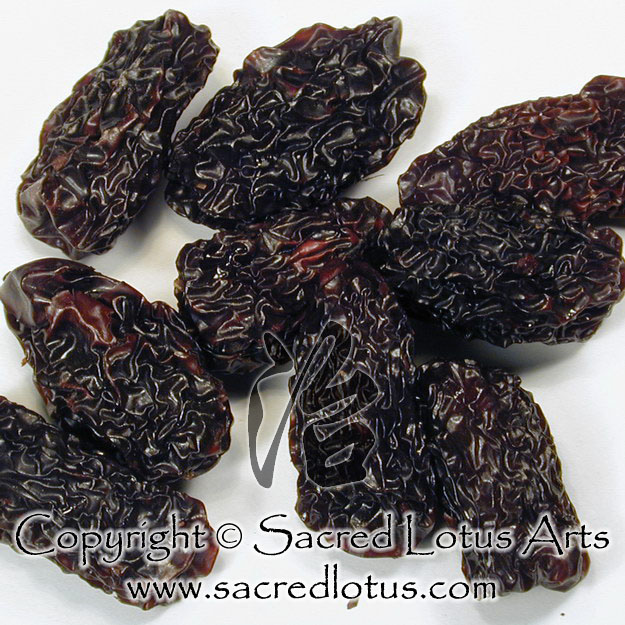
Materia Medica Data
- Category
- Herbs that Tonify Qi
- Temperature
- Warm
- Nature & Flavour
- Sweet, Warm
- Channels Entered
- SP, ST
- Latin (pharmaceutical)
- Fructus Zizyphi Jujubae
- Chinese
- 大枣
- Tone Marks
- dà zăo
- Also Known As
- Hong Zao, Hei Da Zao, Hei Zao
- Translation
- Big Date
Chinese Herb Actions
What is Da Zao (jujube) used for in Chinese medicine?
Da Zao is a sweet, warm fruit that tonifies Spleen and Stomach qi, nourishes the blood, calms the spirit, and harmonizes the other herbs in a formula — it is classed among the qi tonics but is used at least as often for its gentling, protective role alongside harsher herbs as for tonification on its own.
Its main traditional actions:
- Tonifies the Spleen and Stomach — Spleen-qi-deficiency fatigue, loose stools, and poor appetite; entering the same two channels (SP, ST) as its close partner Sheng Jiang.
- Tonifies qi and nourishes the blood — often combined with other qi and blood tonics for combined qi-blood deficiency (pallor, fatigue, low energy).
- Calms the spirit — used for restlessness and unsettled mood tied to Spleen/Heart qi deficiency, most classically in Gan Mai Da Zao Tang (Licorice, Wheat, and Jujube Decoction), where its name-sake role is nourishing the Heart and calming the spirit.
- Harmonizes other herbs — its sweetness moderates the harshness, bitterness, or drying/purgative action of stronger herbs in a formula, and it protects Spleen-Stomach digestion so the rest of the prescription is tolerated.
Source: Sacred Lotus Sacred Lotus sources & references (legacy actions, preserved); Bensky, Chinese Herbal Medicine: Materia Medica (3rd ed.); Chen & Chen, Chinese Herbal Medicine: Materia Medica. Traditional-use framing; not medical advice.
Chinese Herb Dosage
What is the typical dosage of Da Zao (jujube)?
Roughly 10–30 g, or 3–12 whole fruits, decocted with the other herbs. This matches the site’s existing dosage record and standard materia medica ranges; the dried fruit is typically added directly to the decoction pot rather than prepared separately.
Source: Sacred Lotus Sacred Lotus sources & references (dosage, preserved); standard materia medica ranges. Reference only — not a prescription.
Chinese Herb Contraindications & Cautions
Are there cautions for Da Zao (jujube)?
The site’s existing caution stands: Da Zao may cause heat, dampness, and phlegm. Being sweet and cloying, it is generally used with care — or avoided — in patterns of dampness, phlegm accumulation, or food stagnation, and in cases of parasites or abdominal distention/bloating, consistent with cautions given for other sweet Spleen tonics.
Source: Sacred Lotus Sacred Lotus sources & references (caution, preserved); Bensky, Chinese Herbal Medicine: Materia Medica (3rd ed.), general cautions for sweet/cloying Spleen tonics.
Chinese Herb Toxicity & Overdose
Low. Da Zao is a common food (the jujube/red date) with a long dietary history and no significant toxicity reported at the doses used in decoctions. Reference note only; excess amounts may aggravate dampness/phlegm in susceptible patterns (see cautions).
Source: materia medica consensus; long culinary/dietary use of the fruit. Reference note, not a safety guarantee.
Herb-Drug Interactions
No well-established clinical herb–drug interactions are documented for Da Zao at typical dietary/decoction doses, consistent with its long history as a common food. As with any concentrated herbal preparation, patients on multiple medications should mention its use to a qualified practitioner. (Precautionary note, not a demonstrated interaction.)
Western / Biomedical Research
Chinese Herb Clinical Studies & Research
Provided as research context — a summary of published biomedical study, not a therapeutic or medical claim.
Is there modern research on Da Zao (Fructus Zizyphi Jujubae)?
Yes — a body of preclinical work on the fruit plus a small amount of human clinical evidence, though most of it addresses general antioxidant/GI activity rather than the classic TCM indications directly. Reviews note the fruit and seed of Ziziphus jujuba have been studied for substantially different effects, reinforcing that they are not interchangeable.
- Pharmacology review (fruit and seed distinguished) — a review of experimental and clinical pharmacology across Ziziphus jujuba plant parts describes the fruit’s traditional use for digestive disorders, gastric complaints, cough, and mild laxative/hypotensive effects, while separately noting the dried seed (Suan Zao Ren, the spinosa variety) is used specifically for insomnia — a useful confirmation that fruit and seed have distinct, non-overlapping traditional uses.
- Antioxidant activity (preclinical, meta-analysis) — a systematic review and meta-analysis of 19 rodent studies found jujube fruit extracts significantly lowered oxidative-stress markers (malondialdehyde) and raised antioxidant enzymes (superoxide dismutase, glutathione peroxidase), though study quality was rated low and catalase levels were not significantly affected; animal models, not clinical proof.
- Human clinical (single RCT, unrelated condition) — a double-blind randomized trial in adults with treatment-resistant chronic spontaneous urticaria (n = 64) found jujube fruit syrup added to standard antihistamine therapy improved urticaria activity scores versus placebo by day 7 and day 28. This is outside Da Zao’s classic TCM indications and is a single small trial in a different condition — noted here as an example of active human research on the fruit itself, not as support for a traditional-use claim.
Overall: encouraging preclinical antioxidant data on the fruit, with clinical evidence still limited and concentrated outside its classic Spleen/Stomach/spirit-calming indications.
Sources: PMID 28084039 (Rodríguez Villanueva & Rodríguez Villanueva, “Experimental and Clinical Pharmacology of Ziziphus jujuba Mills,” Phytotherapy Research, 2017; review, fruit and seed distinguished); PMID 39139963 (jujube fruit-extract oxidative-stress systematic review/meta-analysis of rodent studies, Food Science & Nutrition, 2024; preclinical); PMID 38094286, PMC 10715122 (randomized double-blind trial, jujube fruit syrup as antihistamine adjuvant in chronic spontaneous urticaria). Research context, not a therapeutic claim.
Chinese Herb Notes
How is Da Zao different from Suan Zao Ren? / What is Da Zao commonly combined with?
Da Zao and Suan Zao Ren are different parts of a related plant and are easily confused by name alone. Da Zao (“great date”) is the dried fruit of Ziziphus jujuba — Sweet, Warm, entering Spleen and Stomach, used to tonify qi/blood and harmonize formulas. Suan Zao Ren (“sour date pit”) is the dried seed of Ziziphus jujuba var. spinosa — a Heart/Liver-blood-nourishing herb prized specifically for calming the spirit and treating insomnia. The pinyin overlap (both contain “zao”/jujube) is a common source of mix-ups; they are not interchangeable and are listed as separate herbs.
Common combinations (grounded in the site’s formula records):
- With Sheng Jiang (fresh ginger) — the classic pairing: Sheng Jiang disperses, Da Zao tonifies and protects the Stomach; together they harmonize the Ying (nutritive) and Wei (defensive) qi, as in Gui Zhi Tang (Cinnamon Twig Decoction) and its many variants (Gui Zhi Jia Long Gu Mu Li Tang, Chai Hu Jia Long Gu Mu Li Tang, Dang Gui Si Ni Tang, Wu Zhu Yu Tang).
- Alongside harsh, bitter, or purgative herbs — Da Zao (often with Sheng Jiang and Zhi Gan Cao) buffers Stomach-irritating combinations of Chai Hu, Huang Qin, Ban Xia, Huang Lian, or Da Huang, as in Xiao Chai Hu Tang, Da Chai Hu Tang, and Ban Xia Xie Xin Tang.
- In qi/blood tonics — with Ren Shen, Huang Qi, Bai Zhu, and Dang Gui in formulas such as Gui Pi Tang (Restore the Spleen Decoction) and Shi Quan Da Bu Tang (All-Inclusive Great Tonifying Decoction).
- In Gan Mai Da Zao Tang — with Gan Cao and Xiao Mai (wheat), it is the formula’s name-sake herb for nourishing the Heart and calming the spirit in restlessness/agitation.
- Constructing the Middle — with Sheng Jiang and Zhi Gan Cao as assistant/envoy herbs in Xiao Jian Zhong Tang, supporting the Spleen and Stomach alongside Gui Zhi and doubled Bai Shao.
Source: Sacred Lotus ingredient links (real formula composition joins for da-zao-date-jujube); Bensky & Barolet, Chinese Herbal Medicine: Formulas & Strategies.
Sources & References
Compiled and edited by Thomas Dehli, Founder & Editor, Sacred Lotus Updated
The information here is referenced from numerous sources — teachers, practitioners, class notes from Five Branches University, the books below, and the published research literature, with citations given as resolvable PubMed identifiers. Where sources disagree, I have flagged the discrepancies directly. If facts couldn't be verified, I have left them out. How we source our content.
Reference information for students and practitioners — not medical advice. Consult a qualified practitioner. Terms of use.
Chinese Herbs Books & References
 https://amzn.to/3WfB3DK
 https://amzn.to/3DR1VUh
 https://amzn.to/42aMz73
 https://amzn.to/3PuD4bt