
Su Zi Jiang Qi Tang
Perilla Fruit Decoction for Directing Qi Downward
- Category
- Formulas that Regulate the Qi
- Subcategory
- Formulas that Direct Rebellious Qi Downward
- Ingredients
- 11 herbs
Actions
What does Su Zi Jiang Qi Tang do?
Su Zi Jiang Qi Tang directs rebellious Lung Qi downward and transforms Phlegm-Cold to relieve cough, wheezing, and copious sputum, while simultaneously warming the Kidney at the root so it can properly "grasp" Qi. It is built for the classic "excess above, deficiency below" pattern, treating branch and root together in one prescription.
- Directs Qi downward and stops wheezing/cough — Zi Su Zi as chief, assisted by Qian Hu.
- Transforms Phlegm-Cold and dries dampness in the Lung — Ban Xia, Chen Pi, and Hou Po.
- Warms the Kidney and assists its grasping of Qi (addresses the deficiency below) — Rou Gui.
- Nourishes Blood and moistens to offset the drying, warming herbs and address cough tied to Blood deficiency — Dang Gui.
- Harmonizes the Stomach and protects the middle — Sheng Jiang, Da Zao, and Gan Cao.
Source: cross-referenced against multiple online sources; Bensky & Barolet, Formulas & Strategies; classical formulation from the Tai Ping Hui Min He Ji Ju Fang (Formulas of the Peaceful Benevolent Dispensary, Song Dynasty, ~1078–1085 CE).
Indications
What is Su Zi Jiang Qi Tang used for?
Su Zi Jiang Qi Tang is used for chronic cough and wheezing with copious white or thin sputum from Phlegm-Cold congesting the Lung, combined with underlying Kidney (and Spleen) deficiency below that fails to grasp Qi. It is a root-and-branch formula rather than a treatment for a simple acute cough.
- Chronic cough and wheezing with copious white, thin, or frothy sputum, often worse lying flat.
- Shortness of breath or dyspnea on exertion, frequently seen in elderly or chronically ill patients with weak lower-body Qi.
- Chest and diaphragm fullness or oppression with difficulty taking a deep breath.
- Cold limbs, lower-body weakness or soreness, or mild lower-limb swelling alongside the cough — signs of Kidney not grasping Qi.
- Presentations resembling chronic bronchitis or bronchial asthma with mixed excess-above/deficiency-below features.
Source: cross-referenced against multiple online sources; Bensky & Barolet, Formulas & Strategies; Tai Ping Hui Min He Ji Ju Fang.
Western Uses:
What conditions is Su Zi Jiang Qi Tang used for in modern practice?
Su Zi Jiang Qi Tang directs rebellious Lung qi downward and warms phlegm-cold, treating the "excess above, deficiency below" wheeze (cough and wheezing with copious thin sputum, worse on exertion, with a weak lower back and legs), so it is referenced for chronic wheezing respiratory disease: bronchial asthma, chronic bronchitis, and pulmonary emphysema.
It is chosen for the phlegm-cold-with-Kidney-deficiency pattern, not for a diagnosis. Asthma is a serious condition requiring medical management, a severe attack is life-threatening, and emphysema (COPD) needs medical care. Traditional-use correlates only, not a treatment claim.
Source: Sacred Lotus sources & references (pattern) + Bensky & Barolet, Formulas & Strategies; biomedical correlates as reference only. Not medical advice.
Ingredients
11 substances in Su Zi Jiang Qi Tang — each links to its full herb monograph.
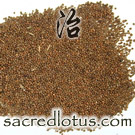 Zi Su Zi9-12 gRelieve Coughing and Wheezing
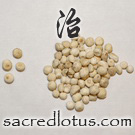 Ban Xia6-9 gWarm Herbs that Transform Phlegm-Cold
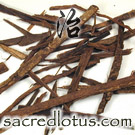 Hou Po3-6 gAromatic Herbs that Transform and Dissolve Dampness
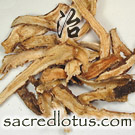 Qian Hu6-9 gCool and Transform Phlegm-Heat
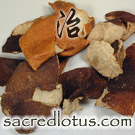 Chen Pi6-9 gRegulate the Qi
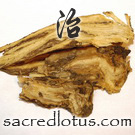 Dang Gui6-9 gTonify Blood
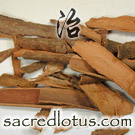 Rou Gui1.5-3 gWarm the Interior and Expel Cold
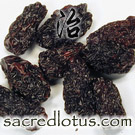 Da Zao3 piecesTonify Qi
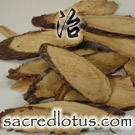 Gan Cao3-4.5 gTonify Qi
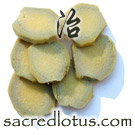 Sheng Jiang2 SlicesWarm, Spicy Herbs that Release the Exterior
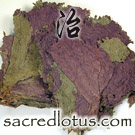 Zi Su Ye5 LeavesWarm, Spicy Herbs that Release the Exterior
Preparation & dosage
How is Su Zi Jiang Qi Tang prepared?
Su Zi Jiang Qi Tang is traditionally taken as a decoction, cooked together with fresh ginger and jujube added directly into the pot, with Zi Su Ye sometimes added later in the cooking to preserve its lighter, aromatic dispersing quality.
- Standard decoction method — the herbs are simmered together in water; Sheng Jiang (fresh ginger, 2 slices) and Da Zao (jujube, 3 pieces) are cooked directly in with the other herbs as classical decoction adjuncts, harmonizing the formula and protecting the Stomach.
- Rou Gui — some formularies note cinnamon bark is better added later in the cooking, or steeped rather than boiled at length, since prolonged high-heat decoction can dissipate its volatile warming compounds.
- Zi Su Ye — as an aromatic leaf, some sources note it is added later in the cooking process ("later addition," hou xia) to preserve its dispersing action, in contrast to root and bark herbs that are simmered longer.
- Taken warm, typically in divided daily doses, as is standard for internal decoctions treating combined Lung/Kidney patterns.
Source: cross-referenced against multiple online sources; Bensky & Barolet, Formulas & Strategies; Tai Ping Hui Min He Ji Ju Fang.
Safety — read before use
What are the cautions for Su Zi Jiang Qi Tang?
Su Zi Jiang Qi Tang is a warming formula built for Phlegm-Cold with Kidney deficiency below, so it is generally unsuitable for Phlegm-Heat, Yin-deficiency cough, or acute febrile/Wind-Heat presentations, and should be used with care in true Kidney Yang collapse requiring stronger rescue formulas. The following points are widely noted as neutral public-safety reference, not administration guidance.
- Not for Phlegm-Heat or Yin-deficiency cough — the formula's warm, drying herbs (Rou Gui, Ban Xia, Hou Po) can aggravate heat signs (yellow sputum, thirst, red tongue) or further deplete Yin.
- Not for acute exterior Wind-Heat or high-fever presentations — it is built for a chronic, root-and-branch cough/wheeze pattern, not an acute externally-contracted illness.
- Caution in severe Kidney Yang collapse (profuse sweating, extreme cold limbs, faint pulse) — such emergencies are generally considered to need stronger rescue formulas rather than this moderate warming/descending combination.
- Contains warming, moving herbs (Rou Gui, Dang Gui) — caution is generally advised in pregnancy and in active bleeding conditions, consistent with general caution around warming/Blood-moving herbs.
- Not intended for long-term, unsupervised use without reassessment of the underlying Lung–Kidney pattern.
Source: cross-referenced against multiple online sources; Bensky & Barolet, Formulas & Strategies.
Originally Appeared In:
- Imperial Grace Formulary of the Tai Ping Era (Tai Ping Hui Min He Ji Ju Fang)
Notes:
How does Su Zi Jiang Qi Tang differ from related formulas?
Su Zi Jiang Qi Tang is distinguished from other Phlegm/cough formulas by its explicit "excess above, deficiency below" structure — most cough formulas address only the Lung, while this one pairs Lung-descending, Phlegm-transforming herbs with a Kidney-warming herb for the root.
- Ding Chuan Tang (Arrest Wheezing Decoction) — also treats Phlegm obstructing the Lung with wheezing, but is built around Ma Huang and Bai Guo for wheezing with an external component, and lacks Su Zi Jiang Qi Tang's explicit Kidney-warming (Rou Gui) root-treating structure.
- Xiao Qing Long Tang (Minor Bluegreen Dragon Decoction) — treats Phlegm-Cold ("water") congesting the Lung, typically from an external cold invasion with wheezing/cough — an acute excess pattern without Su Zi Jiang Qi Tang's built-in Kidney-deficiency component.
- Modified ("Jia Wei") variants — modern clinical research has studied augmented versions of this formula for chronic conditions such as COPD-related airway mucus hypersecretion, extending the same root-and-branch strategy to modern respiratory-disease categories.
- Classical source and lineage — Su Zi Jiang Qi Tang originates in the Tai Ping Hui Min He Ji Ju Fang (Formulas of the Peaceful Benevolent Dispensary, Chinese Imperial Medical Bureau, Song Dynasty, published ~1078–1085 CE), one of the most influential formularies of the period, alongside Huo Xiang Zheng Qi San.
Source: cross-referenced against multiple online sources; Bensky & Barolet, Formulas & Strategies.
Clinical Studies & Research:
Is there modern research on Su Zi Jiang Qi Tang?
Modern research on Su Zi Jiang Qi Tang has focused mainly on modified ("Jia Wei") versions of the formula for chronic respiratory disease, particularly airway mucus hypersecretion in chronic obstructive pulmonary disease (COPD). This research is presented as scientific context on traditional use, not a therapeutic claim.
- A mechanism and clinical-observation study of a modified Jia Wei Su Zi Jiang Qi formula examined its effect on mucus hypersecretion in COPD patients, exploring both clinical outcomes and underlying pharmacological mechanisms.
- Broader Phlegm-Cold and wheeze-formula pharmacology provides supporting context for the Phlegm-transforming, Qi-descending herbs (such as Ban Xia and Chen Pi) shared with Su Zi Jiang Qi Tang, though this is constituent-level rather than whole-formula research.
Sources: PMID 40774575; no additional whole-formula randomized-trial PMIDs for the unmodified classical decoction could be independently verified, so none are cited here.
Sources & References
Compiled and edited by Thomas Dehli, Founder & Editor, Sacred Lotus Updated
The information here is referenced from numerous sources — teachers, practitioners, class notes from Five Branches University, the books below, and the published research literature, with citations given as resolvable PubMed identifiers. Where sources disagree, I have flagged the discrepancies directly. If facts couldn't be verified, I have left them out. How we source our content.
Reference information for students and practitioners — not medical advice. Consult a qualified practitioner. Terms of use.
Chinese Formulas Books & References
 https://amzn.to/4fYI3f8
 https://amzn.to/4j55NRA
 https://amzn.to/4gMROyv
 https://amzn.to/4h7msSK