

uncooked Rhizoma Zingiberis Fresh Ginger Rhizome
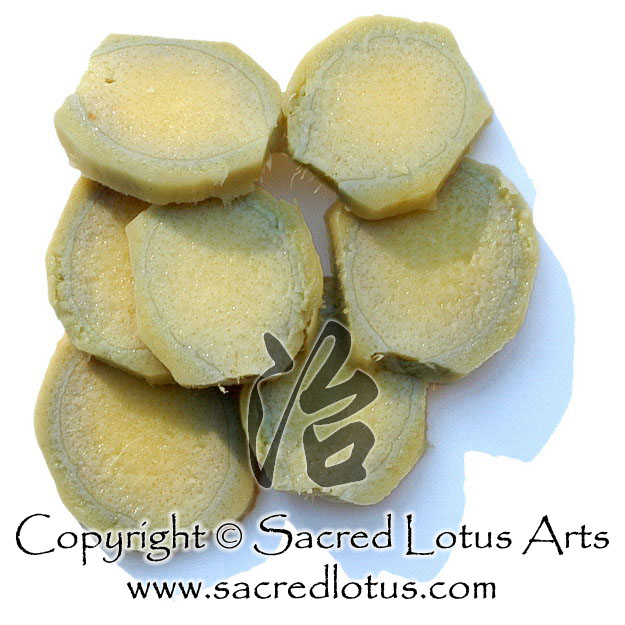
Materia Medica Data
- Temperature
- Warm
- Nature & Flavour
- Spicy, Warm
- Channels Entered
- LU, SP, ST
- Latin (pharmaceutical)
- uncooked Rhizoma Zingiberis
- Chinese
- 生姜
- Tone Marks
- shēng jiāng
Chinese Herb Actions
What is Sheng Jiang (fresh ginger) used for in Chinese medicine?
Sheng Jiang is a spicy, warm herb traditionally used to release the exterior and warm the middle Jiao (Spleen/Stomach) — for exterior Wind-Cold (mild chills, headache, nasal congestion) and for cold in the stomach causing vomiting, diarrhea, and abdominal fullness with pain. It also has a distinctive role as a detoxifying and harmonizing adjunct within formulas.
Its main traditional actions:
- Releases the exterior, warms the middle — mild exterior Wind-Cold together with Cold in the Stomach causing vomiting, diarrhea, and abdominal fullness with pain.
- Disperses Lung Cold and stops cough — Wind-Cold cough or chronic Lung conditions with thin, white phlegm.
- Adjusts the Ying (Nutritive) and Wei (Defensive) levels — exterior deficiency where sweating alone does not resolve the presentation (its classic pairing with Da Zao/red dates in Gui Zhi Tang).
- Reduces toxicity of other herbs — traditionally used to moderate or treat over-dosage from potent processed herbs such as Fu Zi (Aconite) and Ban Xia (Pinellia), and is cooked together with both in many formulas for this reason.
Source: Sacred Lotus (legacy materia medica notes), reviewed against Bensky, Materia Medica (3rd ed.) and Chen & Chen, Chinese Herbal Medicine: Materia Medica. Traditional-use framing; not medical advice.
Chinese Herb Dosage
What is the typical dosage of Sheng Jiang (fresh ginger)?
About 3–9 g of the fresh rhizome — in classical decoctions this is usually given as whole fresh slices (commonly “3 slices”/“3–5 slices” rather than a weighed dose) added directly to the pot with the other herbs, since it is used fresh rather than as a dried, pre-weighed slice like most herbs.
- Part used — the fresh (uncooked) rhizome.
- Form in formulas — typically 1–5 fresh slices per formula (see combinations below), reflecting its role as a harmonizing/detoxifying adjunct as much as a primary herb.
Source: Sacred Lotus; standard materia medica ranges. Reference only — not a prescription.
Chinese Herb Contraindications & Cautions
Are there cautions for using Sheng Jiang (fresh ginger)?
Do not use in cases of Lung Heat, Stomach Heat, or Yin deficiency — as a warming, drying herb, Sheng Jiang can aggravate heat and dryness patterns (dry mouth/throat, heat signs, deficient-heat night sweats) rather than help them.
- Heat/dryness patterns — avoid in Lung Heat, Stomach Heat, and Yin-deficiency presentations.
- Bleeding risk (reference note) — large or concentrated doses (well above culinary/dietary use) have been associated with reduced platelet aggregation; see drug interactions below for anticoagulant/antiplatelet context.
- Pregnancy — ginger is widely researched specifically for pregnancy-related nausea (see research below) at food-comparable doses, but any therapeutic use in pregnancy is a decision for a qualified practitioner, not self-directed high-dose supplementation.
Source: Sacred Lotus (legacy caution note); standard materia medica warm/drying-herb cautions; bleeding-risk research (below). Reference only, not medical advice.
Chinese Herb Toxicity & Overdose
Low. Fresh ginger has a long history as a common food and condiment with no significant toxicity reported at normal culinary or traditional decoction doses. The main practical concerns at higher, concentrated (supplement-level) doses are gastrointestinal irritation/heartburn and a mild inhibitory effect on platelet aggregation (see drug interactions).
Source: materia medica consensus; supported by the absence of significant adverse-event signal in the clinical nausea trials cited below. Reference note, not a safety guarantee.
Herb-Drug Interactions
Possible interaction with anticoagulant/antiplatelet drugs (warfarin, aspirin, clopidogrel), evidence mixed. Ginger inhibits platelet aggregation in laboratory studies, and a longitudinal clinical analysis found ginger use independently associated with increased self-reported bleeding events and supratherapeutic INR in warfarin patients (PMID 17723077). However, a subsequent evidence review classified the interaction as only “probable” (not established), noting that a randomized crossover study in healthy subjects found ginger capsules had no measurable effect on warfarin’s pharmacokinetics or pharmacodynamics, and that case reports alone are weak evidence (PMC 3976951). Practical takeaway: patients on anticoagulant or antiplatelet therapy should disclose ginger use (dietary or supplement) to their prescriber; this is a precaution, not a demonstrated high-risk interaction at normal dietary doses.
Western / Biomedical Research
Chinese Herb Clinical Studies & Research
Provided as research context — a summary of published biomedical study, not a therapeutic or medical claim.
Is there research on ginger (Zingiber officinale) for nausea and vomiting?
Yes — ginger has one of the larger clinical evidence bases of any single herb for nausea/vomiting, spanning pregnancy, chemotherapy, and post-surgical settings, though effect sizes and comparator conditions vary by use. Its bioactive compounds are gingerols and shogarols (pungent phenolic compounds), studied as the likely basis for its anti-emetic and prokinetic effects.
- Nausea/vomiting of pregnancy — a systematic review and meta-analysis of randomized trials found ginger reduced nausea and showed no evidence of increased risk to mother or fetus versus placebo/comparators, though the authors noted the evidence base remains limited in size and quality (PMID 24642205, Nutrition Journal, 2014).
- Chemotherapy-induced nausea — a large placebo-controlled trial in 576 cancer patients found that ginger supplementation (0.5–1.0 g/day, added to standard anti-nausea medication) significantly reduced acute nausea severity on the first day of chemotherapy compared to placebo (PMID 21818642, Support Care Cancer, 2012).
- Postoperative nausea and vomiting (PONV) — results are mixed across reviews. An early systematic review found ginger comparable to placebo at a single 1 g preoperative dose in pooled analysis, while studies of seasickness, morning sickness, and chemotherapy nausea more consistently favored ginger (PMID 10793599, British Journal of Anaesthesia, 2000). A more recent systematic review and meta-analysis concluded ginger was effective for preventing PONV, while calling for more trials before it could be considered a replacement for standard antiemetic drugs (PMID 34312974, Journal of Nursing Scholarship, 2021).
Overall: consistent supportive signal for nausea/vomiting across several distinct clinical contexts, with the strongest and largest trial in chemotherapy-induced nausea; PONV evidence is more mixed depending on dose/timing and comparator. This is research context on the fresh/whole-ginger compound class, not a treatment claim.
Sources: PMID 24642205 (pregnancy nausea meta-analysis); PMID 21818642 (576-patient chemotherapy-induced nausea RCT); PMID 10793599 (early systematic review, mixed PONV/favorable non-surgical nausea); PMID 34312974 (2021 PONV systematic review/meta-analysis); PMID 17723077 and PMC 3976951 (bleeding-risk/interaction evidence, cited under drug interactions). Research context, not a therapeutic claim.
Chinese Herb Notes
How is Sheng Jiang different from Gan Jiang and Pao Jiang?
Sheng Jiang, Gan Jiang, and Pao Jiang are all prepared from the same plant (Zingiber officinale) but are three distinct herbs in Chinese medicine, chosen for different jobs. Confusing them is a common mistake because all three share the character 姜 (jiāng, “ginger”) in their names.
- Sheng Jiang (fresh ginger rhizome) — the fresh, undried rhizome. Spicy and warm; enters the Lung, Spleen, and Stomach channels. Its job is surface-level and acute: releasing exterior Wind-Cold, stopping acute vomiting, and warming the middle for short-term cold-type digestive upset.
- Gan Jiang (dried ginger rhizome) — the same rhizome, sliced and dried. Spicy and hot (stronger and more sustained than fresh); enters the Heart, Lung, Spleen, and Stomach. Its job is deeper and more chronic: warming the interior to expel entrenched cold, rescuing devastated yang (with Fu Zi), and warming the Lungs to transform thin, watery phlegm.
- Pao Jiang (blast-fried/black ginger) — Gan Jiang further processed by high-heat frying until charred. Bitter and astringent rather than purely spicy; its signature action shifts to warming the channels and stopping bleeding from cold-deficiency patterns (e.g. chronic uterine bleeding), a use fresh or dried ginger does not carry.
Key combinations (grounded in Sacred Lotus formula data): Sheng Jiang appears very widely as a supporting/harmonizing herb rather than a chief herb. Notable pairings include Ban Xia (their classic anti-nausea pair, as in Ban Xia Hou Po Tang for plum-pit qi/globus with nausea, and Ban Xia Bai Zhu Tian Ma Tang for phlegm-type dizziness); Da Zao (jujube) to adjust Ying and Wei in Gui Zhi Tang for exterior deficiency; Chai Hu in Xiao Chai Hu Tang and Da Chai Hu Tang to harmonize Shao Yang and stop vomiting; Wu Zhu Yu and Ren Shen in Wu Zhu Yu Tang for Cold-type frontal headache with vomiting; and Fu Zi in Zhen Wu Tang, where Sheng Jiang both assists Fu Zi’s warming action and moderates its toxicity. It also names the formula Dang Gui Sheng Jiang Yang Rou Tang (with Dang Gui and mutton), used traditionally to warm and nourish the blood postpartum. (Traditional formula context, not treatment advice.)
Source: Sacred Lotus herb identity fields (properties/channels for Sheng Jiang, Gan Jiang, Pao Jiang) and ingredient links (39 formulas containing Sheng Jiang, including those named above); Bensky, Materia Medica (3rd ed.).
Sources & References
Compiled and edited by Thomas Dehli, Founder & Editor, Sacred Lotus Updated
The information here is referenced from numerous sources — teachers, practitioners, class notes from Five Branches University, the books below, and the published research literature, with citations given as resolvable PubMed identifiers. Where sources disagree, I have flagged the discrepancies directly. If facts couldn't be verified, I have left them out. How we source our content.
Reference information for students and practitioners — not medical advice. Consult a qualified practitioner. Terms of use.
Chinese Herbs Books & References
 https://amzn.to/3WfB3DK
 https://amzn.to/3DR1VUh
 https://amzn.to/42aMz73
 https://amzn.to/3PuD4bt