

Qiang Huo (Notopterygium Root)
Radix Et Rhizoma Notopterygii Notopterygium Root
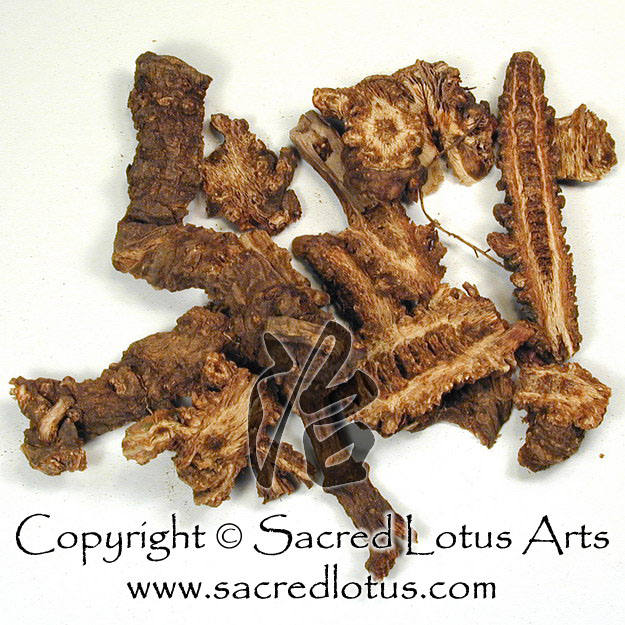
Materia Medica Data
- Temperature
- Warm
- Nature & Flavour
- Spicy, Bitter, Aromatic, Warm
- Channels Entered
- BL, KI
- Latin (pharmaceutical)
- Radix Et Rhizoma Notopterygii
- Chinese
- 羌活
- Tone Marks
- qiāng huó
Chinese Herb Actions
What is Qiang Huo used for in Chinese medicine?
Qiang Huo (Notopterygium Root) is a warm, acrid, strongly dispersing herb traditionally used to release wind-cold-damp from the exterior and relieve painful obstruction (Bi syndrome) of the upper body — especially the head, neck, shoulders, and upper back. It is prized as a “channel-guiding” herb that directs the effect of a formula to the Greater Yang (Taiyang) channels and the upper body.
Its main traditional actions:
- Releases the exterior and disperses wind-cold-damp — for exterior wind-cold-damp invasion with chills, fever, headache, and a pronounced heavy or aching sensation throughout the body.
- Dispels wind-damp and stops painful obstruction (Bi) — for wind-cold-damp Bi pain concentrated in the upper body, including stiff, aching shoulders, upper back, and the back of the head/neck (occiput).
- Guides other herbs to the Greater Yang (Taiyang) and Governing Vessel (Du) channels — added to formulas in smaller amounts to direct their effect toward the upper back, neck, and occiput, independent of its own dispersing dose.
Source: Sacred Lotus sources & references, cross-referenced against multiple online sources (materia medica consensus).
Chinese Herb Dosage
What is the typical dosage of Qiang Huo?
Roughly 3–9 g in decoction, occasionally up to 15 g in formulas aimed specifically at severe wind-damp Bi pain of the upper body/limbs — the part used is the dried root and rhizome. Because it is strongly acrid, aromatic, and drying, it is typically used at the lower end of this range and combined with other herbs rather than used alone or long-term.
Source: Sacred Lotus sources & references, cross-referenced against multiple online sources (standard materia medica ranges). Reference only — not a prescription.
Chinese Herb Contraindications & Cautions
Are there cautions for Qiang Huo?
Qiang Huo is strongly acrid, aromatic, and drying, so it is used cautiously in blood deficiency, yin deficiency, and exterior (Wei-qi) deficiency — its dispersing, sweat-inducing nature can further deplete fluids or aggravate deficiency-type headache and body ache in these patients. Overdose or excessive use may cause nausea and vomiting from its strong, penetrating flavor.
Source: Sacred Lotus sources & references, cross-referenced against multiple online sources (materia medica cautions).
Chinese Herb Toxicity & Overdose
Low at standard decoction doses. Qiang Huo has a long history of dietary/medicinal use with no major toxicity reported in normal clinical use; a 2017 phytochemical and pharmacological review notes that pharmacokinetic and formal toxicology data remain limited in the modern literature, and recommends further study to support quality control and safe clinical use.
Source: PMID 28336469 (ethnopharmacology/phytochemistry/pharmacology review). Reference note, not a safety guarantee.
Herb-Drug Interactions
No well-established clinical herb–drug interactions are documented for Qiang Huo. As with other strongly diaphoretic (sweat-inducing) herbs, practitioner awareness is reasonable in patients on antihypertensive or diuretic therapy where additional fluid loss could matter — this is a precautionary note, not a demonstrated clinical interaction. (Flagged for practitioner confirmation.)
Western / Biomedical Research
Chinese Herb Clinical Studies & Research
Provided as research context — a summary of published biomedical study, not a therapeutic or medical claim.
Is there modern research on Qiang Huo (Notopterygium incisum)?
Yes — preclinical research supports several of its traditional actions, though clinical (human) trial evidence remains limited. A 2017 review in the Journal of Ethnopharmacology surveying the ethnopharmacology, phytochemistry, and pharmacology of Notopterygium incisum reports laboratory evidence of analgesic (pain-relieving), anti-inflammatory, anticancer, and antioxidant activity from its coumarin and volatile-oil constituents, while noting that pharmacokinetic and toxicology data still lag behind.
- Cold-type neuropathic pain (animal model) — a 2023 study found that a water extract of Notopterygium incisum reduced cold-triggered pain behavior in mice with nerve injury and chemotherapy-induced neuropathy, and lowered expression of the TRPA1 cold/pain receptor in nerve tissue — a mechanistic finding consistent with, and supportive of, the herb’s traditional use for dispersing “cold” and relieving cold-aggravated pain. Animal-model evidence, not a clinical treatment claim.
Overall, modern research is preclinical and mechanistic; controlled human trials specific to Notopterygium incisum are still lacking.
Sources: PMID 28336469 (ethnopharmacology/phytochemistry/pharmacology review, J Ethnopharmacol 2017); PMID 36587876 (TRPA1/cold-allodynia mouse study, J Ethnopharmacol 2023). Research context, not a therapeutic claim.
Chinese Herb Notes
How is Qiang Huo different from Du Huo?
Qiang Huo and Du Huo are a classic paired contrast: Qiang Huo targets the upper body and Du Huo the lower body — both release wind-damp and relieve Bi pain, but their regions of action, strength, and typical patient fit differ. This upper-versus-lower distinction is one of the most commonly tested differentiations in Chinese herbal study.
- Qiang Huo — more strongly acrid, aromatic, and drying; released to the upper body: head (especially the occiput), neck, shoulders, and upper back; a stronger, more vigorous exterior-releaser, better suited to more robust, excess-type presentations.
- Du Huo — milder and less drying; directed to the lower body: low back, sacrum, hips, and legs; better tolerated in more deficient or chronic Bi patterns, and more commonly combined with Liver/Kidney-tonifying herbs.
Key combinations: Qiang Huo and Du Huo are frequently paired together (as in Qiang Huo Sheng Shi Tang) to treat wind-cold-damp Bi pain spanning the whole back and body, each herb reinforcing the other while covering its own region. Qiang Huo is also a principal herb in Jiu Wei Qiang Huo Tang, a nine-herb formula for exterior wind-cold-damp with interior heat (fever, chills, no sweating, headache, thirst). (Traditional formula context, not treatment advice.)
Source: Sacred Lotus sources & references (differentiation & combinations); Sacred Lotus formula records for Qiang Huo Sheng Shi Tang and Jiu Wei Qiang Huo Tang.
Sources & References
Compiled and edited by Thomas Dehli, Founder & Editor, Sacred Lotus Updated
The information here is referenced from numerous sources — teachers, practitioners, class notes from Five Branches University, the books below, and the published research literature, with citations given as resolvable PubMed identifiers. Where sources disagree, I have flagged the discrepancies directly. If facts couldn't be verified, I have left them out. How we source our content.
Reference information for students and practitioners — not medical advice. Consult a qualified practitioner. Terms of use.
Chinese Herbs Books & References
 https://amzn.to/3WfB3DK
 https://amzn.to/3DR1VUh
 https://amzn.to/42aMz73
 https://amzn.to/3PuD4bt