
Jiu Wei Qiang Huo Tang
Nine Herb Decoction with Notopterygium
- Category
- Formulas that Release the Exterior
- Subcategory
- Formulas that Release Exterior Cold
- Ingredients
- 9 herbs
Actions
What does Jiu Wei Qiang Huo Tang do?
Jiu Wei Qiang Huo Tang (Nine-Herb Decoction with Notopterygium) releases the exterior to dispel wind-cold-dampness while simultaneously clearing heat that has collected internally. It is built to cover an unusually broad presentation — an exterior invasion of wind, cold, and dampness layered on top of pre-existing interior heat — by pairing strongly acrid, warm, exterior-releasing herbs with two heat-clearing, fluid-protecting herbs in the same decoction.
The nine ingredients divide by role:
- Chief: Qiang Huo strongly releases the exterior and unblocks painful obstruction, targeting the heavy headache, neck/back stiffness, and generalized body aches of wind-cold-damp.
- Deputies: Fang Feng assists Qiang Huo in dispelling wind-dampness from the exterior; Cang Zhu dries dampness and strengthens the formula’s ability to relieve the sensation of heaviness and body aches.
- Assistants (headache by channel): Xi Xin, Bai Zhi, and Chuan Xiong each target headache along a different channel pathway — Xi Xin for deep/occipital pain, Bai Zhi for frontal/sinus pain, and Chuan Xiong for vertex and temporal pain while also invigorating blood to stop pain. Together with Qiang Huo and Fang Feng, this combination is the classic teaching example of "one formula treating headache in all six channels."
- Assistants (clear heat): Sheng Di Huang and Huang Qin clear the interior heat responsible for the bitter taste and slight thirst, and temper the drying, warming nature of the exterior-releasing herbs so they do not injure fluids.
- Envoy: Gan Cao harmonizes the formula.
Traditionally attributed to the Jin-dynasty physician Zhang Yuansu and recorded by his student Wang Haogu in Ci Shi Nan Zhi (“Understanding These Things Is Not Easy”).
Source: Sacred Lotus sources & references + Bensky & Barolet, Formulas & Strategies (chief/deputy/assistant/envoy analysis; formula origin). Traditional-use framing; not medical advice.
Indications
What is Jiu Wei Qiang Huo Tang used for?
Jiu Wei Qiang Huo Tang treats an externally-contracted wind-cold-damp invasion that has already begun generating heat internally. This combined exterior-cold/interior-heat picture is why the formula needs both strongly acrid, warming herbs to release the surface and cooling herbs to address the heat underneath — using either strategy alone would leave part of the pattern untreated.
Its classic clinical presentation:
- Exterior wind-cold-damp signs: chills and fever without sweating, a heavy sensation in the head as if wrapped, headache, stiffness and pain of the neck and back, and generalized aching of the body and limbs.
- Interior heat signs: restlessness, a bitter taste in the mouth, and slight thirst.
Tongue and pulse: tongue coating white or slightly yellow; pulse floating, and often tight.
Source: Sacred Lotus sources & references on pattern + Bensky & Barolet, Formulas & Strategies. Traditional-use framing; not medical advice.
Western Uses:
What is Jiu Wei Qiang Huo Tang used for in modern practice?
In modern practice Jiu Wei Qiang Huo Tang is referenced for the common cold, seasonal influenza, and other upper-respiratory infections presenting with fever, headache, and body aches without sweating — and, because several of its herbs treat head and body pain along specific pathways, for sinus congestion, allergic rhinitis, and rheumatic or musculoskeletal aches with a similar wind-cold-damp presentation. A patent form, Jiuwei Qianghuo Oral Liquid, is listed in the Chinese Pharmacopoeia for common cold due to wind-cold with dampness.
These biomedical correlates are offered as a reference to the formula’s traditional use, not as a claim that it treats any disease. Modern laboratory study has focused on modified versions of the formula in animal models of influenza (see research), not the classic nine-herb decoction in humans. Any use for a diagnosed condition belongs with a qualified practitioner and appropriate medical care.
Source: traditional-use correlates summarized from Bensky & Barolet, Formulas & Strategies; Chinese Pharmacopoeia listing for Jiuwei Qianghuo Oral Liquid. Reference only, not a treatment claim.
Ingredients
9 substances in Jiu Wei Qiang Huo Tang — each links to its full herb monograph.
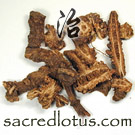 Qiang Huo4.5 gWarm, Spicy Herbs that Release the Exterior
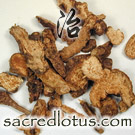 Cang Zhu4.5 gAromatic Herbs that Transform and Dissolve Dampness
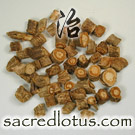 Fang Feng4.5 gWarm, Spicy Herbs that Release the Exterior
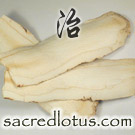 Bai Zhi3 gWarm, Spicy Herbs that Release the Exterior
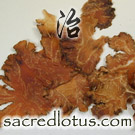 Chuan Xiong3 gInvigorate Blood and Remove Stagnation
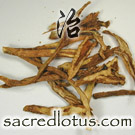 Huang Qin3 gClear Heat and Dry Dampness
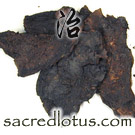 Sheng Di Huang3 gCool the Blood
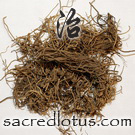 Xi Xin1.5 gWarm, Spicy Herbs that Release the Exterior
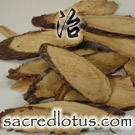 Gan Cao3 gTonify Qi
Preparation & dosage
How is Jiu Wei Qiang Huo Tang prepared?
Traditionally decocted as a tea and taken warm, then followed by rest under light covers to encourage a mild, even sweat — the standard method for acrid, exterior-releasing decoctions, since a forced heavy sweat can waste qi and fluids without improving the release. The formula is generally not simmered for a long time, so the volatile aromatic compounds in Qiang Huo, Fang Feng, Bai Zhi, Chuan Xiong, and Xi Xin — the source of their exterior-releasing action — are not driven off.
Modern proprietary forms (oral liquid, granules, pills) are standardized and dosed per product instructions rather than by classical decoction weights.
Source: Bensky & Barolet, Formulas & Strategies (preparation conventions for acrid exterior-releasing decoctions).
Decoction. Reference relative amounts (as recorded in Sacred Lotus sources & references): Qiang Huo, Fang Feng, Cang Zhu 4.5 g each; Xi Xin 1.5 g; Chuan Xiong, Bai Zhi, Huang Qin, Sheng Di Huang, Gan Cao 3 g each. Xi Xin is kept low by classical convention. Reference only; modern patent forms (oral liquid, granules) are dosed per product label.
Safety — read before use
What are the cautions for Jiu Wei Qiang Huo Tang?
Jiu Wei Qiang Huo Tang is a strongly acrid, warming, and drying formula meant for short-term use during an active exterior invasion — not a long-term or general-purpose remedy. Its wind-dispelling herbs (Qiang Huo, Fang Feng, Cang Zhu, Xi Xin, Bai Zhi) can injure fluids and yin if taken beyond resolution of the exterior pattern, and the formula is not appropriate once the exterior has cleared.
- Not for exterior deficiency with spontaneous sweating — the formula is built for wind-cold-damp without sweating; a diaphoretic-sensitive or already-sweating presentation calls for a gentler exterior-releasing strategy.
- Yin or blood deficiency: use cautiously, as the drying, acrid herbs can further deplete fluids.
- Xi Xin: kept to a low dose by classical convention and traditionally avoided in combination with Li Lu (Veratrum), one of the "eighteen incompatibles."
- Pregnancy: contains blood-invigorating, strongly moving herbs (Chuan Xiong) — use only under professional guidance.
- Not for pure interior heat or pure exterior wind-cold without the combined pattern the formula is designed for; modified when either the cold or the heat clearly predominates.
Source: Bensky & Barolet, Formulas & Strategies (cautions for acrid, warm exterior-releasing formulas; Xi Xin dosing and incompatibility). Traditional-use framing; not medical advice.
Originally Appeared In:
- Hard Won Knowledge (Ci Shi Nana Zhi)
Notes:
How is Jiu Wei Qiang Huo Tang different from Jing Fang Bai Du San and Ma Huang Tang?
Jiu Wei Qiang Huo Tang is distinguished by treating wind-cold-damp exterior invasion together with interior heat in one formula — most exterior-releasing decoctions address only the exterior.
- vs Ma Huang Tang / Gui Zhi Tang: those simpler formulas release wind-cold alone, without the dampness component (heavy head, body aching) or any interior heat to clear.
- vs Jing Fang Bai Du San: also releases wind-cold-dampness, but is built more toward painful obstruction and early-stage sores/toxic swellings, without Jiu Wei Qiang Huo Tang’s explicit heat-clearing pair (Sheng Di Huang, Huang Qin).
- vs Xiang Ru San: treats wind-cold combined with summerheat-dampness (a seasonal variant), not the wind-cold-damp-with-interior-heat pattern here.
Key modifications: add Chai Hu or Sheng Ma for more pronounced fever; add Jie Geng and Zhi Ke when cough or chest congestion accompanies the exterior pattern; reduce or remove Sheng Di Huang and Huang Qin when there are no clear interior-heat signs, leaving a formula for wind-cold-damp alone.
Source: Bensky & Barolet, Formulas & Strategies (formula comparisons and common modifications).
Clinical Studies & Research:
Is there modern research on Jiu Wei Qiang Huo Tang?
Modern research is preclinical and focused on modified versions of the decoction in influenza-infected mice, not clinical trials of the classic nine-herb formula in humans. Two related mouse studies from the same research group examined a modified Jiu Wei Qiang Huo (MJWQH) decoction in H1N1 influenza A infection, reporting reduced lung injury, suppressed inflammatory cytokine production, and normalization of metabolic biomarkers disrupted by the infection.
- H1N1 lung injury (preclinical, modified formula): modified Jiu Wei Qiang Huo decoction increased survival and suppressed TNF-α, IL-1, IL-6, MCP-1, RANTES, and IFN-α in H1N1-infected mice, with effects linked to regulation of the NF-κB pathway (PMID 26089947 / PMC 4451524).
- Metabolomics (preclinical, modified formula): the same modified decoction reversed serum metabolic-biomarker disturbances (amino acid, fatty acid, and arachidonic acid metabolism) in mice with influenza A pneumonia (PMID 24132661).
Sources: PubMed 26089947 / PMC 4451524; PubMed 24132661. Both studies used a modified variant of the formula in animal models; research context only, not a therapeutic claim, and not direct evidence for the classic nine-herb decoction in humans.
Sources & References
Compiled and edited by Thomas Dehli, Founder & Editor, Sacred Lotus Updated
The information here is referenced from numerous sources — teachers, practitioners, class notes from Five Branches University, the books below, and the published research literature, with citations given as resolvable PubMed identifiers. Where sources disagree, I have flagged the discrepancies directly. If facts couldn't be verified, I have left them out. How we source our content.
Reference information for students and practitioners — not medical advice. Consult a qualified practitioner. Terms of use.
Chinese Formulas Books & References
 https://amzn.to/4fYI3f8
 https://amzn.to/4j55NRA
 https://amzn.to/4gMROyv
 https://amzn.to/4h7msSK