

Sheng Di Huang (Chinese Foxglove Root, Rehmannia)
Radix Rehmanniae Glutinosae Chinese Foxglove Root, Rehmannia
Also known as Sheng Di
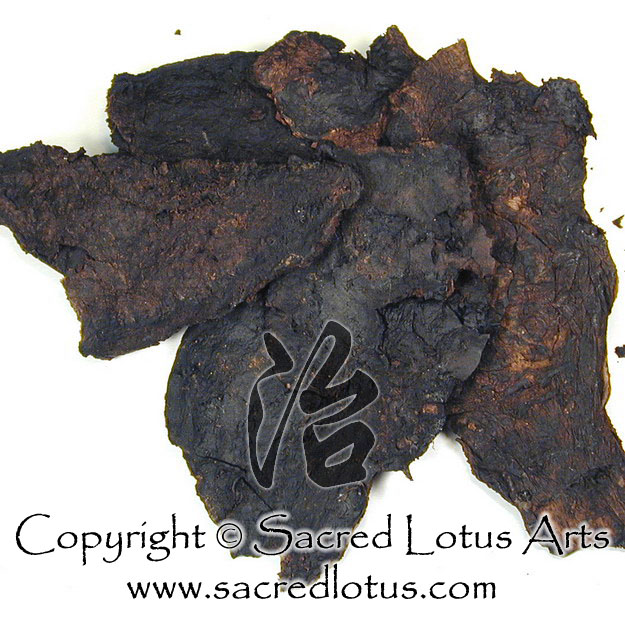
Materia Medica Data
- Category
- Herbs that Cool the Blood
- Temperature
- Cold
- Nature & Flavour
- Sweet, Bitter, Cold
- Channels Entered
- HT, KI, LIV
- Latin (pharmaceutical)
- Radix Rehmanniae Glutinosae
- Chinese
- 生地黄
- Tone Marks
- shēng dì huáng
- Also Known As
- Sheng Di
- Translation
- Fresh Earth Yellow
Chinese Herb Actions
What is Sheng Di Huang used for in Chinese medicine?
Sheng Di Huang is a sweet, bitter, cold herb entering the Heart, Kidney, and Liver channels, used to clear heat, cool the Blood, nourish Yin, and generate fluids — for heat entering the Blood/Ying level with high fever and a dark red tongue, for various patterns of bleeding, and for Yin-fluid damage from heat causing thirst, dryness, and constipation.
Its main traditional actions:
- Clears Heat and cools the Blood — for heat at the Ying (nutritive) level causing very high fever, thirst, and a dark red tongue; also used for hemorrhage, epistaxis (nosebleed), spitting blood, bloody urine, and uterine bleeding.
- Nourishes the Yin and increases fluids — for Yin injured by heat, causing dry mouth, throat pain, a wasting-and-thirsting disorder (xiao ke), and constipation from fluid depletion.
- Clears Heart fire — for irritability, restlessness, mouth and tongue sores, or insomnia arising from Heart-fire/Heart-yin-deficiency heat.
Source: Sacred Lotus reference content, cross-checked against Bensky & Barolet and Chen & Chen, Chinese Herbal Medicine: Materia Medica (heat-clearing/blood-cooling category).
Chinese Herb Dosage
What is the typical dosage of Sheng Di Huang?
Roughly 9–30 g in decoction — the higher end of the range is used for more severe heat-in-the-blood or fluid-depletion presentations, consistent with standard materia medica dosage ranges for this herb.
Fresh (undried) root, when available, is traditionally regarded as stronger at clearing heat and generating fluid for acute exterior-heat thirst and bleeding, while the dried root is used more for bleeding and dryness arising from underlying Yin and Blood deficiency — a difference of degree, not a different herb.
Source: Sacred Lotus reference content; standard materia medica dosage ranges. Reference only — not a prescription.
Chinese Herb Contraindications & Cautions
Are there cautions for Sheng Di Huang?
Sheng Di Huang is cold and cloying by nature — it is traditionally contraindicated in Spleen and Stomach deficiency (loose stools or diarrhea), in dampness/phlegm-damp accumulation, and in Yang deficiency, since its cooling, rich quality can further weaken digestion and encourage dampness. It is also traditionally cautioned against in pregnant women with Blood deficiency.
Source: Sacred Lotus reference content, cross-checked against Bensky & Barolet / Chen & Chen Materia Medica consensus. Reference only, not a safety guarantee.
Chinese Herb Toxicity & Overdose
Low. Rehmannia glutinosa is not classified as a toxic or endangered herb in Chinese materia medica and has a long history of dietary and medicinal use as both Sheng Di Huang and Shu Di Huang. The main real-world concern is not intrinsic toxicity but its cold, cloying nature aggravating digestion (loose stools, poor appetite) in Spleen-deficient or damp-prone individuals when used long-term or at high dose — a traditional caution rather than a demonstrated organ toxicity.
Source: materia medica consensus (herb not flagged toxic/endangered); Sacred Lotus reference content. Reference note, not a safety guarantee.
Herb-Drug Interactions
No well-established clinical herb–drug interactions are documented for the raw decocted herb. Older pharmacology literature on the related Zhi Mu / Sheng Di Huang / Gan Cao combination reports it can affect pituitary–adrenal axis activity in animal models, which has been proposed (without confirmatory clinical trials) as a reason for practitioner awareness when a patient is also taking corticosteroids or immunosuppressants. This is precautionary, preclinical-derived awareness, not a demonstrated clinical interaction, and should be confirmed with a qualified practitioner rather than acted on directly.
Western / Biomedical Research
Chinese Herb Clinical Studies & Research
Provided as research context — a summary of published biomedical study, not a therapeutic or medical claim.
Is there modern research on Sheng Di Huang (Rehmannia glutinosa)?
Yes — one human RCT of a standardized extract plus a substantial preclinical/pharmacology literature, with human clinical evidence still limited. Rehmannia glutinosa's principal studied constituents are iridoid glycosides (catalpol, rehmanniosides, aucubin) and phenylpropanoid glycosides (acteoside/verbascoside).
- Human clinical (single RCT, standardized extract) — a randomized controlled trial in 479 adults with primary chronic glomerulonephritis found that adding a Rehmannia glutinosa acteosides extract to the angiotensin-receptor blocker irbesartan reduced 24-hour urinary protein by 36.4% versus 28.0% with irbesartan alone after 8 weeks, with similarly low adverse-event rates in both groups. This tested a standardized acteoside-rich extract, not the whole decocted raw herb, and is a single trial — treat as preliminary.
- Antidiabetic/antioxidant (preclinical) — catalpol extracted from Rehmannia glutinosa improved glucose handling, lipid profile, and antioxidant enzyme activity (SOD, GSH-Px, catalase) in a streptozotocin/high-fat-diet rat model of diabetes; animal research, not clinical proof.
- Broader pharmacology (reviews) — comprehensive reviews describe anti-inflammatory, antioxidant, immunomodulating, neuroprotective, and cardio-/cerebrovascular-protective activity for Rehmannia glutinosa constituents across cell and animal models, alongside its long ethnopharmacological history.
- Network pharmacology (in silico) — a 2025 network-pharmacology and molecular-docking analysis identified around 40 bioactive compounds (including caffeic acid, geraniol, and iridoid glycosides) with predicted multi-target activity relevant to immune, metabolic, and inflammatory pathways; a computational hypothesis-generating study, not clinical evidence.
Human clinical evidence remains limited to a single RCT of a standardized extract for a specific kidney condition; it does not directly test the traditional heat-clearing, Blood-cooling, or Yin-nourishing indications of the whole decocted herb, which remain traditional-use knowledge.
Sources: PMID 23519822 (RCT, Rehmannia glutinosa acteosides + irbesartan, chronic glomerulonephritis, Phytother Res 2014); PMID 27175212 (catalpol antidiabetic/antioxidant, rat model, Chin Med 2016); PMID 37907043 (pharmacology & clinical-application review, Biomed Pharmacother 2023); PMID 18407446 (botany/chemistry/pharmacology review, J Ethnopharmacol 2008); PMC 12110064 (network pharmacology & molecular docking, 2025). Research context, not a therapeutic claim.
Chinese Herb Notes
What is the difference between Sheng Di Huang and Shu Di Huang?
Sheng Di Huang and Shu Di Huang come from the same root (Rehmannia glutinosa) but are processed very differently and used for opposite ends of the same spectrum. Sheng Di Huang is the raw or simply dried root — sweet, bitter, and cold — and is used to clear heat and cool the Blood while nourishing Yin. Shu Di Huang is the same root repeatedly steamed and sun-dried (traditionally with wine), which turns it sweet and slightly warm instead of cold — it loses the heat-clearing action and becomes a rich tonic that nourishes Blood and Kidney/Liver Yin-essence. In short: Sheng Di Huang cools and clears; Shu Di Huang tonifies and enriches. Because the names differ by only one syllable and the plant identity is identical, mixing them up is one of the most common errors in practice — always check whether a formula calls for the raw (sheng) or prepared (shu) form.
- Sheng Di Huang (raw/dried, cold) — clears heat, cools Blood, nourishes Yin and fluids; used for heat-toxin bleeding, high fever at the Ying level, and Yin-fluid depletion with thirst/constipation.
- Shu Di Huang (wine/steam-processed, slightly warm) — tonifies Blood and nourishes Kidney/Liver Yin-essence; used for Blood deficiency (pallor, dizziness, palpitations) and Kidney-Yin deficiency (low back/knee weakness, night sweats, tidal fever). See slug shu-di-huang-chinese-foxglove-root-rehmannia.
Key combinations (grounded in Sacred Lotus formula data): Sheng Di Huang is a core ingredient across the classical formulary, including Qing Ying Tang (clears heat at the Ying level, matching its lead action above), Xi Jiao Di Huang Tang and Dao Chi San (clear heat-toxin/Heart-fire and cool the Blood for bleeding), Qing Wen Bai Du Yin (epidemic heat-toxin), Huang Tu Tang (tonify and stop bleeding), Tian Wang Bu Xin Dan (nourish Heart Yin, calm the spirit, for insomnia), Zeng Ye Tang (increase fluids for dryness/constipation), Yi Guan Jian (nourish Liver/Kidney Yin), and Da Ding Feng Zhu / San Jia Fu Mai Tang / Zhi Gan Cao Tang (nourish Yin and Blood, extinguish internal wind, settle palpitations). (Traditional formula context, not treatment advice.)
Source: Sacred Lotus reference content; formula associations per Sacred Lotus formula–herb cross-reference; differentiation per Bensky & Barolet / Chen & Chen Materia Medica consensus.
Sources & References
Compiled and edited by Thomas Dehli, Founder & Editor, Sacred Lotus Updated
The information here is referenced from numerous sources — teachers, practitioners, class notes from Five Branches University, the books below, and the published research literature, with citations given as resolvable PubMed identifiers. Where sources disagree, I have flagged the discrepancies directly. If facts couldn't be verified, I have left them out. How we source our content.
Reference information for students and practitioners — not medical advice. Consult a qualified practitioner. Terms of use.
Chinese Herbs Books & References
 https://amzn.to/3WfB3DK
 https://amzn.to/3DR1VUh
 https://amzn.to/42aMz73
 https://amzn.to/3PuD4bt