
Dao Chi San
Guide Out the Red Powder
- Category
- Formulas that Clear Heat
- Subcategory
- Formulas that Clear Heat from the Organs
- Ingredients
- 4 herbs
Actions
What does Dao Chi San do?
Dao Chi San (Guide Out the Red Powder) clears heat from the Heart, enriches yin, and drains that heat downward and out through the urine. It is built for a Heart channel excess-heat pattern with an underlying thread of yin insufficiency, and for heat that has passed from the Heart to its paired organ, the Small Intestine — “guiding out the red” refers to relieving the resulting dark, reddish, painful urine.
How the four ingredients work together:
- Chief — Sheng Di Huang (raw Rehmannia): cools and enriches, clearing Heart heat while protecting the fluids so heat is not simply drained away.
- Deputy — Chuan Mu Tong (Clematis stem): drains Heart fire and promotes urination, directing the heat down through the Small Intestine and out.
- Assistant — Dan Zhu Ye (Lophatherus): clears heat from the Heart, eases irritability, and promotes urination.
- Envoy — Gan Cao tips (raw Licorice): the “tips” (shao) clear heat, ease painful urination, and harmonize the formula.
Source: Bensky & Barolet, Chinese Herbal Medicine: Formulas & Strategies (2nd ed.), Clear Heat from the Organs; composition confirmed against the Sacred Lotus formula record. Traditional-use framing; not medical advice.
Indications
What is Dao Chi San used for?
Dao Chi San is used for Heart heat and for Heart heat transferring to the Small Intestine. The classic picture is irritability and a sensation of heat in the chest, a flushed face, thirst with a desire for cold drinks, and mouth and tongue sores or ulcers. When heat descends to the Small Intestine it adds dark, scanty, painful, or reddish urination.
Typical presentation:
- Heart-heat signs: irritability, restlessness, red face, a warm/feverish sensation in the chest, thirst.
- Mucosal heat: sores or ulcers of the mouth and tongue, a red tongue (especially the tip).
- Small-Intestine (urinary) signs: dark, scanty, hot, painful urination.
- In children: restlessness and night crying — the pediatric context of the source text.
Tongue: red, especially at the tip. Pulse: rapid.
Source: Bensky & Barolet, Formulas & Strategies (2nd ed.); tongue/pulse per the Sacred Lotus formula record. Traditional-use framing; not medical advice.
Western Uses:
What is Dao Chi San used for in modern practice?
In modern TCM practice, practitioners reference Dao Chi San when a presentation fits its Heart-heat / Small-Intestine-heat pattern. Reported reference conditions include recurrent mouth and tongue ulcers (aphthous stomatitis), lower urinary-tract irritation with dark scanty painful urine, and, in the pediatric tradition of its source text, restlessness and night crying in children.
These are pattern-based reference framings, not diagnoses or treatment claims: the formula is selected for the TCM pattern, and a Western label only appears when the underlying pattern matches. A qualified practitioner confirms the diagnosis.
Source: Bensky & Barolet, Formulas & Strategies (2nd ed.), reported clinical uses. Reference framing only; not a medical claim.
Ingredients
4 substances in Dao Chi San — each links to its full herb monograph.
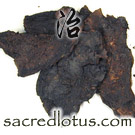 Sheng Di Huang15-30 gCool the Blood
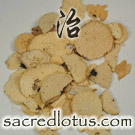 Chuan Mu Tong3-6 gRegulate Water and Drain Dampness
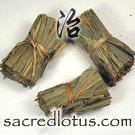 Dan Zhu Ye3-6 gDrain Fire
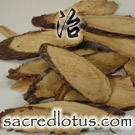 Gan Cao3-6 gTips UsedTonify Qi
Preparation & dosage
How is Dao Chi San prepared?
Dao Chi San ("Guide Out the Red Powder") — despite the "powder" (san) in its name — is today most often prepared as a water decoction (tang) of its four herbs (Sheng Di Huang, Chuan Mu Tong, Dan Zhu Ye and Gan Cao), taken warm.
In the original method the herbs were ground to a coarse powder and simmered together (often with a little bamboo leaf) and the strained liquid taken — the classical "powder decocted as a draught." Modern granule forms reproduce the same combination.
Source: Sacred Lotus sources & references (composition and preparation note) + Bensky & Barolet, Formulas & Strategies.
Taken as a decoction. Typical range: Sheng Di Huang 15-30 g; Chuan Mu Tong, Dan Zhu Ye, and Gan Cao (tips) 3-6 g each. Originally prepared as a powder taken with bamboo leaf; commonly decocted today. Reference only, not a prescription.
Safety — read before use
What are the cautions for Dao Chi San?
Dao Chi San is cold and draining, so it suits excess heat, not deficiency. Use it with care in people with Spleen/Stomach deficiency and cold (poor appetite, loose stools), where its bitter cold and diuretic action can aggravate the underlying weakness. It is intended for short-term clearing of an excess pattern, not prolonged use.
- Not for deficiency-type heat: it clears an excess Heart-heat pattern, not empty (yin-deficient) heat without the excess signs.
- Spleen/Stomach cold or deficiency: use cautiously; the cold, urine-promoting action can worsen it.
- Pregnancy: use only under professional guidance, given the draining, downward-directing action.
Source: Bensky & Barolet, Formulas & Strategies (2nd ed.), cautions. Not a substitute for professional advice.
Important species note: the “mu tong” here is Chuan Mu Tong (Caulis Clematidis Armandii), the species specified in the Sacred Lotus record. It should NOT be substituted with Guan Mu Tong (Aristolochia manshuriensis), an aristolochic-acid-containing herb linked to kidney injury and now widely restricted. Confirm the botanical source of any “mu tong” before dispensing.
Originally Appeared In:
- Craft of Medicinal Treatment for Childhood Disease Patterns (Xiao Er Yao Zheng Zhi Jue)
Notes:
How does Dao Chi San compare to related formulas, and how is it modified?
Dao Chi San is the mild formula for Heart / Small-Intestine heat that also protects yin. It differs from stronger fire-draining formulas by pairing a cooling, yin-enriching chief (Sheng Di Huang) with gentle downward clearing, rather than heavy bitter-cold draining.
- vs Long Dan Xie Gan Tang: that formula drains excess Liver/Gallbladder fire and damp-heat and is far stronger; Dao Chi San targets Heart/Small-Intestine heat and is gentler and more nourishing.
- Emphasis: use Dao Chi San when mouth sores and irritability lead, or when dark painful urination signals heat reaching the Small Intestine.
Common modifications:
- For pronounced Heart fire, add Huang Lian to strengthen the clearing.
- For blood in the urine, cooling blood-stopping herbs (e.g. Xiao Ji) may be added.
Source: Bensky & Barolet, Formulas & Strategies (2nd ed.), comparisons and modifications. Reference only.
Clinical Studies & Research:
Is there modern research on Dao Chi San?
Direct modern research is scarce. PubMed indexes no clinical trial of Dao Chi San itself; it appears mainly as a component of derived prescriptions (e.g. Zishui Qingxin Yin) in chemical-profiling work. Evidence rests on classical and traditional use.
Source: PubMed 40326501 (J Sep Sci, 2025, derived formula). Research context, not a therapeutic claim.
Sources & References
Compiled and edited by Thomas Dehli, Founder & Editor, Sacred Lotus Updated
The information here is referenced from numerous sources — teachers, practitioners, class notes from Five Branches University, the books below, and the published research literature, with citations given as resolvable PubMed identifiers. Where sources disagree, I have flagged the discrepancies directly. If facts couldn't be verified, I have left them out. How we source our content.
Reference information for students and practitioners — not medical advice. Consult a qualified practitioner. Terms of use.
Chinese Formulas Books & References
 https://amzn.to/4fYI3f8
 https://amzn.to/4j55NRA
 https://amzn.to/4gMROyv
 https://amzn.to/4h7msSK