
Xie Bai San
Drain the White Powder
- Category
- Formulas that Clear Heat
- Subcategory
- Formulas that Clear Heat from the Organs
- Ingredients
- 4 herbs
Actions
What does Xie Bai San do?
Xie Bai San drains smoldering heat from the Lung and stops wheezing and cough. Its category in our records is "Formulas that Clear Heat from the Organs" — it targets heat that has settled and lingered inside the Lung itself (not an acute external invasion), the kind of low-grade, deep-seated Lung heat classically called "hidden fire" (fu huo).
The four ingredients divide by role:
- Chief: Sang Bai Pi (Mori Cortex, mulberry root bark), 30 g — sweet and cold, it drains Lung heat, calms wheezing/panting, and promotes urination so heat exits through the water passages.
- Deputy: Di Gu Pi (Lycii Cortex, wolfberry root bark), 30 g — cold and sweet, it drains Lung fire and cools blood-level (deficiency-type) heat, reinforcing Sang Bai Pi’s heat-clearing action.
- Assistant/Envoy: Zhi Gan Cao (honey-fried licorice), 3 g, and Geng Mi (non-glutinous/japonica rice), 15–30 g — both protect and harmonize the Stomach and Spleen, moderating the cold, draining nature of the chief and deputy so the formula does not injure digestion.
The formula is comparatively mild: it clears heat without the strongly bitter, drying herbs used for acute excess-heat patterns, which is why it suits heat that is smoldering rather than raging.
Source: Sacred Lotus sources & references + Bensky & Barolet, Formulas & Strategies (chief/deputy/assistant/envoy analysis). Traditional-use framing; not medical advice.
Indications
What is Xie Bai San used for?
Xie Bai San treats smoldering Lung heat presenting as cough and wheezing, with skin that feels hot to the touch and a fever that characteristically worsens in the afternoon or evening. The pattern is not a fresh external cold or heat invasion; it is heat that has quietly lodged in the Lung, often following an unresolved exterior illness or arising internally, and now disturbs the Lung’s function of descending qi.
Its classic clinical presentation:
- Respiratory signs: cough, wheezing or rapid/labored breathing (panting), a feeling of fullness or oppression in the chest.
- Heat signs: skin that feels hot to the touch, low-grade fever that characteristically intensifies in the afternoon or evening, possible malar (cheek) flushing.
- General: the presentation is usually mild-to-moderate rather than a severe, acute high fever — consistent with heat that has smoldered rather than surged.
Tongue and pulse: classically a red tongue with a thin yellow coating; a thin, rapid (or thin and slightly rapid) pulse, reflecting heat without strong excess.
Source: Bensky & Barolet, Formulas & Strategies; Chen & Chen, Chinese Herbal Formulas and Applications (indications for smoldering Lung heat). Traditional-use framing; not medical advice.
Western Uses:
What is Xie Bai San used for in modern practice?
In modern practice Xie Bai San is referenced, in its traditional Lung-heat role, for pediatric cough and wheezing conditions such as bronchitis, whooping cough, and pneumonia in children — contexts where Western medicine recognizes a productive or spasmodic cough with low-grade fever. It originates from a Song-dynasty pediatric text (Qian Yi’s Xiao’er Yao Zheng Zhi Jue) and has long been associated with children’s respiratory complaints, though it is also used in adults with the matching Lung-heat pattern.
These biomedical correlates are offered as a reference to the formula’s traditional use, not as a claim that it treats any disease. Contemporary study is mostly preclinical network-pharmacology and pharmacokinetic work (see research). Any use for a diagnosed respiratory condition belongs with a qualified practitioner and appropriate medical care.
Source: traditional-use correlates summarized from Bensky & Barolet, Formulas & Strategies, and Chen & Chen, Chinese Herbal Formulas and Applications (formula origin and pediatric association); reference only, not a treatment claim.
Ingredients
4 substances in Xie Bai San — each links to its full herb monograph.
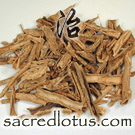 Di Gu Pi30 gCool the BloodNo specimen photographGeng Mi15-30 gTonify Qi
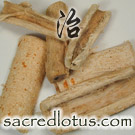 Sang Bai Pi30 gRelieve Coughing and Wheezing
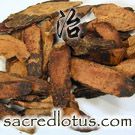 Zhi Gan Cao3 gTonify Qi
Preparation & dosage
How is Xie Bai San prepared?
Traditionally decocted as a water decoction, with Sang Bai Pi and Di Gu Pi dry-fried (chao) or honey-fried to moderate their cold, draining nature before use. Geng Mi (non-glutinous rice) is cooked together with the other herbs; it is the formula’s namesake "envoy," protecting Stomach qi and, per pharmacokinetic research, contributing to the natural nanoparticle formation observed when the decoction is prepared as a whole (see research).
Source: Bensky & Barolet, Formulas & Strategies (standard preparation for cold-natured Lung-heat formulas); PubMed 38617795 (role of rice/whole-decoction preparation). Reference only.
Water decoction. Reference relative amounts (per Sacred Lotus sources & references): Sang Bai Pi (dry-fried) 30 g; Di Gu Pi 30 g; Zhi Gan Cao 3 g; Geng Mi (non-glutinous rice) 15-30 g. Traditionally the four herbs are ground to a coarse powder (san, "powder") and decocted together, or simmered as a standard decoction in modern practice. Reference only; not a prescription.
Safety — read before use
What are the cautions for Xie Bai San?
Xie Bai San is formulated for smoldering, deep Lung heat — it is not the right choice for a fresh external wind-cold or wind-heat cough, nor for cough due to Lung/Spleen qi deficiency or cold-phlegm. Its two main herbs, Sang Bai Pi and Di Gu Pi, are cold and draining; used where cold or deficiency actually predominates, they can further weaken digestion.
- Avoid or modify for exterior (wind-cold/wind-heat) cough without the smoldering-heat pattern — treating the exterior first is standard practice.
- Use cautiously with a weak Spleen/Stomach or loose stools, since Sang Bai Pi and Di Gu Pi are cold in nature; Zhi Gan Cao and Geng Mi are included specifically to buffer this, but additional Stomach-protective modification may still be needed.
- Not for cold-type wheezing or cough with thin, clear, or white phlegm — those patterns call for warming, not draining, formulas.
Source: Bensky & Barolet, Formulas & Strategies; Chen & Chen, Chinese Herbal Formulas and Applications (contraindications for cold-natured heat-clearing formulas). Traditional-use framing; not medical advice.
Originally Appeared In:
- Craft of Medicinal Treatment for Childhood Disease Patterns (Xiao Er Yao Zheng Zhi Jue)
Notes:
How is Xie Bai San different from Ma Xing Shi Gan Tang and other Lung-heat formulas?
Xie Bai San is a milder formula for smoldering, lingering Lung heat, whereas Ma Xing Shi Gan Tang is a stronger formula for acute Lung heat with wheezing from an unresolved external invasion. Choosing between them depends on how the heat arose and how intense the presentation is.
- vs Ma Xing Shi Gan Tang: Ma Xing Shi Gan Tang combines Ma Huang, Xing Ren, Shi Gao, and Gan Cao for more forceful, acute Lung heat with sweating, higher fever, and more severe wheezing following an external pathogen; Xie Bai San is gentler, for heat that has smoldered rather than surged, without a strong exterior component.
- vs Xie Huang San: a related "draining" formula from the same source text, but targeting Spleen/Stomach heat (mouth sores, bad breath) rather than Lung heat and wheezing.
- Key modifications: add Huang Qin and Zhi Mu for more pronounced heat; add Di Long, Chuan Bei Mu, or Sang Ye for stronger phlegm-heat wheezing; add Mai Men Dong or Sha Shen when heat has also damaged Lung yin/fluids (dry cough, dry mouth).
Source: Bensky & Barolet, Formulas & Strategies (formula comparisons and standard modifications).
Clinical Studies & Research:
Is there modern research on Xie Bai San?
Yes, but it is largely preclinical — network-pharmacology and pharmacokinetic studies on the whole formula, plus compound-level work on its individual herbs. A network-pharmacology study of Xiebai San (Xie Bai San) for pediatric pneumonia identified 120 active ingredients (quercetin and kaempferol prominent among them) and 128 potential targets, and found the formula suppressed LPS-induced NF-κB p65 activation and the pro-inflammatory cytokines IL-6 and IL-1β in experimental validation. Separate pharmacokinetic work found that decocting the four herbs together causes the formula’s active compounds to self-assemble into natural nanoparticles (~105 nm), which enhanced their oral absorption and blood levels in rats compared to the free compounds — a possible modern explanation for why the whole decoction (rice included) is prepared as a unit rather than as separate extracts.
- Pediatric pneumonia mechanism (network pharmacology + in vitro validation): Xiebai San suppressed NF-κB p65 activation and IL-6/IL-1β production induced by LPS (PMID 35237157).
- Formula-level pharmacokinetics (nanoparticle self-assembly): whole-decoction preparation of Xie-Bai-San forms self-assembled nanoparticles (~104.5 nm) that raised oral bioavailability of key active compounds in rats versus the compounds alone (PMID 38617795).
- Di Gu Pi (Lycium chinense root bark), compound-level: nine compounds isolated from the root bark showed anti-inflammatory activity, with several exceeding the curcumin positive control in vitro (PMID 28752035).
Sources: PubMed 35237157; PubMed 38617795; PubMed 28752035. Research context, not a therapeutic claim; direct clinical trial evidence in humans remains limited.
Sources & References
Compiled and edited by Thomas Dehli, Founder & Editor, Sacred Lotus Updated
The information here is referenced from numerous sources — teachers, practitioners, class notes from Five Branches University, the books below, and the published research literature, with citations given as resolvable PubMed identifiers. Where sources disagree, I have flagged the discrepancies directly. If facts couldn't be verified, I have left them out. How we source our content.
Reference information for students and practitioners — not medical advice. Consult a qualified practitioner. Terms of use.
Chinese Formulas Books & References
 https://amzn.to/4fYI3f8
 https://amzn.to/4j55NRA
 https://amzn.to/4gMROyv
 https://amzn.to/4h7msSK