
Zuo Jin Wan
Left Metal Pill
- Category
- Formulas that Clear Heat
- Subcategory
- Formulas that Clear Heat from the Organs
- Ingredients
- 2 herbs
Actions
What does Zuo Jin Wan do?
Zuo Jin Wan (Left Metal Pill) clears Liver fire and directs rebellious Stomach qi downward. It is built for Liver fire that overacts on (invades) the Stomach, disrupting the Stomach’s normal downward flow — so it pairs a large dose of a bitter, cold fire-draining herb with a small dose of an acrid, warm descending herb in the classic ~6:1 ratio.
How the two ingredients work together:
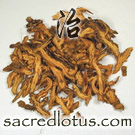
- Chief — Huang Lian (Coptis), 15–18 g: intensely bitter and cold; drains Liver and Stomach fire (and Heart fire, the Liver’s “child”), quieting the heat that is harassing the Stomach.
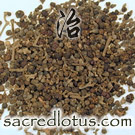
- Assistant/envoy — Wu Zhu Yu (Evodia), 2–3 g: acrid, bitter, and hot; directs rebellious qi downward to stop vomiting and acid reflux, guides the action to the Liver channel, and tempers Huang Lian’s cold so it does not congeal and cause stagnation.
The name (“Left Metal”) reflects Five-Phase reasoning: clearing Liver (Wood, on the “left”) fire frees the Lung (Metal) to restrain the Liver.
Source: Bensky & Barolet, Chinese Herbal Medicine: Formulas & Strategies (2nd ed.), Clear Heat from the Organs; composition confirmed against the Sacred Lotus formula record. Traditional-use framing; not medical advice.
Indications
What is Zuo Jin Wan used for?
Zuo Jin Wan is used for Liver-fire-invading-the-Stomach patterns centered on the epigastrium and acid reflux. The classic picture is burning pain in the epigastrium and hypochondrium (flanks/ribs), acid regurgitation and heartburn, belching, nausea or vomiting, and a bitter taste in the mouth — with heat signs of irritability, a dry mouth, and thirst.
Typical presentation:
- Digestive: epigastric and hypochondriac pain and distention, sour/acid reflux, heartburn, belching, nausea, vomiting.
- Heat/Liver signs: a bitter taste, irritability, a dry mouth, thirst.
Tongue: red with a yellow coat. Pulse: wiry and rapid.
Source: Bensky & Barolet, Formulas & Strategies (2nd ed.); tongue/pulse per the Sacred Lotus formula record. Traditional-use framing; not medical advice.
Western Uses:
What is Zuo Jin Wan used for in modern practice?
In modern TCM practice, practitioners reference Zuo Jin Wan when a presentation fits its Liver-fire-invading-Stomach pattern. Reported reference conditions include gastro-esophageal reflux disease (GERD) and reflux esophagitis, gastritis, and peptic ulcer disease — the acid-reflux and epigastric-pain territory that has drawn most of the modern gastrointestinal and oncology research (below).
These are pattern-based reference framings, not diagnoses or treatment claims: the formula is chosen for the TCM pattern of Liver fire overacting on the Stomach, and a Western label only appears when that pattern matches. A qualified practitioner confirms the diagnosis.
Source: Bensky & Barolet, Formulas & Strategies (2nd ed.); reported uses consistent with the gastrointestinal focus of the modern literature (PubMed 34942456; 27872653). Reference framing only; not a medical claim.
Ingredients
2 substances in Zuo Jin Wan — each links to its full herb monograph.
Preparation & dosage
How is Zuo Jin Wan prepared?
Zuo Jin Wan ("Left Metal Pill") is a tiny two-herb formula — Huang Lian and Wu Zhu Yu — classically made as pills, and often prepared today as a small water decoction (tang).
Its defining feature is the ratio: about 6 parts Huang Lian to 1 part Wu Zhu Yu — cold, bitter Huang Lian clears Liver-fire invading the Stomach, while a little warm, acrid Wu Zhu Yu prevents the cold from congealing and directs qi downward, easing acid reflux and epigastric pain. Available as ready-made pills or granules.
Source: Sacred Lotus sources & references (composition and preparation note) + Bensky & Barolet, Formulas & Strategies.
Taken as a decoction (the Sacred Lotus record) or as the traditional pill. The defining feature is the ratio: Huang Lian ~15-18 g to Wu Zhu Yu ~2-3 g (classically about 6:1). As a pill, much smaller daily amounts are used. Reference only, not a prescription.
Safety — read before use
What are the cautions for Zuo Jin Wan?
Zuo Jin Wan is dominated by bitter, cold Huang Lian, so it suits excess Liver/Stomach fire, not cold or deficiency. It is not appropriate for acid reflux or vomiting arising from Stomach cold or Spleen/Stomach deficiency, where the cold herbs can further injure Stomach yang and impair digestion.
- Not for cold or deficiency patterns: cold-type vomiting/reflux and deficiency-cold epigastric pain are treated differently.
- Spleen/Stomach deficiency: use cautiously; bitter cold can weaken digestion, so it is generally used short-term.
- Pregnancy: use only under professional guidance.
Source: Bensky & Barolet, Formulas & Strategies (2nd ed.), cautions. Not a substitute for professional advice.
Originally Appeared In:
- Teachings of Dan Xi (Dan Xi Xin Fa)
Notes:
How does Zuo Jin Wan compare to related formulas, and how is it modified?
Zuo Jin Wan’s defining feature is its lopsided ~6:1 pairing of Huang Lian with Wu Zhu Yu; its key contrast is with Xiang Lian Wan, which also leads with Huang Lian but targets the Intestines rather than the Stomach.
- vs Xiang Lian Wan (Huang Lian + Mu Xiang): treats damp-heat dysentery/diarrhea with abdominal pain and tenesmus — Mu Xiang moves qi in the Intestines; Zuo Jin Wan instead clears Liver fire and settles rebellious Stomach qi (reflux, vomiting).
Common variations and modifications:
- Jia Wei Zuo Jin Wan (“augmented”): adds herbs such as Chai Hu, Bai Shao, and others to strengthen the Liver-coursing, qi-regulating action.
- For pronounced acid reflux, practitioners often add Wu Zei Gu (Hai Piao Xiao) and/or Duan Wa Leng Zi to absorb acid.
- For marked Stomach heat and thirst, reinforce the fire-clearing; for Liver-qi constraint, add Liver-coursing herbs.
Source: Bensky & Barolet, Formulas & Strategies (2nd ed.), comparisons and modifications. Reference only.
Clinical Studies & Research:
Is there modern research on Zuo Jin Wan?
Research is largely preclinical, concentrated in gastrointestinal disease and oncology. Network-pharmacology and cell studies report that Zuojin capsule/formula acts on multiple targets in colorectal cancer cells and that Zuo Jin Wan can induce apoptosis in cisplatin-resistant gastric cancer cells via cofilin-1; other work links its extracts to attenuated Wnt/β-catenin signaling. Robust human trials are lacking.
Source: PubMed 34942456 (Phytomedicine, 2022, colorectal cancer network pharmacology); PubMed 27872653 (Evid Based Complement Alternat Med, 2016, cisplatin-resistant gastric cancer / cofilin-1); PubMed 29183322 (BMC Complement Altern Med, 2017, Wnt/β-catenin). Research context, not a therapeutic claim.
Sources & References
Compiled and edited by Thomas Dehli, Founder & Editor, Sacred Lotus Updated
The information here is referenced from numerous sources — teachers, practitioners, class notes from Five Branches University, the books below, and the published research literature, with citations given as resolvable PubMed identifiers. Where sources disagree, I have flagged the discrepancies directly. If facts couldn't be verified, I have left them out. How we source our content.
Reference information for students and practitioners — not medical advice. Consult a qualified practitioner. Terms of use.
Chinese Formulas Books & References
 https://amzn.to/4fYI3f8
 https://amzn.to/4j55NRA
 https://amzn.to/4gMROyv
 https://amzn.to/4h7msSK