

Rhizoma Coptidis Coptis Rhizome
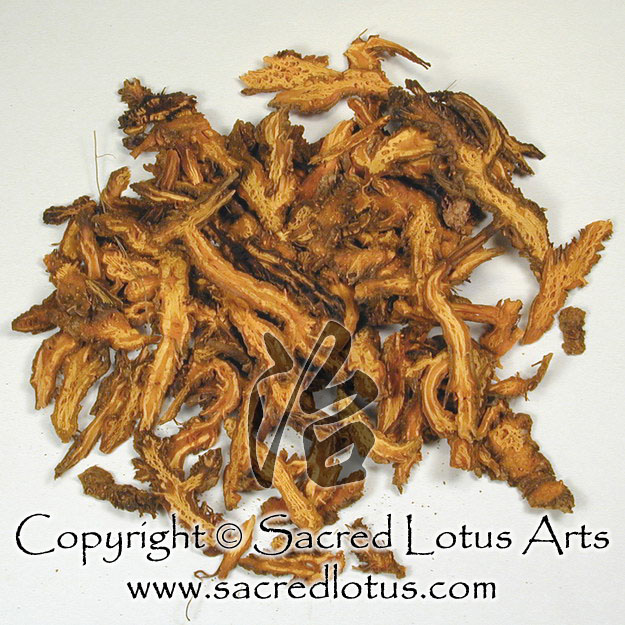
Materia Medica Data
- Temperature
- Cold
- Nature & Flavour
- Bitter, Cold
- Channels Entered
- HT, LI, LIV, ST
- Latin (pharmaceutical)
- Rhizoma Coptidis
- Chinese
- 黄连
- Tone Marks
- huáng lián
- Translation
- Yellow Links
Chinese Herb Actions
What is Huang Lian (Coptis Rhizome) used for in Chinese medicine?
Huang Lian drains fire, dries damp-heat, and relieves fire toxicity — classically used for high fever with irritability and delirium, Damp-Heat vomiting or diarrhea/dysentery, insomnia from Heart–Kidney disharmony, and heat-type bleeding, and applied topically for red, painful eyes and mouth/tongue sores.
Its main traditional actions:
- Drains Fire and relieves toxicity — for fire symptoms such as high fever, irritability, delirium, a red tongue, and a full, rapid pulse; also for heat with toxicity causing painful red eyes, sore throat, and toxic skin lesions (sores, carbuncles).
- Drains Dampness and clears Heat, especially from the Stomach and Intestines — for Damp-Heat in the Stomach with vomiting or acid regurgitation, Stomach Fire with bad breath and foul-smelling belching, and Damp-Heat in the Intestines with diarrhea or dysentery.
- Calms Heart Fire — for irritability and insomnia from Heart–Kidney disharmony (“the Heart and Kidney fail to communicate”), classically paired with E Jiao and egg yolk in Huang Lian E Jiao Tang.
- Clears Heat and stops bleeding — for heat-type bleeding such as epistaxis (nosebleed) and blood in the stool, urine, or vomit.
- Used topically — as a powder or wash to clear heat in the eyes, tongue, and mouth.
Source: Sacred Lotus materia medica record, cross-checked against Bensky & Barolet, Chinese Herbal Medicine: Materia Medica (3rd ed.) and Chen & Chen, Chinese Medical Herbology and Pharmacology. Traditional-use framing; not medical advice.
Chinese Herb Dosage
What is the typical dosage of Huang Lian (Coptis Rhizome)?
Roughly 1.5–9 g in a standard water decoction, per the Sacred Lotus materia medica record — consistent with standard materia medica ranges for this very bitter, very cold herb, which is typically dosed at the lower end, or combined with warming herbs, to offset its coldness.
- Internal (decoction) — about 1.5–9 g.
- Topical — used externally as a fine powder or wash for the eyes, mouth, and tongue (see Actions).
Source: Sacred Lotus materia medica record; standard materia medica ranges. Reference only — not a prescription.
Chinese Herb Contraindications & Cautions
Are there cautions for Huang Lian (Coptis Rhizome)?
Huang Lian is very bitter and very cold, and easily damages the Spleen and Stomach with prolonged use. It is cautioned in Yin or Blood deficiency, Stomach cold, and diarrhea from Spleen–Kidney deficiency, and long-term use may injure digestion. Given its cold, purging nature and a documented pharmacological effect relevant to newborns (see Research), it warrants particular caution in pregnancy and professional supervision generally.
- Traditional incompatibility (reference note) — some traditional sources say it should not be taken with pork, and that it may antagonize Xuan Shen (Radix Scrophulariae), Ju Hua (Flos Chrysanthemi), Jiang Can (Bombyx Batryticatus), Bai Xian Pi (Cortex Dictamni), and Niu Xi (Radix Achyranthis Bidentatae).
- Pregnancy / neonatal (reference note) — berberine, Huang Lian's principal alkaloid, displaces bilirubin from albumin in laboratory and animal studies, a mechanism historically linked to kernicterus (bilirubin brain injury) risk in jaundiced Chinese newborns exposed to huanglian preparations. This is a reasonable basis for treating pregnancy/infant exposure as its own caution rather than assuming general adult safety data apply (see Research).
Source: Sacred Lotus materia medica record (traditional cautions); PMID 8513024, DOI 10.1159/000243932 (bilirubin–albumin displacement). Traditional-use and safety reference framing, not medical advice.
Chinese Herb Toxicity & Overdose
Low acute toxicity at traditional doses, with the main real-world issue being mild, self-limited GI upset rather than organ toxicity. In human trials of berberine (Huang Lian's principal alkaloid) at roughly 1–1.5 g/day for up to 3 months, the most common side effects were transient diarrhea, constipation, or abdominal discomfort, with no signal for liver or kidney injury. The one well-documented, mechanism-specific safety concern is not general toxicity but a pharmacological one: berberine displaces bilirubin from albumin, a finding directly tied to historical kernicterus risk in jaundiced newborns given huanglian preparations — the basis for treating pregnancy/infant exposure as a distinct caution (see Cautions) rather than extrapolating from general adult tolerability data.
Source: PMID 18442638; PMID 18397984 (human-trial tolerability data); PMID 8513024, DOI 10.1159/000243932 (bilirubin displacement). Reference note, not a safety guarantee.
Herb-Drug Interactions
Berberine (Huang Lian's principal alkaloid) inhibits several drug-metabolizing enzymes and has been shown, in a clinical study, to raise blood levels of the immunosuppressant cyclosporine A — practitioner awareness is warranted for patients on narrow-therapeutic-index medications. A controlled human pharmacokinetic study found that two weeks of berberine (300 mg three times daily) significantly inhibited CYP2D6 (roughly ninefold), CYP2C9, and CYP3A4 activity, with no measurable effect on CYP2C19 or CYP1A2. Separately, in renal-transplant recipients, co-administered berberine significantly raised cyclosporine A blood concentrations, consistent with a CYP3A4/P-glycoprotein-mediated interaction. (Flagged for practitioner confirmation; not an exhaustive interaction list.)
Source: PMID 21870106 (CYP2D6/2C9/3A4 inhibition in humans); PMID 16133554 (cyclosporine A interaction in renal-transplant recipients). Research context, not a substitute for a pharmacist/practitioner check.
Western / Biomedical Research
Chinese Herb Clinical Studies & Research
Provided as research context — a summary of published biomedical study, not a therapeutic or medical claim.
Is there modern research on Huang Lian (Coptis chinensis / berberine)?
Yes — berberine, Coptis chinensis's principal alkaloid, is one of the most studied Chinese-medicine compounds, with multiple human randomized trials in type 2 diabetes and dyslipidemia, a positive trial for infectious diarrhea, and mechanistic/preclinical work relevant to its traditional damp-heat and fire-clearing uses.
- Type 2 diabetes (human RCT vs. metformin) — a 13-week randomized trial in 116 newly diagnosed patients compared berberine (500 mg three times daily) with metformin (500 mg three times daily): fasting blood glucose fell by about 26% and HbA1c dropped comparably in both arms, with berberine also improving lipid parameters; the most frequent side effect was transient diarrhea in roughly a third of participants, with no hepatic or renal toxicity signal.
- Type 2 diabetes and dyslipidemia (human RCT vs. placebo) — a separate 3-month, randomized, placebo-controlled trial (n=116, 1.0 g/day) reported significant reductions in fasting and postload glucose, HbA1c, triglycerides, total cholesterol, and LDL-cholesterol versus placebo, with mild constipation in a small number of participants.
- Cholesterol-lowering mechanism — a mechanistic/clinical study (32 hypercholesterolemic patients, plus hamster models) found berberine lowered serum cholesterol (~29%), triglycerides (~35%), and LDL-cholesterol (~25%), working by upregulating liver LDL-receptor expression through a mechanism distinct from statins (ERK-dependent mRNA stabilization, not the SREBP pathway).
- Damp-heat / infectious diarrhea (human RCT) — a randomized trial in adults with acute diarrhea from enterotoxigenic E. coli or Vibrio cholerae found a single 400 mg dose of berberine sulfate significantly reduced stool volume and shortened diarrhea duration versus control in the E. coli group, with a more modest effect in cholera — a mechanistic echo of Huang Lian's traditional use for Damp-Heat dysentery.
- Gut microbiota (preclinical) — in high-fat-diet-fed rats, berberine prevented obesity and insulin resistance alongside structural shifts in gut bacteria (reduction of many taxa, selective enrichment of short-chain-fatty-acid producers), suggesting the microbiota as one mediator of its metabolic effects; animal research, not directly clinical evidence.
Human clinical evidence is strongest for glucose and lipid metabolism; the antidiarrheal trial and microbiota findings add mechanistic support for traditional Damp-Heat indications but are more limited (one trial) or preclinical (animal only), respectively.
Sources: PMID 18442638 (RCT vs. metformin, T2DM); PMID 18397984 (RCT vs. placebo, T2DM + dyslipidemia); PMID 15531889 (cholesterol-lowering mechanism); PMID 3549923 (RCT, infectious diarrhea); PMID 22880019 (gut microbiota, preclinical). Research context, not a therapeutic claim.
Chinese Herb Notes
What are Huang Lian's key preparations and formula combinations?
Processing shifts its focus, and it anchors several classic formulas. Dry-fried (chǎo huáng lián) to strengthen its cooling action and let it enter the Blood level; prepared with ginger to focus on Stomach heat; prepared with salt to direct it toward the Large Intestine and Bladder; and used topically as a powder.
- Zuo Jin Wan (Left Metal Pill) — with a small amount of Wu Zhu Yu, for Liver Fire invading the Stomach.
- Huang Lian Jie Du Tang (Coptis Decoction to Relieve Toxicity) — with Huang Qin, Huang Bai, and Zhi Zi, for fire toxin in all three burners.
- Huang Lian E Jiao Tang — with E Jiao and egg yolk, for Fire from Yin deficiency with Heart–Kidney disharmony and insomnia.
- Ban Xia Xie Xin Tang and the wider Xie Xin Tang family — with Huang Qin, Ban Xia, Gan Jiang, and Ren Shen, for a Cold–Heat complex in the middle burner (epigastric focal distention).
- Ge Gen Huang Lian Huang Qin Tang — with Ge Gen and Huang Qin, for lingering exterior heat with interior Damp-Heat diarrhea.
- Shao Yao Tang and Bai Tou Weng Tang — for Damp-Heat/toxin dysentery.
- Qing Wei San — for blazing Stomach Fire rising to the mouth, teeth, and gums.
- An Gong Niu Huang Wan and Zhu Sha An Shen Wan — for, respectively, severe febrile/phlegm-heat disease and Heart Fire injuring Yin and Blood.
Source: Sacred Lotus materia medica record (processing notes); Sacred Lotus formula–herb links (combinations). Traditional formula context, not treatment advice.
Sources & References
Compiled and edited by Thomas Dehli, Founder & Editor, Sacred Lotus Updated
The information here is referenced from numerous sources — teachers, practitioners, class notes from Five Branches University, the books below, and the published research literature, with citations given as resolvable PubMed identifiers. Where sources disagree, I have flagged the discrepancies directly. If facts couldn't be verified, I have left them out. How we source our content.
Reference information for students and practitioners — not medical advice. Consult a qualified practitioner. Terms of use.
Chinese Herbs Books & References
 https://amzn.to/3WfB3DK
 https://amzn.to/3DR1VUh
 https://amzn.to/42aMz73
 https://amzn.to/3PuD4bt