
Qing Shu Yi Qi Tang
Clear Summerheat and Augment the Qi Decoction
- Category
- Formulas that Clear Heat
- Subcategory
- Formulas that Relieve Summerheat
- Ingredients
- 10 herbs
Actions
What does Qing Shu Yi Qi Tang do?
Qing Shu Yi Qi Tang (Wang's version) clears summerheat while simultaneously augmenting the qi and nourishing yin and fluids. It treats the combination pattern that follows summerheat exposure: the pathogen's heat continues to smolder while the sweating it provokes drains both qi and fluids, so the formula must cool, tonify, and moisten at the same time rather than relying on any single strategy.
The ten ingredients divide by role:
- Chief: Xi Yang Shen (American ginseng, gently tonifies qi and nourishes yin without warming) paired with Xi Gua (watermelon rind, Xi Gua Pi) which clears summerheat and generates fluids — together they address both the deficiency and the heat at the formula's core.
- Deputies: Lian Geng (lotus stem), Shi Hu, and Mai Men Dong support Xi Yang Shen by nourishing yin and generating fluid.
- Assistants: Huang Lian, Zhi Mu, and Dan Zhu Ye support Xi Gua by clearing residual heat and calming irritability; Huang Lian is used in a small dose (2–3 g) specifically to avoid injuring the Stomach.
- Envoys: Gan Cao and Geng Mi (rice) harmonize the formula and protect Stomach qi.
Source: Sacred Lotus sources & references + Bensky & Barolet, Formulas & Strategies, cross-checked against a TCM formulas course handout (Chinese Acupuncture & Wellness) for the chief/deputy/assistant/envoy analysis. Traditional-use framing; not medical advice.
Indications
What is Qing Shu Yi Qi Tang used for?
Qing Shu Yi Qi Tang treats summerheat that has injured both qi and fluids — the pattern that follows heat exposure with heavy sweating, where the sweating itself depletes what the heat has not already consumed. It is distinguished from formulas for summerheat with dampness by the absence of a greasy tongue coating or heavy, bloated sensations.
Its classic clinical presentation:
- Residual heat signs: fever, profuse sweating, irritability, thirst for cold drinks, scanty dark urine.
- Qi-and-fluid deficiency signs: fatigue, shortness of breath, low spirits, and a general sense of depletion following the heat and sweating.
Tongue and pulse: a red tongue with scanty fluid (dry), and a deficient, rapid pulse.
Source: Sacred Lotus sources & references on pulse + Bensky & Barolet, Formulas & Strategies, cross-checked against Chinese-language formula references (tongue: 舌红少津, pulse: 脉虚数) for the tongue description, which Sacred Lotus sources & references leaves blank. Traditional-use framing; not medical advice.
Western Uses:
What is Qing Shu Yi Qi Tang used for in modern practice?
In modern practice this formula is referenced for heat-exhaustion and heat-stroke-type presentations — fever, heavy sweating, thirst, and fatigue following heat exposure — and for depleted, dehydrated states more broadly where Western medicine recognizes fluid loss and exhaustion. Contemporary lab research (see research) has specifically tested it in models of exertional heat stroke.
These biomedical correlates are offered as a reference to the formula's traditional use, not as a claim that it treats any disease. Any use for a diagnosed condition (including heat stroke, which is a medical emergency) belongs with a qualified practitioner and appropriate medical care.
Source: traditional-use correlates summarized from Bensky & Barolet, Formulas & Strategies, and the research findings cited below; reference only, not a treatment claim.
Ingredients
10 substances in Qing Shu Yi Qi Tang — each links to its full herb monograph.
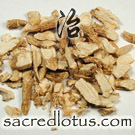 Xi Yang Shen4.5-6 gTonify Yin
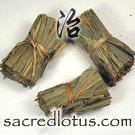 Dan Zhu Ye4.5-6 gDrain Fire
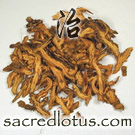 Huang Lian2-3 gClear Heat and Dry Dampness
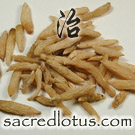 Mai Men Dong6-9 gTonify Yin
 Shi Hu12-15 gTonify Yin
 Zhi Mu4.5-6 gDrain FireNo specimen photographGeng Mi12-15 gTonify QiNo specimen photographLian Geng12-15 gClear and Relieve Summerheat
 Gan Cao2-3 gTonify Qi
Preparation & dosage
How is Qing Shu Yi Qi Tang prepared?
Qing Shu Yi Qi Tang is taken as a water decoction. Xi Gua Pi (watermelon rind) and Geng Mi (rice) are decocted along with the other herbs; some sources add the rice to help thicken and harmonize the decoction, in the manner of Bai Hu Tang.
Source: Sacred Lotus sources & references + Bensky & Barolet, Formulas & Strategies, general preparation convention for rice-containing heat-clearing decoctions.
Decoction. Reference relative amounts: Xi Gua Pi (watermelon rind) 24-30 g; Lian Geng (lotus stem), Shi Hu, Geng Mi (rice) 12-15 g each; Mai Men Dong 6-9 g; Xi Yang Shen, Dan Zhu Ye, Zhi Mu 4.5-6 g each; Huang Lian, Gan Cao 2-3 g each. Huang Lian is kept to a small dose to avoid injuring the Stomach. Reference only.
Safety — read before use
What are the cautions for Qing Shu Yi Qi Tang?
Qing Shu Yi Qi Tang is built for summerheat with qi-and-fluid damage, not summerheat complicated by dampness — its yin-nourishing herbs (Xi Yang Shen, Shi Hu, Mai Men Dong) can aggravate dampness if given to a patient with a greasy tongue coating, heaviness, or bloating, in whom a damp-resolving formula (e.g., Liu Yi San or Li Dongyuan's version of the same name) is more appropriate.
- Not for summerheat-with-dampness: avoid when the tongue coating is greasy/thick rather than simply dry, or when heaviness and poor appetite point to damp obstruction.
- Cold, bitter Huang Lian is kept to a small dose in the formula specifically to limit Stomach-injuring potential; the formula as a whole still leans cooling and is not intended for cold or yang-deficient constitutions.
- Not for exterior (early-stage) conditions without qi-and-fluid deficiency already present.
Source: Bensky & Barolet, Formulas & Strategies (cautions for summerheat-and-dampness differentiation), cross-checked against Chinese-language formula references on contraindication in damp-predominant summerheat. Traditional-use framing; not medical advice.
Originally Appeared In:
- Warp and Woof of Warm Febrile Diseases (Wen Re Jing Wei)
Notes:
Is this the same formula as Li Dongyuan's Qing Shu Yi Qi Tang?
No — the name is shared by two distinct classical formulas, and this record is Wang Mengying's version. Li Dongyuan's Qing Shu Yi Qi Tang, from his Jin-Yuan dynasty text Pi Wei Lun, is a 15-herb formula built around Huang Qi, Ren Shen, Bai Zhu, and Cang Zhu that dries dampness and tonifies Spleen qi for summerheat complicated by dampness and Spleen deficiency (fatigue, loose stools, heaviness). Wang Mengying's version, from Wen Re Jing Wei (1852), is the 10-herb formula in this record: it has no Huang Qi, Bai Zhu, or Cang Zhu, and instead pairs Xi Yang Shen with Xi Gua to clear heat while nourishing yin and generating fluid, without a damp-drying strategy.
- Choose Wang's version (this formula) when summerheat has injured qi and fluids without significant dampness — dry mouth/tongue, thirst for cold drinks, scanty dark urine.
- Choose Li Dongyuan's version when summerheat coincides with dampness and Spleen-qi deficiency — heaviness, loose stools, poor appetite, a greasy tongue coating.
- Relationship to Sheng Mai San: the qi-and-yin-tonifying strategy (ginseng-type herb + Mai Men Dong) echoes Sheng Mai San, but this formula substitutes cooling, heat-clearing herbs (Xi Gua, Huang Lian, Zhi Mu, Dan Zhu Ye) for Sheng Mai San's astringent Wu Wei Zi, making it suited to active heat rather than pure qi-yin deficiency with sweating.
Source: Bensky & Barolet, Formulas & Strategies (both formulas listed under formulas that relieve summerheat) + Sacred Lotus sources & references confirming this record matches Wang's 10-herb formula, not Li Dongyuan's 15-herb formula.
Clinical Studies & Research:
Is there modern research on Qing Shu Yi Qi Tang?
Yes, but it is preclinical — animal and cell studies testing the formula's traditional "clears summerheat" role against heat-related injury, plus one cachexia study using it in combination with another herb. The most directly relevant recent study found the decoction reduced intestinal barrier injury in rats with exertional heat stroke.
- Exertional heat stroke (preclinical): Qingshu Yiqi decoction significantly reduced hyperthermia and multi-organ injury and protected the intestinal barrier in a rat heat-stroke model, acting via the NF-κB/MLC pathway and gut microbiota changes (PMID 40339554).
- Cancer cachexia, in combination (preclinical): Qing-Shu-Yi-Qi-Tang combined with Scutellaria baicalensis reduced tumor mass and muscle wasting and improved immune markers in tumor-bearing mice undergoing chemotherapy (PMID 21782419).
- Heat-stress protection, modified tea-form preparation (preclinical): a "Qingshu Yiqi tea prescription" — a modified formulation, not the classical decoction — reduced oxidative liver/intestinal damage and blunted the heat-shock response in a mouse heat-stress model (PMID 40992336).
Sources: PubMed 40339554; PubMed 21782419; PubMed 40992336. Research context, not a therapeutic claim; direct clinical trial evidence is not yet established.
Sources & References
Compiled and edited by Thomas Dehli, Founder & Editor, Sacred Lotus Updated
The information here is referenced from numerous sources — teachers, practitioners, class notes from Five Branches University, the books below, and the published research literature, with citations given as resolvable PubMed identifiers. Where sources disagree, I have flagged the discrepancies directly. If facts couldn't be verified, I have left them out. How we source our content.
Reference information for students and practitioners — not medical advice. Consult a qualified practitioner. Terms of use.
Chinese Formulas Books & References
 https://amzn.to/4fYI3f8
 https://amzn.to/4j55NRA
 https://amzn.to/4gMROyv
 https://amzn.to/4h7msSK