
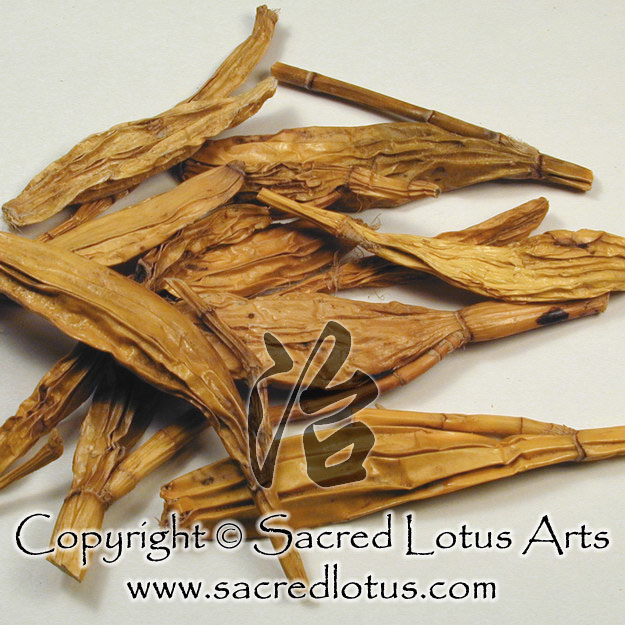
Materia Medica Data
- Category
- Herbs that Tonify Yin
- Temperature
- Cold
- Nature & Flavour
- Sweet, Slightly Salty, Bland, Cold
- Channels Entered
- KI, ST
- Latin (pharmaceutical)
- Herba Dendrobii
- Chinese
- 石斛
- Tone Marks
- shí hú
- Translation
- Bushel of Stone
- Photo Note
- Substitute Shown (You Gua Shi Hu)
Chinese Herb Actions
What is Shi Hu used for in Chinese medicine?
Shi Hu (Dendrobium stem) is traditionally used to nourish Stomach and Kidney Yin, generate body fluids, and clear deficiency heat — it is a go-to herb for dryness and thirst after febrile illness, and for the low-grade heat, dry mouth, and night sweats of Kidney-Yin deficiency.
- Nourishes Stomach Yin, generates fluids, and clears heat — thirst, dry/parched mouth and throat, irritability, and sweating from a warm-febrile illness that has injured body fluids.
- Nourishes Kidney Yin and clears deficiency heat — unremitting low-grade fever, dry and painful throat, and a red tongue with no coating; also chronic dry cough with low-grade fever and night sweats, typically used alongside other Yin tonics.
- Tonifies the Kidneys and brightens the eyes — weak low back, tendons, and bones; blurred vision, dizziness, and spots in front of the eyes; also used for limb numbness or Wei (atrophy) syndrome.
Source: Sacred Lotus sources & references; cross-referenced against multiple online sources; Bensky, Materia Medica (3rd ed.).
Chinese Herb Dosage
What is the typical dosage of Shi Hu?
Roughly 6–15 g of the dried stem in decoction (some sources cite 6–12 g), or 15–30 g of the fresh stem, pre-cooked before the other herbs are added. The fresh form is prized in some traditions as stronger for generating fluids, while the dried form is more widely available and used across standard formulas.
Source: Sacred Lotus sources & references; cross-referenced against multiple online sources; Bensky, Materia Medica (3rd ed.). Reference only — not a prescription.
Chinese Herb Contraindications & Cautions
Are there cautions for Shi Hu?
Shi Hu should not be used in the early/exterior stage of a warm-febrile disease, especially with damp-heat, and is unsuited to Spleen deficiency with loose stools or a thick, greasy tongue coating — its cooling, Yin-nourishing, moistening nature can worsen damp-type or exterior conditions and further weaken a deficient Spleen.
- Early-stage/exterior febrile disease, especially with dampness — avoid; the herb is meant for Yin/fluid deficiency after heat has damaged fluids, not for clearing an exterior or damp-heat pattern.
- Spleen deficiency with loose stools, or thick/greasy tongue coating (damp/phlegm accumulation) — avoid; moistening Yin tonics can aggravate dampness and digestive weakness.
Source: Sacred Lotus sources & references; cross-referenced against multiple online sources; Bensky, Materia Medica (3rd ed.). Reference note, not medical advice.
Chinese Herb Toxicity & Overdose
Low toxicity at normal doses; seizures have been reported with gross over-dosage. Shi Hu has a long dietary and medicinal history and is generally well tolerated within standard ranges. The main real-world safety issue in practice is not intrinsic toxicity but product authenticity — confirming genuine Dendrobium species material (see sourcing/substitution note above) matters for predictable safety and effect.
Source: Sacred Lotus sources & references; cross-referenced against multiple online sources. Reference note, not a safety guarantee.
Herb-Drug Interactions
No well-established clinical herb–drug interactions are documented for Shi Hu. Given its traditional fluid-generating, Yin-nourishing use, practitioner awareness is reasonable for patients on medications affecting blood glucose (see research below on hypoglycemic effects) — this is precautionary, not a demonstrated clinical interaction. (Flagged for practitioner confirmation.)
Western / Biomedical Research
Chinese Herb Clinical Studies & Research
Provided as research context — a summary of published biomedical study, not a therapeutic or medical claim.
Is there modern research on Shi Hu (Dendrobium)?
Yes — an active and growing research literature, concentrated on Dendrobium officinale polysaccharides, with reported gastroprotective, blood-sugar, liver-protective, and immune effects, alongside a body of species-authentication research driven by market adulteration concerns. A comprehensive review identifies roughly 190 isolated compounds, with polysaccharides as the primary studied bioactive class.
- Gastric mucosa protection — animal studies report that Dendrobium officinale polysaccharides help repair ethanol- and acetic-acid-induced gastric mucosal injury/ulcers in rats, via effects on inflammatory (MAPK) signaling and protective growth-factor expression; this is consistent with, though mechanistically distinct from, the traditional “nourishes Stomach Yin” use.
- Broader pharmacology — the 2017 review reports studied effects including liver protection, blood-sugar regulation, anti-fatigue, and anticancer potential in preclinical models, while noting that toxicology and standardization data remain incomplete.
- Species authentication — DNA barcoding research (chloroplast and nuclear markers) has been developed specifically to distinguish Dendrobium huoshanense from adulterant material, reflecting the documented market-substitution problem discussed above.
Human clinical trial evidence for Shi Hu/Dendrobium remains limited; most support is preclinical (cell and animal models).
Sources: PMID 28386292 (Dendrobium officinale ethnopharmacology/pharmacology review, Evidence-Based Complementary and Alternative Medicine, 2017); PMID 34898361 (gastric mucosal repair, MAPK pathway, Bioengineered, 2022); PMID 38398633 (gastric ulcer, rat model, Molecules, 2024); PMID 30486530 (DNA barcoding/adulterant identification, Zhongguo Zhong Yao Za Zhi, 2018). Research context, not a therapeutic claim.
Chinese Herb Notes
Why is Shi Hu expensive, and why do species/quality vary so much?
Shi Hu comes from Dendrobium orchid stems, a genus that is slow-growing, heavily wild-collected historically, and now internationally trade-regulated — which makes genuine, high-grade material expensive and market substitution/adulteration a documented, real problem. Multiple Dendrobium species are used medicinally (e.g. Dendrobium officinale/nobile, D. huoshanense), and they are not interchangeable in traditional grading: some are prized far above others, and cheaper or unrelated plant material has been sold under the same common name.
- CITES-regulated trade — the orchid family (Orchidaceae), which includes the genus Dendrobium, is subject to CITES international trade controls; wild collection pressure on slow-growing epiphytic/lithophytic orchids like Dendrobium is a recognized conservation concern, and most commercial Shi Hu today is cultivated rather than wild-harvested.
- Species substitution and adulteration — because premium species such as Dendrobium huoshanense command high prices, DNA-based authentication studies have been developed specifically to distinguish it from adulterant/substitute material sold under the same name, reflecting a documented quality-control issue in the trade.
- Practical takeaway (neutral reference note) — buyers and practitioners should expect price and quality to vary significantly by species and source, and should favor suppliers who can verify species identity, rather than assuming all product labeled “Shi Hu” or “Dendrobium” is equivalent.
Source: cross-referenced against multiple online sources; PMID 30486530 (DNA barcoding identification of Dendrobium huoshanense and its adulterants, Zhongguo Zhong Yao Za Zhi, 2018). Sourcing/conservation notes are neutral reference, not usage instructions.
This herb is from an endangered/protected species and is illegal in the United States
Sources & References
Compiled and edited by Thomas Dehli, Founder & Editor, Sacred Lotus Updated
The information here is referenced from numerous sources — teachers, practitioners, class notes from Five Branches University, the books below, and the published research literature, with citations given as resolvable PubMed identifiers. Where sources disagree, I have flagged the discrepancies directly. If facts couldn't be verified, I have left them out. How we source our content.
Reference information for students and practitioners — not medical advice. Consult a qualified practitioner. Terms of use.
Chinese Herbs Books & References
 https://amzn.to/3WfB3DK
 https://amzn.to/3DR1VUh
 https://amzn.to/42aMz73
 https://amzn.to/3PuD4bt