
Zhong Man Fen Xiao Wan
Separate and Reduce Fullness in the Middle Pill
- Category
- Formulas that Expel Dampness
- Subcategory
- Formulas that Clear Damp-Heat
- Ingredients
- 16 herbs
Actions
What does Zhong Man Fen Xiao Wan do?
Zhong Man Fen Xiao Wan (“Separate and Reduce Fullness in the Middle Pill”) simultaneously drains damp-heat, moves stagnant qi, and tonifies a weakened Spleen to relieve severe, drum-like distention of the epigastrium and abdomen. Devised by Li Dongyuan, it is a complex sixteen-herb formula that layers several classical strategies into one prescription rather than following a simple chief-deputy-assistant-envoy structure.
Its sixteen herbs group by strategy:
- Chief (breaks the distention): Hou Po (ginger-fried) and Zhi Shi (dry-fried) — the classic qi-moving pair that descends rebellious qi and breaks up fullness in the Middle Jiao.
- Clears damp-heat: Huang Qin and Huang Lian (both dry-fried) drain heat and dry dampness from the Middle Jiao; Zhi Mu (dry-fried) clears heat while offsetting the formula’s many drying, warming herbs.
- Drains dampness through urination: Fu Ling, Zhu Ling, and Ze Xie (echoing Wu Ling San) leach damp-heat out through the urine.
- Warms and dries residual cold-damp / phlegm: Ban Xia and Gan Jiang dry dampness and transform phlegm, balancing the formula’s cold herbs so heat is cleared without further injuring the Middle Jiao; Jiang Huang helps move qi and blood.
- Tonifies and harmonizes (echoing Si Jun Zi Tang): Ren Shen, Bai Zhu, and Zhi Gan Cao support the underlying Spleen-qi deficiency that allows damp-heat to accumulate in the first place; Chen Pi and Sha Ren regulate qi and aromatically transform dampness so the tonics do not become cloying.
Secondary compilations of this formula (which are not primary academic sources) assign the deputy/assistant/envoy roles for the remaining fourteen herbs somewhat differently from one another — e.g. whether Ban Xia, Jiang Huang, and Gan Jiang rank as deputy or assistant. Only the Hou Po/Zhi Shi chief pairing is consistent across sources, so the functional groupings above are given instead of a single disputed herb-by-herb hierarchy.
Source: this site’s own composition record (matches the amounts below) + Bensky & Barolet, Formulas & Strategies, cross-referenced against multiple online sources. Traditional-use framing; not medical advice.
Indications
What is Zhong Man Fen Xiao Wan used for?
Zhong Man Fen Xiao Wan treats “drum-like” abdominal distention caused by damp-heat accumulation in the Middle Jiao — a stubborn, firm fullness rather than the softer bloating of simple qi stagnation, arising against a background of underlying Spleen-qi weakness.
Its classic clinical presentation:
- Core sign: abdominal and epigastric distention with firmness and a sensation of fullness, sometimes with bursting pain.
- Heat signs: irritability, fever, a bitter taste in the mouth, dark-yellow urine.
- Bowel involvement: constipation, or foul-smelling diarrhea.
Tongue and pulse: a yellow, greasy tongue coating; a wiry, rapid pulse.
Source: this site’s own tongue/pulse record + Bensky & Barolet, Formulas & Strategies, cross-referenced against multiple online sources. Traditional-use framing; not medical advice.
Western Uses:
What is Zhong Man Fen Xiao Wan used for in modern practice?
In modern practice this formula’s damp-heat-with-distention pattern is referenced for conditions involving abdominal fullness, ascites, and hepatobiliary damp-heat — several independent TCM clinical-formula references list traditional application to conditions such as ascites from cirrhosis, hepatitis, and cholecystitis with jaundice, contexts where Western medicine recognizes fluid accumulation and biliary inflammation.
These correlates are drawn from practitioner clinical-reference compilations rather than a peer-reviewed source, and are offered only as a reference to the formula’s traditional use pattern — not as a claim that it treats any diagnosed disease. No dedicated modern research on this formula was located (see research). Any use for a diagnosed condition, especially ascites or liver disease, belongs with a qualified practitioner and appropriate medical care.
Source: traditional-use correlates cross-referenced against multiple online sources; reference only, not a treatment claim.
Ingredients
16 substances in Zhong Man Fen Xiao Wan — each links to its full herb monograph.
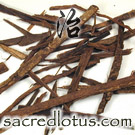 Hou Po30 gAromatic Herbs that Transform and Dissolve Dampness
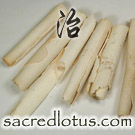 Fu Ling6 gRegulate Water and Drain Dampness
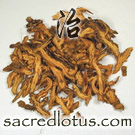 Huang Lian15 gDry-FriedClear Heat and Dry Dampness
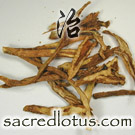 Huang Qin36 gDry-FriedClear Heat and Dry Dampness
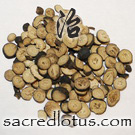 Zhi Shi15 gDry-FriedRegulate the Qi
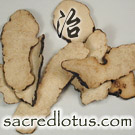 Zhu Ling3 gRegulate Water and Drain Dampness
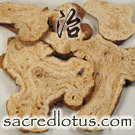 Bai Zhu3 gTonify Qi
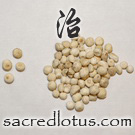 Ban Xia15 gWarm Herbs that Transform Phlegm-Cold
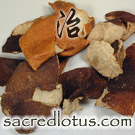 Chen Pi9 gRegulate the Qi
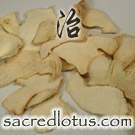 Gan Jiang6 gWarm the Interior and Expel Cold
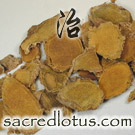 Jiang Huang3 gInvigorate Blood and Remove Stagnation
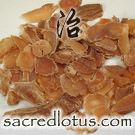 Ren Shen3 gTonify Qi
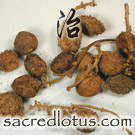 Sha Ren6 gAromatic Herbs that Transform and Dissolve Dampness
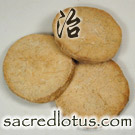 Ze Xie9 gRegulate Water and Drain Dampness
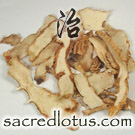 Zhi Mu12 gDry FriedDrain Fire
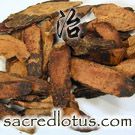 Zhi Gan Cao3 gTonify Qi
Preparation & dosage
How is Zhong Man Fen Xiao Wan prepared?
Traditionally the herbs are ground to a fine powder and formed into pills (wan), consistent with its name, and taken with warm water rather than decocted whole — though modern practice sometimes prepares it as a decoction.
Source: Bensky & Barolet, Formulas & Strategies, cross-referenced against multiple online sources. Reference only; a licensed practitioner should direct actual preparation and dosing.
Reference relative amounts (as pills or decoction): Huang Qin 36 g (dry-fried); Hou Po 30 g (ginger-fried); Zhi Shi, Huang Lian, Ban Xia 15 g each (Zhi Shi and Huang Lian dry-fried); Zhi Mu 12 g (dry-fried); Chen Pi 9 g; Ze Xie 9 g; Gan Jiang, Sha Ren, Fu Ling 6 g each; Jiang Huang, Zhu Ling, Bai Zhu, Ren Shen, Zhi Gan Cao 3 g each. As a pill, traditionally 6-9 g taken 2-3 times daily with warm water. Reference only.
Safety — read before use
What are the cautions for Zhong Man Fen Xiao Wan?
Zhong Man Fen Xiao Wan is built specifically for distention due to damp-heat and should not be used, without modification, for distention due to cold. It is a strong, complex formula combining substantial doses of bitter-cold herbs (Huang Qin, Huang Lian) with warming, drying herbs and tonics — appropriate only when the damp-heat, Spleen-deficiency picture is clearly present.
- Not for cold-type or pure-deficiency distention: using it without modification where damp-heat is absent risks further injuring Spleen yang.
- Pregnancy: contains Zhi Shi and Ban Xia; use only under professional guidance.
- Complexity: sixteen ingredients at substantial doses (e.g. Huang Qin up to 36 g) — this is a professionally dosed and monitored formula, not a self-prescribed remedy, particularly where ascites or liver disease is suspected.
Source: Bensky & Barolet, Formulas & Strategies, cross-referenced against multiple online sources. Traditional-use framing; not medical advice.
Originally Appeared In:
- Secrets from the Orchid Chamber (Lan Shi Mi Cang)
Notes:
How does Zhong Man Fen Xiao Wan relate to other formulas?
Zhong Man Fen Xiao Wan layers several classical strategies rather than modifying a single base formula. Its qi-moving pair (Hou Po, Zhi Shi) recalls Zhi Shi Dao Zhi Wan’s approach to stubborn digestive stagnation; its diuretic trio (Fu Ling, Zhu Ling, Ze Xie) echoes Wu Ling San’s damp-draining strategy; and its Ren Shen/Bai Zhu/Zhi Gan Cao core echoes Si Jun Zi Tang’s Spleen-qi support — combined here with substantial Huang Qin and Huang Lian to clear damp-heat.
Distinct from “Zhong Man Fen Xiao Tang” (a decoction that shares part of the name but is composed and indicated differently, reportedly for hernial/cold-type disorders) — the two are easy to confuse by name alone and should not be substituted for one another.
Source: Bensky & Barolet, Formulas & Strategies (formula-family comparisons) + multiple online sources (Zhong Man Fen Xiao Tang distinction).
Clinical Studies & Research:
Is there modern research on Zhong Man Fen Xiao Wan?
No dedicated modern research on this formula was located. Repeated PubMed searches — using the pinyin name, common transliteration variants, and the original Chinese characters (中滿分消丸) — returned no clinical trials, network-pharmacology, or mechanistic studies of Zhong Man Fen Xiao Wan as a whole formula. Broader web searches for adjacent research (e.g. on its traditionally associated use for cirrhotic ascites) likewise turned up no study naming this specific formula.
Sources: PubMed searches (no results); general web search (no results). Per site content policy, no citations are given because none could be verified — absence of research is reported honestly rather than inferred or fabricated.
Sources & References
Compiled and edited by Thomas Dehli, Founder & Editor, Sacred Lotus Updated
The information here is referenced from numerous sources — teachers, practitioners, class notes from Five Branches University, the books below, and the published research literature, with citations given as resolvable PubMed identifiers. Where sources disagree, I have flagged the discrepancies directly. If facts couldn't be verified, I have left them out. How we source our content.
Reference information for students and practitioners — not medical advice. Consult a qualified practitioner. Terms of use.
Chinese Formulas Books & References
 https://amzn.to/4fYI3f8
 https://amzn.to/4j55NRA
 https://amzn.to/4gMROyv
 https://amzn.to/4h7msSK