

Zhu Ling (Polyporus Sclerotium)
Sclerotium Polypori Umbellati Polyporus Sclerotium
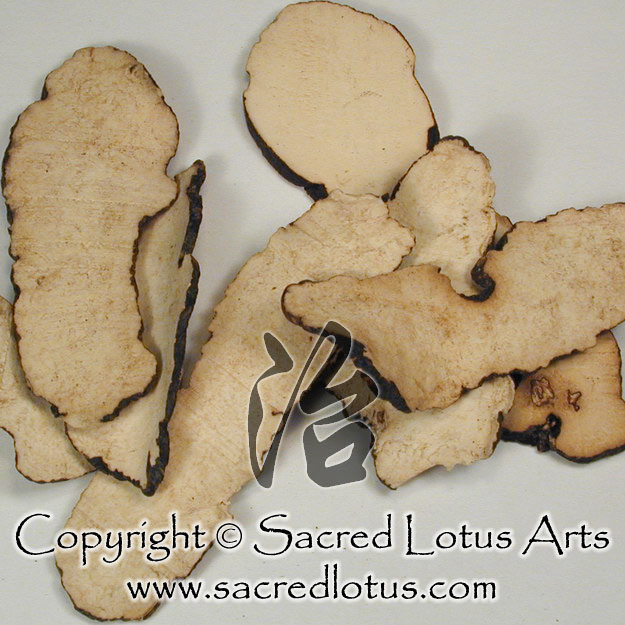
Materia Medica Data
- Temperature
- Cool, Neutral
- Nature & Flavour
- Sweet, Bland, Cool (or Neutral)
- Channels Entered
- SP, KI, BL
- Latin (pharmaceutical)
- Sclerotium Polypori Umbellati
- Chinese
- 猪苓
- Tone Marks
- zhū líng
Chinese Herb Actions
What is Zhu Ling used for in Chinese medicine?
Zhu Ling (Polyporus umbellatus sclerotium) promotes urination and leaches out dampness — it is a plain, sweet-bland diuretic herb used for edema, scanty urine, diarrhea from damp, difficult or painful urination, turbid discharge, and jaundice. Unlike many damp-draining herbs it has essentially no other action — it does one job, strongly.
- Promotes urination, drains dampness — edema and scanty, difficult urination from water accumulation.
- Treats damp-heat urinary/genital patterns — turbid, painful urination, leucorrhea, and spermatorrhea associated with damp-heat in the lower burner.
- Resolves damp underlying jaundice — used as part of formulas addressing damp-related jaundice.
Source: Sacred Lotus sources & references; cross-referenced against multiple online sources and Bensky, Materia Medica (3rd ed.).
Chinese Herb Dosage
What is the typical dosage of Zhu Ling?
Roughly 5–12 g in decoction — Chen & Chen give 5–10 g, while Bensky lists 6–12 g; both ranges are standard and largely overlapping. Zhu Ling is used raw (unprocessed) and decocted along with the other herbs in a formula.
Source: Sacred Lotus sources & references (existing dosage data); cross-referenced against Bensky, Materia Medica (3rd ed.) and Chen & Chen, Chinese Medical Herbology and Pharmacology. Reference only, not a prescription.
Chinese Herb Contraindications & Cautions
Are there cautions for Zhu Ling?
Zhu Ling should only be used where damp is actually present — because it has no tonifying action, long-term or excessive use can be draining and drying, depleting fluids rather than helping. It is contraindicated for dizziness or other patterns arising from yin deficiency without damp, since it will aggravate fluid loss.
- Use only in cases with damp — not indicated for dry or purely deficient presentations.
- Avoid in yin-deficiency dizziness without a damp component.
- Long-term use — can be excessively draining and drying; not intended for extended, unsupervised use.
Source: Sacred Lotus sources & references; cross-referenced against multiple online sources. Reference only, not medical advice.
Chinese Herb Toxicity & Overdose
Low. No significant toxicity is reported at standard decoction doses; Zhu Ling has a long history of dietary and medicinal use as a fungal sclerotium. The main documented caution is functional (over-draining fluids with prolonged use), not a toxic reaction.
Source: Sacred Lotus sources & references; materia medica consensus (Bensky, Chen & Chen).
Herb-Drug Interactions
No well-established clinical herb–drug interactions are documented. Because Zhu Ling is a diuretic, practitioner awareness is reasonable for patients concurrently taking prescribed diuretics or other agents affecting fluid/electrolyte balance — this is a precautionary, common-sense note rather than a demonstrated interaction.
Western / Biomedical Research
Chinese Herb Clinical Studies & Research
Provided as research context — a summary of published biomedical study, not a therapeutic or medical claim.
Is there modern research on Zhu Ling (Polyporus umbellatus)?
Yes — extensive preclinical research, but evidence remains largely at the cell-culture and animal-model stage. A comprehensive 2013 pharmacology review found diuretic, nephroprotective, anti-cancer, immune-enhancing, hepatoprotective, anti-inflammatory, and antioxidative activities reported across studies, mostly using crude polysaccharide or ergosterol-type extracts in animal models.
- Diuretic/nephroprotective (preclinical) — animal studies support the traditional water-draining action and investigate kidney-protective effects of Polyporus extracts; the review notes most work used poorly characterized crude extracts and calls for better-controlled and clinical studies.
- Anticancer (preclinical) — cell and animal studies report that Polyporus umbellatus polysaccharide can inhibit tumor cell proliferation and promote apoptosis in breast cancer models by down-regulating AKT signaling, and an iron-based polysaccharide nanocomposite has been investigated for combinational anti-breast-cancer therapy via macrophage polarization; these are laboratory/animal findings, not clinical proof.
- Immune-enhancing and hepatoprotective (preclinical/traditional-use review) — reviews describe immuno-enhancing, anti-tumor, anti-inflammatory, and hepatoprotective activity associated with Polyporus umbellatus polysaccharide, drawing partly on its traditional use for hepatitis-type presentations in China; controlled human trial data are not established in these reviews.
No robust human clinical trial evidence was identified confirming these effects in people; current support is preclinical/laboratory. Treat as research context only.
Sources: PMID 23811047 (Zhao, J Ethnopharmacol 2013, comprehensive pharmacology review); PMID 34419536 (polysaccharide extraction/bioactivity review, Int J Biol Macromol 2021); PMID 27447121 (AKT-mediated antitumor effect in breast cancer models, Biomed Pharmacother 2016); PMID 37586629 (polysaccharide-iron nanocomposite, anti-breast-cancer, Int J Biol Macromol 2023). Research context, not a therapeutic claim.
Chinese Herb Notes
How is Zhu Ling different from Fu Ling? What formulas is it in?
Zhu Ling is a stronger diuretic than Fu Ling but, unlike Fu Ling, has no tonifying action at all — this contrast is the key teaching point distinguishing the two most common damp-draining fungi in the materia medica.
- Zhu Ling (Polyporus) — promotes urination more strongly than Fu Ling, but does not tonify the Spleen or calm the spirit; it is a "pure drainer" with no deficiency-supporting action, so it is not used where Spleen qi or Heart-spirit support is also needed.
- Fu Ling (Poria) — a gentler diuretic, but it also tonifies the Spleen and calms the spirit (Shen), making it useful in deficiency patterns where Zhu Ling is not.
- Zhu Ling vs. Ze Xie — Zhu Ling promotes urination more strongly than Ze Xie but cannot drain blazing ministerial (Kidney) fire the way Ze Xie can; both are used for spermatorrhea, but Zhu Ling addresses damp-heat in the lower burner while Ze Xie addresses disturbed essence from blazing ministerial fire.
Key formulas: Zhu Ling is a core herb in Wu Ling San (Five-Ingredient Powder with Poria, with Fu Ling, Bai Zhu, Ze Xie, and Gui Zhi) for water accumulation with Bladder qi-transformation failure, and gives its name to Zhu Ling Tang (Polyporus Decoction, with Fu Ling, Ze Xie, Hua Shi, and E Jiao) for water-heat interlocking with yin deficiency — painful urinary dysfunction with concurrent thirst or insomnia. (Traditional formula context, not treatment advice.)
Source: Sacred Lotus sources & references; cross-referenced against multiple online sources and Bensky, Materia Medica (3rd ed.).
Sources & References
Compiled and edited by Thomas Dehli, Founder & Editor, Sacred Lotus Updated
The information here is referenced from numerous sources — teachers, practitioners, class notes from Five Branches University, the books below, and the published research literature, with citations given as resolvable PubMed identifiers. Where sources disagree, I have flagged the discrepancies directly. If facts couldn't be verified, I have left them out. How we source our content.
Reference information for students and practitioners — not medical advice. Consult a qualified practitioner. Terms of use.
Chinese Herbs Books & References
 https://amzn.to/3WfB3DK
 https://amzn.to/3DR1VUh
 https://amzn.to/42aMz73
 https://amzn.to/3PuD4bt