
Wu Ling San
Five Ingredient Powder with Poria
- Category
- Formulas that Expel Dampness
- Ingredients
- 5 herbs
Actions
What does Wu Ling San do?
Wu Ling San promotes urination and drains water-dampness, strengthens the Spleen, and warms Yang Qi to restore the Bladder's power of qi transformation. It is the classic Shang Han Lun formula for "water-amassment" (shui ni) — fluid that pools in the lower body while the upper body is deprived of it — and it acts on both the water itself and the mechanism that failed to move it.
- Promotes urination, drains accumulated water-dampness: Ze Xie (heaviest dose, generally regarded as chief) directs excess fluid out through the urine; Fu Ling and Zhu Ling assist as deputies with the same downward, draining action.
- Strengthens the Spleen to control water at its source: Bai Zhu dries dampness and supports the Spleen's role in transforming and transporting fluids, so accumulation is less likely to recur.
- Warms Bladder Yang and restores qi transformation, while opening the exterior: Gui Zhi serves as the formula's envoy, giving the diuretic herbs the warmth needed to actually move the water and simultaneously dispersing any lingering wind-cold at the surface.
Source: Sacred Lotus sources & references + Bensky & Barolet, Formulas & Strategies (chief/deputy/assistant/envoy analysis). Traditional-use framing; not medical advice.
Indications
What is Wu Ling San used for?
Wu Ling San treats Taiyang water-amassment (shui ni) — failure of the Bladder's qi transformation, usually from unresolved Wind-Cold at the exterior disrupting fluid metabolism, so that water pools below while the body above is starved of fluid.
- Water-amassment with lingering exterior signs: scanty or difficult urination, mild fever or aversion to wind-cold, headache, and a floating pulse.
- Marked thirst with vomiting of fluids: intense thirst that drives the person to drink, followed by immediate vomiting once water is swallowed — water cannot be "transformed" and is thrown back up.
- General oedema from Spleen-deficient water-dampness: body heaviness, puffy swelling of the limbs or trunk, and possibly loose stools, when the Spleen cannot move fluid normally.
- Internal fluid retention below the umbilicus: a throbbing or pulsing sensation at the lower abdomen, dizziness or vertigo, palpitations, and phlegm-fluid (tan yin) patterns as described in the Jin Gui Yao Lue.
Source: Sacred Lotus sources & references on pattern/tongue/pulse + Bensky & Barolet, Formulas & Strategies; classical presentation per Shang Han Lun / Jin Gui Yao Lue.
Western Uses:
What conditions is Wu Ling San used for in modern practice?
Wu Ling San promotes urination and moves accumulated water (fluid retention with thirst but difficult urination), so it is referenced across a wide range of fluid-accumulation conditions: chronic nephritic oedema, cardiac oedema, ascites from liver cirrhosis, urinary retention, scrotal hydrocele, acute gastritis and enteritis, gastric dilation (gastrectasis), Ménière's disease, and neurogenic bladder.
It is chosen for the water-accumulation pattern, not for a diagnosis. Oedema and ascites can signal serious heart, kidney or liver disease and always require medical assessment; urinary retention is an emergency. This formula is a traditional adjunct, not a substitute. Traditional-use correlates only, not a treatment claim.
Source: Sacred Lotus sources & references (pattern) + Bensky & Barolet, Formulas & Strategies; biomedical correlates as reference only. Not medical advice.
Ingredients
5 substances in Wu Ling San — each links to its full herb monograph.
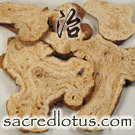 Bai Zhu2.3 gTonify Qi
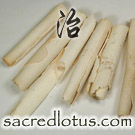 Fu Ling2.3 gRegulate Water and Drain Dampness
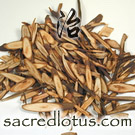 Gui Zhi1.5 gWarm, Spicy Herbs that Release the Exterior
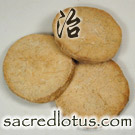 Ze Xie4 gRegulate Water and Drain Dampness
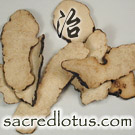 Zhu Ling2.3 gRegulate Water and Drain Dampness
Preparation & dosage
How is Wu Ling San prepared and taken?
Classically Wu Ling San is a true powder (san): the five herbs are ground fine and taken by the spoonful in warm water, several times a day, rather than decocted — the name itself means "five-ingredient powder."
- Classical dosing: historically about one "square-inch spoon" (roughly 6–9 g of the mixed powder) stirred into warm water, taken three times daily.
- Classical instruction to induce sweating: the Shang Han Lun directs the patient to drink plenty of additional warm water after taking the powder, until a mild sweat breaks — "duo yin nuan shui, han chu yu chai." The extra warm water is deliberate: it helps expel the lingering exterior Wind-Cold via sweating at the same time the powder resolves the interior water-accumulation, so exterior and interior are treated in one step.
- Modern adaptation: the formula is now commonly given as a water decoction of the same five herbs at proportionally larger gram weights, cooked relatively briefly, when a powder is impractical — a pragmatic substitution rather than a change to the classical method.
Source: classical method per Shang Han Lun (Zhang Zhongjing), as summarized in Bensky & Barolet, Formulas & Strategies. Reference only; not administration guidance.
Safety — read before use
What are the cautions for Wu Ling San?
Wu Ling San is a warming, drying, and strongly diuretic formula, so it is unsuitable when urinary difficulty or thirst stems from Yin or fluid deficiency rather than water-accumulation. Using it in that setting would drain fluids further and aggravate dryness.
- Avoid in Yin/fluid-deficient dysuria: scanty urination with signs of dryness, night sweats, or a red, peeled tongue points away from this formula toward a Yin-nourishing approach instead.
- Not for prolonged, unsupervised use: its diuretic action can deplete Qi and fluids over time if continued longer than the underlying water-accumulation requires, particularly in an already Qi-deficient patient.
- No restricted or toxic ingredients: all five herbs (Ze Xie, Fu Ling, Zhu Ling, Bai Zhu, Gui Zhi) are standard, unrestricted materials — unlike formulas built on aconite, ephedra, or cinnabar, Wu Ling San carries no special toxicity flag; ordinary sourcing/quality precautions still apply.
Source: Bensky & Barolet, Formulas & Strategies (cautions for warming diuretic formulas); Sacred Lotus sources & references confirms no toxic/restricted ingredient is present. Traditional-use framing; not medical advice.
Originally Appeared In:
- On Cold Damage (Shang Han Lun)
Notes:
How does Wu Ling San differ from Zhu Ling Tang and Wei Ling Tang?
Wu Ling San, Zhu Ling Tang, and Wei Ling Tang all drain water-dampness through Ze Xie, Fu Ling, and Zhu Ling, but they diverge on temperature and the pattern they were built for. Choosing between them depends on whether cold or heat, exterior signs, or middle-jiao dampness dominates the presentation.
- vs Zhu Ling Tang: Zhu Ling Tang (also from the Shang Han Lun) removes Gui Zhi and Bai Zhu and adds E Jiao and Hua Shi. That swap changes the whole strategy — from Wu Ling San's warming restoration of Bladder qi transformation to a cooling, Yin-nourishing, hemostatic approach for water-accumulation complicated by heat and Yin damage: dysuria with blood in the urine, thirst, and restlessness or insomnia, without the ext Wind-Cold signs Wu Ling San addresses.
- vs Wei Ling Tang: Wei Ling Tang is Wu Ling San combined with Ping Wei San (Cang Zhu, Hou Po, Chen Pi, Zhi Gan Cao). Adding Ping Wei San's dampness-drying, qi-moving herbs shifts the emphasis toward the middle jiao — it is favored for damp-predominant diarrhea or dysentery with abdominal distention and a thick, greasy tongue coat, where digestive dampness is more prominent than the thirst/oedema picture Wu Ling San alone treats.
- Related formula: Si Ling San is simply Wu Ling San with Gui Zhi removed, used for damp-heat dysuria once there is no cold or exterior component left to address.
Classical source: Wu Ling San originates in Zhang Zhongjing's Shang Han Lun (Treatise on Cold Damage, c. early 3rd century), where it is given for Taiyang water-amassment, and it reappears in his Jin Gui Yao Lue for phlegm-fluid (tan yin) patterns such as dizziness and palpitations from fluid retention.
Source: Bensky & Barolet, Formulas & Strategies (Zhu Ling Tang and Wei Ling Tang composition and comparison); classical attribution per Shang Han Lun / Jin Gui Yao Lue.
Clinical Studies & Research:
Is there modern research on Wu Ling San?
Yes — mostly preclinical mechanistic studies on its diuretic and renal-protective action, plus early-stage clinical trial work, none of which establishes it as a treatment for any diagnosed disease. Laboratory studies consistently link the formula's traditional "water-draining" action to modulation of renal aquaporin water channels and inflammatory signaling.
- Hyperuricemia (preclinical): network-pharmacology and animal work found Wu Ling San lowered serum uric acid via antioxidant and anti-inflammatory pathways (PMID 36911073), and a separate mouse study showed it protected kidney function in fructose-induced hyperuricemia by suppressing renal TLR4/MyD88 signaling and NLRP3 inflammasome activation (PMID 25914040).
- Aquaporin regulation (preclinical): in adriamycin-induced nephropathy, the formula differentially regulated aquaporin-2 expression in kidney versus intestinal tissue, a proposed mechanistic basis for its combined diuretic and anti-diarrheal traditional uses (PMID 35068345).
- Breast-cancer-related lymphoedema (clinical, protocol stage): a multicentre, double-blind, placebo-controlled pilot trial protocol was registered and published to test Wu Ling San for upper-extremity lymphoedema after breast cancer treatment; this is a study design paper, not yet reported efficacy results (PMID 27986736).
Sources: PubMed 36911073; PubMed 25914040; PubMed 35068345; PubMed 27986736 (trial protocol). Research context on the formula's traditional water-draining action, not a therapeutic claim.
Sources & References
Compiled and edited by Thomas Dehli, Founder & Editor, Sacred Lotus Updated
The information here is referenced from numerous sources — teachers, practitioners, class notes from Five Branches University, the books below, and the published research literature, with citations given as resolvable PubMed identifiers. Where sources disagree, I have flagged the discrepancies directly. If facts couldn't be verified, I have left them out. How we source our content.
Reference information for students and practitioners — not medical advice. Consult a qualified practitioner. Terms of use.
Chinese Formulas Books & References
 https://amzn.to/4fYI3f8
 https://amzn.to/4j55NRA
 https://amzn.to/4gMROyv
 https://amzn.to/4h7msSK