
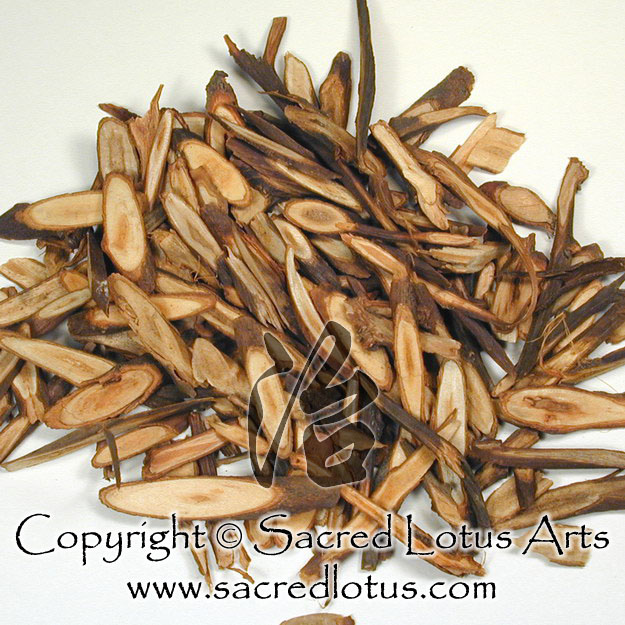
Ramulus Cinnamomi Cassiae Cinnamon Twig, Cassia Twig
Materia Medica Data
- Temperature
- Warm
- Nature & Flavour
- Spicy, Sweet, Warm
- Channels Entered
- HT, LU, BL
- Latin (pharmaceutical)
- Ramulus Cinnamomi Cassiae
- Chinese
- 桂枝
- Tone Marks
- guì zhī
Chinese Herb Actions
What is Gui Zhi (Cinnamon Twig) used for in Chinese medicine?
Gui Zhi is a spicy, sweet, warm herb used to release the exterior in wind-cold, warm and unblock the channels and collaterals, unblock the Yang qi of the chest, and promote blood circulation — entering the Heart, Lung, and Bladder channels. It is one of the most widely combined herbs in the formulary, pairing with almost every category of herb.
Its main traditional actions:
- Releases the exterior / adjusts the Ying (nutritive) and Wei (defensive) levels — for Wind-Cold, especially from an underlying deficiency, when sweating alone does not relieve the condition.
- Warms the channels and collaterals — for Wind-Cold-Damp Bi (painful obstruction) syndrome and arthritic complaints, especially of the shoulders; and for cold obstructing the free flow of Blood in dysmenorrhea and other gynecological conditions.
- Unblocks the Yang qi of the chest — for chest pain, palpitations, edema, dysuria (difficult urination), and abdominal fullness tied to Yang/fluid stagnation.
- Promotes blood circulation — for amenorrhea, dysmenorrhea, angina-pectoris-type chest pain, and abdominal masses from Blood stasis.
Source: Sacred Lotus reference content, cross-checked against Bensky & Barolet, Chinese Herbal Medicine: Materia Medica (3rd ed.) and Chen & Chen, Chinese Medical Herbology and Pharmacology. Traditional-use framing; not medical advice.
Chinese Herb Dosage
What is the typical dosage of Gui Zhi?
Roughly 3–9 g in decoction, up to 9–15 g for Bi (painful obstruction) patterns. The lower range (3–9 g) is used for externally-contracted Wind-Cold; the higher range (9–15 g) is used when the goal is stronger warming/unblocking of the channels, as in Bi-type joint pain. The part used is the young twig (ramulus) of the cinnamon tree, not the bark — see the comparison with Rou Gui below.
Source: Sacred Lotus reference content; standard materia medica dosage ranges (Bensky & Barolet). Reference only — not a prescription.
Chinese Herb Contraindications & Cautions
Are there cautions for using Gui Zhi?
Caution is traditionally advised in patients with fever, heat from deficiency, heat in the Blood, pregnancy, and heavy or profuse menstruation. As a warming, Blood-moving herb, Gui Zhi can aggravate heat-type patterns and may be too activating where there is a bleeding tendency or excess menstrual flow.
- Heat conditions — avoid or use cautiously with fever, Yin/deficiency heat, or Heat in the Blood (e.g., certain skin/bleeding disorders with a heat component), since its warm nature can add fuel to heat patterns.
- Pregnancy — traditionally used with caution given its warming, Blood-moving action.
- Heavy or profuse menstrual bleeding — caution, as promoting Blood circulation can increase flow.
Source: Sacred Lotus reference content (existing caution field); consistent with Bensky & Barolet and Chen & Chen contraindication notes for warm, exterior-releasing/Blood-moving herbs.
Chinese Herb Toxicity & Overdose
Low toxicity is reported at traditional decoction doses. A 2020 pharmacology/phytochemistry/toxicology review of Cinnamomi ramulus reports that acute-toxicity testing in mice found no toxicity at 10 g/kg body weight, and a 30-day repeated-dose feeding study in rats found no toxicity at 5, 2.5, or 1.25 g/kg body weight — doses far above typical human decoction use — concluding that, based on available pharmacodynamic and pharmacokinetic data, Cinnamomi ramulus appears safe at studied doses. This is animal toxicology data, not a human safety guarantee, and does not apply to concentrated extracts or essential-oil products, which were not the basis of these dose figures.
Source: PMID 31750548, DOI 10.1111/jphp.13189 (Liu et al., “The traditional uses, phytochemistry, pharmacology and toxicology of Cinnamomi ramulus: a review,” Journal of Pharmacy and Pharmacology, 2020). Reference note, not a safety guarantee.
Herb-Drug Interactions
No well-established clinical herb–drug interactions specific to Gui Zhi (the twig, used in decoction) are documented. Cinnamon species as a group contain coumarin-class compounds, and consumer-health sources describe case reports of cassia-cinnamon bark/supplement use (a much higher-coumarin, higher-dose product than a TCM twig decoction) potentiating bleeding risk in patients on warfarin or other anticoagulants. Given Gui Zhi’s own traditional Blood-moving action, practitioner awareness is reasonable for patients on anticoagulant or antiplatelet therapy — this is a precautionary flag carried over from the broader cinnamon literature, not a documented clinical interaction for Gui Zhi itself. (Flagged for practitioner confirmation.)
Western / Biomedical Research
Chinese Herb Clinical Studies & Research
Provided as research context — a summary of published biomedical study, not a therapeutic or medical claim.
Is there modern research on Gui Zhi (Ramulus Cinnamomi)?
Yes — a substantial phytochemistry/pharmacology literature, though almost entirely preclinical (cell, animal, and network-pharmacology studies) rather than clinical trials on the herb itself. A comprehensive 2020 review catalogued more than 121 isolated compounds (volatile oil, cinnamaldehyde and related aldehydes, organic acids, coumarins, flavonoids, triterpenoid saponins) and summarized reported antibacterial, anti-inflammatory, antipyretic, and antiviral activity.
- Traditional-use/pharmacology/toxicology review — the most complete single source, covering botany, phytochemistry, pharmacology, pharmacokinetics, and toxicology of Cinnamomi ramulus; see the Toxicity section above for its specific safety-testing data. Preclinical/review, not a clinical trial.
- Network pharmacology – ankylosing spondylitis — identified cinnamaldehyde, 2-methoxycinnamaldehyde, and 2-hydroxycinnamaldehyde as Cinnamomi ramulus’s major active compounds and PTGS2, MMP9, and TLR4 as core targets, with immunohistochemistry on patient tissue supporting elevated target expression versus controls; proposed mechanism involves IL-17/TNF/NF-κB/Toll-like-receptor signaling. Mechanistic/exploratory, not a clinical outcome study.
- Network pharmacology – Gui Zhi–Bai Shao (Ramulus Cinnamomi–Paeonia lactiflora) herb pair — modeled 15 active compounds against 130 potential targets for chronic pain with comorbid anxiety and depression, converging on 9 shared targets (including Akt1, IL6, TNF, PTGS2) across 11 pathways spanning inflammation, immune modulation, and neurotransmission. Computational/predictive, not a clinical trial.
- Anticancer, in vitro — Cinnamomi ramulus inhibited growth across ten human cancer cell lines (including A549 lung, HepG2 liver, HeLa cervical) by inducing G2/M cell-cycle arrest via suppression of the PLK1/CDK1/Cyclin B axis. Cell-culture study only; no animal or human data.
Overall: consistent preclinical signal for anti-inflammatory, antimicrobial, and cell-cycle-related activity across multiple independent groups, but no clinical trials of Gui Zhi itself were located — treat all of the above as mechanistic/laboratory context, not evidence of clinical efficacy.
Sources: PMID 31750548, DOI 10.1111/jphp.13189 (review); PMC 10836281, PMID 38019769 (ankylosing spondylitis network pharmacology); PMC 8812742, PMID 35098831, DOI 10.1080/07853890.2022.2031268 (Gui Zhi–Bai Shao herb-pair network pharmacology); PMC 10063822, PMID 37007025, DOI 10.3389/fphar.2023.1121799 (in vitro anticancer). Research context, not a therapeutic claim.
Chinese Herb Notes
What is the difference between Gui Zhi (cinnamon twig) and Rou Gui (cinnamon bark)?
Both come from the same tree, Cinnamomum cassia, but are different plant parts with different properties and uses — they are not interchangeable. Gui Zhi (桂枝) is the dried young twig (Ramulus Cinnamomi Cassiae): spicy, sweet, and only warm, entering the Heart, Lung, and Bladder channels. It is light and moves upward and outward, so it excels at releasing the exterior and warming the channels of the upper body and limbs. Rou Gui (肉桂) is the dried inner bark (Cortex Cinnamomi Cassiae): spicy, sweet, and hot, entering the Heart, Kidney, Liver, and Spleen channels. It is heavy and moves downward and inward, so it excels at powerfully tonifying Kidney Yang (Mingmen fire), warming the deep interior, and leading floating Yang back to its source. In short: Gui Zhi treats the surface/limbs/upper body and mild channel-warming; Rou Gui treats deep Kidney-Yang deficiency and interior cold. The Sacred Lotus database lists them as two separate herbs for this reason.
Key formula combinations (traditional formula context, not treatment advice):
- Gui Zhi Tang (with Bai Shao, Sheng Jiang, Da Zao, Zhi Gan Cao) — the classic pairing for Wind-Cold with sweating, from a Wei-level deficiency; the template for “adjusting Ying and Wei.”
- Ma Huang Tang (with Ma Huang, Xing Ren, Zhi Gan Cao) — Wind-Cold without sweating, where Gui Zhi assists Ma Huang in releasing the exterior.
- Xiao Qing Long Tang and Ling Gui Zhu Gan Tang — warming the Yang to transform thin mucus/phlegm-fluid (cough/wheeze; dizziness and palpitations from fluid retention).
- Wen Jing Tang — warms the menses and moves Blood for cold-type gynecological/menstrual disorders.
- Zhi Gan Cao Tang and Gui Zhi Jia Long Gu Mu Li Tang — unblocking chest Yang qi for palpitations/irregular pulse and for anchoring floating Yang.
- Dang Gui Si Ni Tang and Xiao Jian Zhong Tang — warming and nourishing Blood for frigid extremities and warming the middle for deficiency-cold abdominal pain.
- Also appears in Wu Ling San, Ge Gen Tang, Gui Zhi Fu Ling Wan, Gui Zhi Shao Yao Zhi Mu Tang, Jin Gui Shen Qi Wan, Tao He Cheng Qi Tang, Wu Mei Wan, and Zai Zao San — reflecting how broadly it combines across categories (exterior-releasing, blood-moving, Yang-warming, and fluid-transforming formulas alike).
Source: Sacred Lotus herb/formula identity fields (Sacred Lotus); Bensky & Barolet and Chen & Chen materia medica for the Gui Zhi/Rou Gui comparison.
Sources & References
Compiled and edited by Thomas Dehli, Founder & Editor, Sacred Lotus Updated
The information here is referenced from numerous sources — teachers, practitioners, class notes from Five Branches University, the books below, and the published research literature, with citations given as resolvable PubMed identifiers. Where sources disagree, I have flagged the discrepancies directly. If facts couldn't be verified, I have left them out. How we source our content.
Reference information for students and practitioners — not medical advice. Consult a qualified practitioner. Terms of use.
Chinese Herbs Books & References
 https://amzn.to/3WfB3DK
 https://amzn.to/3DR1VUh
 https://amzn.to/42aMz73
 https://amzn.to/3PuD4bt