
Radix et Rhizoma Ligustici Chinensis Straw Weed, Chinese Lovage Root
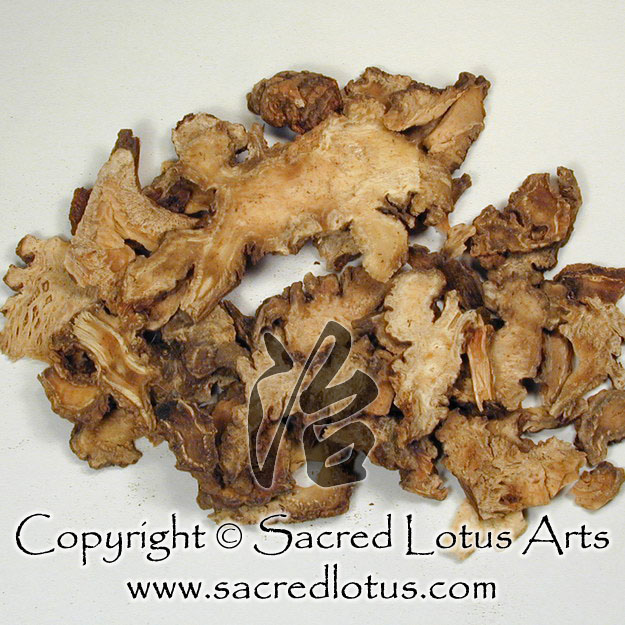
Materia Medica Data
- Temperature
- Warm
- Nature & Flavour
- Spicy, Warm
- Channels Entered
- BL
- Latin (pharmaceutical)
- Radix et Rhizoma Ligustici Chinensis
- Chinese
- 藁本
- Tone Marks
- găo bĕn
- Translation
- Ligusticum root
Chinese Herb Actions
What is Gao Ben used for in Chinese medicine?
Gao Ben (Ligusticum sinense, Straw Weed / Chinese Lovage Root) is traditionally used to release Wind-Cold from the exterior and stop pain, and it is the classic channel-guiding herb for headache at the very top (vertex) of the head. Its acrid, warm nature carries it upward along the Governing Vessel (Du Mai), which is why it is singled out for vertex headache and headache that radiates from the crown down to the vertex, forehead, or teeth.
Its main traditional actions:
- Releases the exterior and disperses Wind-Cold — for Wind-Cold invasion with headache, chills, and body aches.
- Stops vertex/top-of-head headache — the signature indication; also used where pain extends to the cheeks and teeth, and for Wind-Cold-Damp headache generally.
- Expels Wind-Damp and relieves pain — for Bi (painful obstruction) patterns with joint pain, and for cold, cramping abdominal pain.
- Treats both ends of the Governing Vessel (Du Mai) — because the Du Mai runs from the lower back up over the crown of the head, Gao Ben is traditionally used for both vertex headache and acute lower-back pain arising from an exterior Wind-Cold invasion.
Source: Sacred Lotus sources & references, cross-referenced against multiple online sources and materia medica consensus (Bensky & Barolet; Chen & Chen).
Chinese Herb Dosage
What is the typical dosage of Gao Ben?
Roughly 3–9 g in decoction, consistent with standard materia medica ranges for this herb. The part used is the dried root and rhizome (Radix et Rhizoma Ligustici Chinensis).
Source: Sacred Lotus sources & references; standard materia medica dosage ranges. Reference only — not a prescription.
Chinese Herb Contraindications & Cautions
Are there cautions for Gao Ben?
Gao Ben is notably drying — caution is advised in patients with Yin or Blood deficiency, where its warm, acrid, drying nature can aggravate dryness-related symptoms. As with other exterior-releasing herbs, it is not intended for headache due to internal causes (such as Yin- or Blood-deficient headache) rather than an external Wind-Cold/Damp invasion.
Source: Sacred Lotus sources & references, cross-referenced against multiple online sources and materia medica consensus.
Chinese Herb Toxicity & Overdose
Low at standard decoction doses. Gao Ben's action comes largely from its volatile (essential) oil; materia medica sources do not report significant toxicity within normal dosage ranges, though, like other volatile-oil-rich acrid herbs, excess or prolonged use can be unnecessarily drying rather than acutely toxic.
Source: materia medica consensus; cross-referenced against multiple online sources. Reference note, not a safety guarantee.
Western / Biomedical Research
Chinese Herb Clinical Studies & Research
Provided as research context — a summary of published biomedical study, not a therapeutic or medical claim.
Is there modern research on Gao Ben (Ligusticum sinense)?
Yes — mostly preclinical phytochemistry and pharmacology, with no clinical trials specific to Gao Ben's traditional headache use. A 2024 comprehensive review of Ligustici Rhizoma et Radix (the shared pharmacopoeial name covering Ligusticum sinense Oliv. and the related L. jeholense) catalogued around 190 constituents — chiefly phthalides, phenylpropanoids, flavonoids, and volatile oil — and summarized reported anti-inflammatory, analgesic, antioxidant, antibacterial, and vasodilatory activity across cell and animal studies.
- Anti-inflammatory phthalides (preclinical) — dimeric phthalide compounds newly isolated from Ligusticum sinense Oliv. rhizomes inhibited nitric-oxide production in lipopolysaccharide-stimulated macrophage cells (an inflammation marker), with the most active compounds in the low-micromolar range; cell-based evidence, not clinical proof.
- Nasal-to-brain delivery (preclinical, unrelated indication) — a nanoemulsion gel carrying Ligusticum sinense volatile oil, given intranasally, improved neurological outcomes and reduced infarct size in a rat model of ischemic stroke, illustrating brain-targeted delivery of the volatile oil; this is stroke-model research, not evidence for the traditional headache indication.
Overall, modern research supports plausible anti-inflammatory and analgesic mechanisms for the volatile-oil/phthalide chemistry shared across Ligusticum species, but does not yet include clinical trials of Gao Ben for headache specifically.
Note: Some phthalide/pharmacology papers in the literature are conducted on "Ligusticum sinense cv. Chuanxiong" (i.e. Chuan Xiong, a distinct cultivar) rather than the straight species used as Gao Ben; care was taken here to cite only studies on Ligusticum sinense Oliv. proper or on the shared Ligustici Rhizoma et Radix pharmacopoeial material, not on Chuan Xiong-specific material.
Sources: PMID 38163554 (Journal of Ethnopharmacology, 2024, comprehensive review of Ligustici Rhizoma et Radix); PMID 33515648 (Fitoterapia, 2021, dimeric phthalides from Ligusticum sinense Oliv., anti-inflammatory NO-inhibition assay); PMID 36364473 (Molecules, 2022, intranasal volatile-oil nanoemulsion, rat ischemic-stroke model). Research context, not a therapeutic claim.
Chinese Herb Notes
How is Gao Ben different from Chuan Xiong?
Both come from the Ligusticum genus and share an acrid, warm, pain-relieving nature, but Gao Ben is a narrower, drier exterior-releasing herb aimed specifically at vertex headache, while Chuan Xiong is a broader blood-invigorating herb used for headache of almost any location and cause. The two are easy to confuse by family resemblance but fill different roles in practice.
- Gao Ben — releases Wind-Cold and stops pain; its headache indication is specific to the vertex (crown) and the Governing Vessel; it does not invigorate the Blood; it is noted as quite drying.
- Chuan Xiong (see the separate Chuan Xiong entry) — invigorates Blood and moves Qi as its primary action, and is used for headache from Wind-Cold, Wind-Heat, Wind-Damp, Blood stasis, or Blood deficiency in almost any location, plus a wide range of gynecological Blood/Qi-stasis patterns.
Formula context: Gao Ben is a supporting/guiding herb in classical Wind-Cold and Wind-Damp headache formulas, typically combined with other acrid, warm exterior-releasing herbs such as Qiang Huo and Fang Feng to reinforce its reach along the Tai Yang channel and vertex. (Traditional formula context, not treatment advice.)
Source: Sacred Lotus sources & references, cross-referenced against multiple online sources and materia medica consensus (Bensky & Barolet; Chen & Chen).
Sources & References
Compiled and edited by Thomas Dehli, Founder & Editor, Sacred Lotus Updated
The information here is referenced from numerous sources — teachers, practitioners, class notes from Five Branches University, the books below, and the published research literature, with citations given as resolvable PubMed identifiers. Where sources disagree, I have flagged the discrepancies directly. If facts couldn't be verified, I have left them out. How we source our content.
Reference information for students and practitioners — not medical advice. Consult a qualified practitioner. Terms of use.
Chinese Herbs Books & References
 https://amzn.to/3WfB3DK
 https://amzn.to/3DR1VUh
 https://amzn.to/42aMz73
 https://amzn.to/3PuD4bt