
Gui Zhi Fu Ling Wan
Cinnamon Twig and Poria Pill
- Category
- Formulas that Invigorate the Blood
- Ingredients
- 5 herbs
Actions
What does Gui Zhi Fu Ling Wan do?
Gui Zhi Fu Ling Wan gently invigorates the blood and dispels blood stasis, gradually breaking up a fixed mass in the lower abdomen while sparing the body’s healthy blood and fluids. It is formulated as a small honey pill rather than a decoction precisely so its action unfolds slowly (see preparation). Five herbs balance moving/breaking against nourishing/harmonizing:
- Chief: Gui Zhi (Ramulus Cinnamomi) — warms and moves the blood and unblocks the vessels, using its warming, opening quality to loosen stasis rather than force it.
- Deputies: Tao Ren (Semen Persicae) and Mu Dan Pi (Cortex Moutan) both strongly invigorate blood and break stasis to dissolve the mass; Mu Dan Pi additionally clears the heat that stagnant blood tends to generate and helps cool the blood to check bleeding.
- Assistant: Bai Shao (Radix Paeoniae Alba) nourishes blood and softens the Liver, tempering the harshness of the blood-breaking herbs so healthy blood is not injured in the process.
- Assistant/Envoy: Fu Ling (Sclerotium Poriae Cocos) strengthens the Spleen, drains dampness, and harmonizes the formula, supporting normal fluid metabolism as the mass resolves.
Source: the Sacred Lotus formula database (composition) cross-referenced against multiple online sources and Bensky & Barolet, Formulas & Strategies (chief/deputy/assistant analysis). Traditional-use framing; not medical advice.
Indications
What is Gui Zhi Fu Ling Wan used for?
Gui Zhi Fu Ling Wan is used for a fixed blood-stasis mass (zheng jia) in the lower abdomen or uterus, classically presenting alongside irregular bleeding and fixed, stabbing pain. In contemporary practice and Japanese Kampo medicine, where it is known as Keishibukuryogan, its traditional pattern is referenced in connection with:
- A firm, non-tender, fixed lower-abdominal or uterine mass with a sensation of fullness or hardness
- Painful, irregular, or prolonged menstrual bleeding with dark, clotted blood
- Amenorrhea or dysmenorrhea attributed to blood stasis
- Chronic lower-abdominal pain of a fixed, stabbing (rather than diffuse) character
Tongue and pulse: a purple tongue body, often with dark or purple spots at the sides, and a choppy pulse (possibly wiry, or slippery specifically when the pattern coexists with pregnancy) — classic signs of blood stasis.
Source: the Jin Gui Yao Lue (classical origin) cross-referenced against multiple online sources and Bensky & Barolet, Formulas & Strategies; tongue/pulse per the Sacred Lotus formula database.
Western Uses:
What conditions is Gui Zhi Fu Ling Wan used for in modern practice?
Gui Zhi Fu Ling Wan gently transforms blood stasis and a fixed lower-abdominal mass (zheng jia), so it is referenced chiefly for gynaecological conditions involving stasis: endometritis and adnexitis (pelvic inflammatory disease), uterine fibroids (hysteromyoma), ovarian cysts, painful periods (dysmenorrhoea), infertility, postpartum bleeding, retained lochia, and irregular menstruation.
It is chosen for the blood-stasis-mass pattern, not for a diagnosis. Pelvic inflammatory disease, fibroids, ovarian cysts, infertility, and postpartum bleeding all require medical/gynaecological diagnosis and care — and postpartum haemorrhage is a life-threatening emergency. This formula is used within, not instead of, that care. Traditional-use correlates only, not a treatment claim.
Source: Sacred Lotus sources & references (pattern) + Bensky & Barolet, Formulas & Strategies; biomedical correlates as reference only. Not medical advice.
Ingredients
5 substances in Gui Zhi Fu Ling Wan — each links to its full herb monograph.
 Gui Zhi9-12 gWarm, Spicy Herbs that Release the Exterior
 Mu Dan Pi9-12 gCool the Blood
 Tao Ren9-12 gInvigorate Blood and Remove Stagnation
 Bai Shao9-15 gTonify Blood
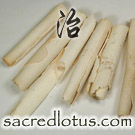 Fu Ling9-12 gRegulate Water and Drain Dampness
Preparation & dosage
How is Gui Zhi Fu Ling Wan prepared, and why as a pill?
Classically the five herbs are ground to a fine powder and formed with honey into small pills, traditionally described as the size of a rabbit dropping, with dosing begun at just one pill a day before meals and increased only gradually (to two or three) if no effect is seen. This is a deliberate, named departure from the faster-acting decoction (tang) form typical of most blood-stasis formulas.
The gradual pill (wan) form matters specifically for this indication: the classical text applies the formula to a case where a pre-existing mass is suspected to coexist with, or be mistaken for, an early pregnancy. A strong, fast-acting decoction able to forcefully break stasis risked disturbing or harming a genuine, viable pregnancy along with the pathological mass; a slow-releasing pill, taken in small and only gradually increased amounts, was understood to let the stasis resolve incrementally while minimizing that risk — the mildness of the form is treated as inseparable from the safety of the indication, not simply a matter of convenience.
In contemporary practice the same five herbs are also decocted as a tang for a stronger, faster effect in non-pregnancy gynecological conditions, and the formula is manufactured as a concentrated Kampo granule/tablet extract (Keishibukuryogan) for standardized dosing.
Source: the Jin Gui Yao Lue (classical pill form and dosing instruction) cross-referenced against multiple online sources; Bensky & Barolet, Formulas & Strategies (rationale for pill vs. decoction). Reference only, not a prescription.
Safety — read before use
What are the cautions for Gui Zhi Fu Ling Wan, especially in pregnancy?
Gui Zhi Fu Ling Wan contains two dedicated blood-breaking herbs, Tao Ren and Mu Dan Pi, and its classical association with pregnancy is specifically about resolving a pathological mass complicating a pregnancy — not a general endorsement of the formula during a normal, wanted pregnancy. The differential diagnosis in the source text (distinguishing a harmful old mass from a healthy fetus) was itself considered a delicate, skilled judgment; contemporary sources are correspondingly cautious.
- Pregnancy: given its blood-invigorating, stasis-breaking ingredients, this formula is generally avoided in normal pregnancy and should only ever be considered, for the specific classical mass-with-bleeding presentation, under the direct supervision of a qualified TCM practitioner — never self-prescribed.
- Not for blood deficiency without stasis: using blood-breaking herbs where there is no true fixed mass or stasis can needlessly deplete healthy blood.
- Heavy or excess bleeding: caution is warranted where bleeding is heavy or from a cause other than blood stasis, since Tao Ren and Mu Dan Pi are moving rather than astringing herbs.
- No cinnabar, aconite, or ephedra-type restricted ingredients are present in this formula; the caution here concerns its blood-moving action and pattern fit, not a toxic ingredient.
Source: the Jin Gui Yao Lue (classical pregnancy context) cross-referenced against multiple online sources; Bensky & Barolet, Formulas & Strategies (cautions for blood-breaking formulas in pregnancy). Traditional-use framing; not medical advice.
Originally Appeared In:
- Essentials from the Golden Cabinet (Jin Gui Yao Lue)
Notes:
What is the classical source of Gui Zhi Fu Ling Wan, and how does it compare to related formulas?
Gui Zhi Fu Ling Wan comes from the Jin Gui Yao Lue (Essentials from the Golden Cabinet), attributed to Zhang Zhongjing (Han dynasty, c. 3rd century CE), in the chapter on diseases of pregnant women — making it one of the earliest recorded formulas specifically for a gynecological blood-stasis mass. Under its Japanese Kampo name, Keishibukuryogan (桂枝舲苶丣), it is among the most extensively studied Kampo formulas for gynecological conditions in Japan (see research).
- vs Tao Hong Si Wu Tang: both use Tao Ren for blood stasis, but Tao Hong Si Wu Tang builds on the richer, more nourishing Si Wu Tang base (adding Hong Hua) for blood stasis with underlying blood deficiency, typically in menstrual irregularity; Gui Zhi Fu Ling Wan is comparatively lighter and more targeted at dissolving a discrete fixed mass, with Fu Ling added for dampness rather than deeper blood nourishment.
- vs Shao Fu Zhu Yu Tang: Shao Fu Zhu Yu Tang is a stronger, warmer blood-invigorating decoction built for cold-based stasis with more pronounced pain, using a larger set of blood-moving and warming herbs; Gui Zhi Fu Ling Wan is the milder, classically pill-dosed formula for a more chronic, established mass.
Common modifications: Yi Yi Ren is sometimes added where dampness is more pronounced; the formula is combined with heat-clearing herbs or formulas when a mass shows clearer heat signs.
Source: the Jin Gui Yao Lue (classical origin) cross-referenced against multiple online sources; Bensky & Barolet, Formulas & Strategies (comparisons and modifications).
Clinical Studies & Research:
Is there modern research on Gui Zhi Fu Ling Wan?
Yes — under its Japanese Kampo name, Keishibukuryogan, this is one of the more heavily researched classical formulas for gynecological conditions, with clinical, systematic-review, and preclinical evidence concentrated on uterine fibroids. Evidence is encouraging but limited in size and rigor, and much of the mechanistic detail comes from animal studies rather than humans.
- Uterine fibroids (clinical, early study): a clinical study of 110 premenopausal patients with uterine myomas treated with Keishi-bukuryo-gan reported improvement in hypermenorrhea and dysmenorrhea in over 90% of cases, with shrinkage of the fibroids in roughly 60% of cases (PMID 1471615).
- Uterine fibroids (clinical, modern RCT): a randomized, double-blind trial comparing low-dose and conventional-dose modified Guizhi Fuling Wan in women with symptomatic uterine fibroids found both doses improved symptom severity, quality of life, and fibroid volume versus baseline over 16 weeks, with no serious adverse events (PMID 34562564).
- Uterine fibroids (preclinical, systematic review): a systematic review of 21 in-vivo animal studies (461 animals) found Guizhi Fuling Wan had potentially beneficial effects over placebo on fibroid characteristics (reduced uterine weight and smooth-muscle thickness) and sex-hormone markers, though results varied by species and model, and the authors called for better-reported future studies (PMID 31445128).
Sources: PubMed 1471615; PubMed 34562564; PubMed 31445128. Research context, not a therapeutic claim; direct high-quality clinical trial evidence remains limited, and pregnancy safety was not studied in these fibroid trials.
Sources & References
Compiled and edited by Thomas Dehli, Founder & Editor, Sacred Lotus Updated
The information here is referenced from numerous sources — teachers, practitioners, class notes from Five Branches University, the books below, and the published research literature, with citations given as resolvable PubMed identifiers. Where sources disagree, I have flagged the discrepancies directly. If facts couldn't be verified, I have left them out. How we source our content.
Reference information for students and practitioners — not medical advice. Consult a qualified practitioner. Terms of use.
Chinese Formulas Books & References
 https://amzn.to/4fYI3f8
 https://amzn.to/4j55NRA
 https://amzn.to/4gMROyv
 https://amzn.to/4h7msSK