

Herba Seu Flos Schizonepetae Tenuifoliae Schizonepeta Bud or Stem
Also known as Jing Jie Sui
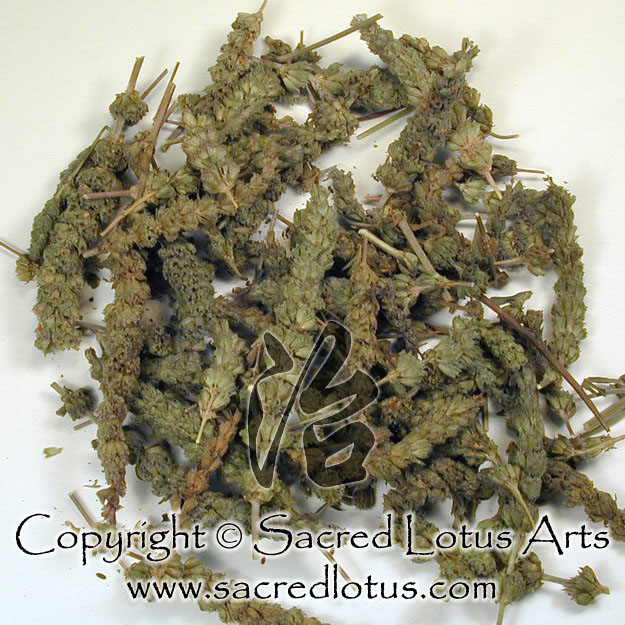
Materia Medica Data
- Temperature
- Slightly Warm
- Nature & Flavour
- Spicy, Aromatic, Slightly Warm
- Channels Entered
- LU, LIV
- Latin (pharmaceutical)
- Herba Seu Flos Schizonepetae Tenuifoliae
- Chinese
- 荆芥
- Tone Marks
- jīng jiè
- Also Known As
- Jing Jie Sui
Chinese Herb Actions
What is Jing Jie used for in Chinese medicine?
Jing Jie (Schizonepeta) gently releases the exterior and expels wind, vents skin eruptions, and — in its charred (carbonized) form — stops bleeding. It is one of the mildest exterior-releasing herbs, spicy and aromatic but only slightly warming, so it is used for both wind-cold and wind-heat presentations and is considered gentle enough to combine into formulas for children, the elderly, or the already-weakened.
Its main traditional actions:
- Releases the exterior and expels wind — for early-stage common cold with headache, chills/fever, and body aches, whether the pattern leans wind-cold or wind-heat (its mild warmth is offset by other herbs in the formula depending on presentation).
- Vents rashes and alleviates itching — a go-to herb for the early, still-erupting stage of measles, urticaria (hives), and other skin eruptions; also used for early-stage boils and sores, particularly with accompanying chills and fever.
- Stops bleeding (charred form, Jing Jie Tan) — carbonized Jing Jie is used for nosebleed (epistaxis), blood in the stool, uterine bleeding, and other bleeding of a more superficial or wind-associated character.
Source: Sacred Lotus sources & references, cross-referenced against multiple online sources and materia medica consensus (Bensky, Chinese Herbal Medicine: Materia Medica, 3rd ed.; Chen & Chen, Chinese Medical Herbology and Pharmacology). Traditional-use framing; not medical advice.
Chinese Herb Dosage
What is the typical dosage of Jing Jie, and how is it prepared?
Typically 3–9 g in decoction, using the dried aerial part — the flowering spike/stem tip (also sold as Jing Jie Sui, the spike alone). A key preparation rule: Jing Jie should not be decocted for more than 10–15 minutes, since its exterior-releasing action depends on volatile aromatic oils that are lost with prolonged boiling; it is usually added toward the end of cooking a decoction.
- Raw (generic use) — used for releasing the exterior and venting rashes, at the standard 3–9 g range.
- Charred / carbonized (Jing Jie Tan) — the herb is stir-fried until scorched black on the outside ("burnt to charcoal") before use specifically to stop bleeding; this processing step changes both its chemistry and its clinical application (see Notes).
Source: Sacred Lotus sources & references; standard materia medica dosage ranges (Bensky; Chen & Chen). Reference only — not a prescription.
Chinese Herb Contraindications & Cautions
Are there cautions for using Jing Jie?
Jing Jie is generally mild and well tolerated, but traditional sources caution against its use in internal Liver-wind conditions (e.g., tremor, convulsion, or dizziness from internal wind rather than an external wind invasion, since Jing Jie is designed to move wind outward, not to settle internal wind). It is also traditionally avoided once measles or sores/boils have already ulcerated or suppurated — its rash-venting action is meant for the early, still-erupting stage, not for open lesions.
- Spontaneous sweating — as with other exterior-releasing herbs, used cautiously in patients who already sweat spontaneously from underlying deficiency.
- Charred form (Jing Jie Tan) — reserved for bleeding presentations; not interchangeable with raw Jing Jie for exterior-releasing purposes.
Source: Sacred Lotus sources & references; materia medica consensus (Bensky; Chen & Chen). Traditional-use caution, not medical advice.
Chinese Herb Toxicity & Overdose
Low. Jing Jie is a mild, commonly used exterior-releasing herb with a long culinary and medicinal history (the fresh leaf is also eaten as a garnish/vegetable in parts of China and Korea) and no significant toxicity reported at standard decoction doses. Its activity is carried largely by volatile essential-oil constituents, which is also why prolonged boiling reduces its effect rather than making it more concentrated.
Source: materia medica consensus; chemical-constituent research (below). Reference note, not a safety guarantee.
Herb-Drug Interactions
No well-established clinical herb–drug interactions are documented for Jing Jie. Because carbonized Jing Jie Tan is used traditionally to stop bleeding, and raw Jing Jie is not, practitioners should be mindful of which form is being used when a patient is on anticoagulant or antiplatelet medication — this is a precautionary distinction based on traditional function, not a demonstrated pharmacological interaction. (Flagged for practitioner confirmation.)
Western / Biomedical Research
Chinese Herb Clinical Studies & Research
Provided as research context — a summary of published biomedical study, not a therapeutic or medical claim.
Is there modern research on Jing Jie (Schizonepetae Herba/Spica)?
Yes — research directly supports the traditional raw-vs-charred distinction, plus separate lines of evidence for anti-inflammatory, antiviral, and antiallergic activity. Chemically, Jing Jie's volatile oil is dominated by monoterpenes and sesquiterpenes alongside various aldehydes, ketones, and phenolic acids.
- Raw vs. charred (direct support for the traditional distinction) — a comparative study of raw and stir-fry-charred Schizonepetae Spica found the charred form had a significantly stronger hemostatic (bleeding-stopping) effect in animal models, while the raw form retained stronger anti-inflammatory activity; charring was also linked to markedly increased antiviral activity. Chemical profiling found dozens of compounds appeared or disappeared with carbonization, directly explaining the shift in function.
- Atopic dermatitis / allergic skin conditions (animal model) — Schizonepeta tenuifolia extract reduced IgE and inflammatory cytokines (TNF-α, IL-6) and suppressed NF-κB/MAPK signalling in a mouse model of atopic dermatitis, supporting the traditional use for itching, rashes, and skin eruptions.
- Antiviral (preclinical) — extracts have shown activity against enterovirus 71 and norovirus in cell and animal models, working in part by inducing antiviral interferon responses.
- Anti-inflammatory / antioxidant (essential oil) — spectrum-effect analyses link specific essential-oil components to measurable antioxidant and anti-inflammatory activity, consistent with the traditional "expels wind, releases exterior" action.
This is preclinical (cell and animal) evidence; it explains and supports traditional processing distinctions but is not clinical proof in humans.
Sources: PMID 34087404 (raw vs. charred Schizonepetae Spica — anti-inflammatory, antiviral, hemostatic comparison); PMID 22949410 (atopic dermatitis mouse model); PMID 28428548 (antiviral activity against enterovirus 71); PMID 30141161 (antiviral activity against noroviruses via interferon induction); PMID 33638568 (essential oil antioxidant/anti-inflammatory spectrum-effect study); PMID 36014489 (review of chemical constituents and pharmacological effects). Research context, not a therapeutic claim.
Chinese Herb Notes
What is the difference between raw Jing Jie and charred Jing Jie Tan?
Raw Jing Jie releases the exterior and vents rashes; charred Jing Jie (Jing Jie Tan) is processed specifically to stop bleeding — the two forms are traditionally kept distinct because carbonization measurably shifts the herb's chemistry and action. Raw Jing Jie is a light, dispersing herb for early-stage exterior/skin conditions. Jing Jie Tan — stir-fried until charred — is reserved for bleeding disorders such as epistaxis, bloody stool, and uterine bleeding, particularly where a wind or exterior element is also present.
Note: This raw-vs-charred distinction is a real, well-documented processing difference (not a naming variant) — modern chemical-profiling research directly supports it (see Research).
Key combination — Jing Jie with Fang Feng (Siler/Ledebouriella): these two mild, spicy exterior-releasing herbs are classically paired and appear together throughout the formulary (e.g., in combinations addressing wind-cold/wind-heat exterior patterns and wind-related skin eruptions). Both are gentler than stronger diaphoretics like Ma Huang, which is why the pair is favored for patients where a harsher release is undesirable — children, the elderly, or already-depleted patients. Jing Jie's rash-venting action also complements formulas built around Fang Feng for wind-damp or wind-heat skin presentations.
Source: Sacred Lotus sources & references; materia medica consensus on herb pairing and processing (Bensky; Chen & Chen).
Sources & References
Compiled and edited by Thomas Dehli, Founder & Editor, Sacred Lotus Updated
The information here is referenced from numerous sources — teachers, practitioners, class notes from Five Branches University, the books below, and the published research literature, with citations given as resolvable PubMed identifiers. Where sources disagree, I have flagged the discrepancies directly. If facts couldn't be verified, I have left them out. How we source our content.
Reference information for students and practitioners — not medical advice. Consult a qualified practitioner. Terms of use.
Chinese Herbs Books & References
 https://amzn.to/3WfB3DK
 https://amzn.to/3DR1VUh
 https://amzn.to/42aMz73
 https://amzn.to/3PuD4bt