

Huai Hua San
Sophora Japonica Flower Powder
- Category
- Formulas that Stop Bleeding
- Subcategory
- Formulas that Clear Heat and Stop Bleeding
- Ingredients
- 4 herbs
Actions
What does Huai Hua San do?
Huai Hua San cools heat from the blood, stops bleeding, and clears damp-heat while dispersing wind from the large intestine. It is the classic formula for bright-red intestinal bleeding — blood in the stool and bleeding hemorrhoids — caused by wind-heat or damp-heat lodging in the large intestine and forcing blood from its normal pathways.
The four ingredients divide by role:
- Chief: Huai Hua (charred) cools blood heat specifically in the large intestine and is the formula’s primary hemostatic (blood-stopping) herb; charring (chao tan) strengthens this astringent, bleeding-stopping action.
- Deputy: Ce Bai Ye cools the blood, stops bleeding, and reinforces Huai Hua’s action.
- Assistant: Jing Jie Sui (charred) disperses wind and unblocks the network vessels of the intestines — addressing the “wind” component of intestinal wind-bleeding (chang feng) — while charring gives it its own hemostatic effect.
- Assistant/Envoy: Zhi Ke regulates qi and directs it downward, relieving the local qi stagnation, swelling, and heaviness around the anus that commonly accompanies damp-heat bleeding, and helps carry the other herbs’ action to the lower body.
Source: Sacred Lotus sources & references + Bensky & Barolet, Formulas & Strategies (chief/deputy/assistant/envoy analysis). Traditional-use framing; not medical advice.
Indications
What is Huai Hua San used for?
Huai Hua San treats bright-red rectal bleeding caused by wind-heat or damp-heat settled in the large intestine — the classic pattern behind bleeding hemorrhoids and blood appearing before, mixed with, or after a bowel movement. Because the intestines are the Large Intestine’s domain, heat lodged there scorches the local blood vessels and forces blood out of its pathways, producing bright or dark-red blood rather than the pale, chronic bleeding of an underlying deficiency pattern.
Its classic clinical presentation:
- Bleeding pattern: bright red (or dark red) blood in the stool, blood before or after defecation, or blood and stool mixed together; bleeding hemorrhoids; possible dysenteric-type bleeding.
- Local signs: anal swelling, heat, or discomfort consistent with damp-heat settling in the lower bowel.
Tongue and pulse: per Sacred Lotus sources & references, the tongue is red; the pulse is wiry and rapid, or soggy and rapid — wiry-rapid pointing more to heat, soggy-rapid pointing more to dampness accompanying the heat.
Source: Sacred Lotus sources & references on pattern/tongue/pulse + Bensky & Barolet, Formulas & Strategies. Traditional-use framing; not medical advice.
Western Uses:
What is Huai Hua San used for in modern practice?
In modern practice Huai Hua San is referenced for bright-red lower-gastrointestinal bleeding — a traditional pattern that practitioners have applied to presentations such as bleeding internal or external hemorrhoids, anal fissure bleeding, and hematochezia (blood in the stool), and that contemporary lab research has explored in connection with ulcerative colitis, where Western medicine also recognizes inflamed, bleeding bowel mucosa.
These biomedical correlates are offered as a reference to the formula’s traditional use, not as a claim that it treats any diagnosed disease. Direct human clinical-trial evidence for the formula is limited; the available PubMed-indexed research is largely mechanistic (see research). Any use for rectal bleeding, hemorrhoids, or colitis belongs with a qualified practitioner and appropriate medical evaluation — rectal bleeding always warrants a proper diagnosis to rule out serious causes.
Source: traditional-use correlates summarized from Bensky & Barolet, Formulas & Strategies; reference only, not a treatment claim.
Ingredients
4 substances in Huai Hua San — each links to its full herb monograph.
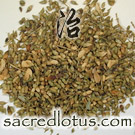 Huai Hua Mi9-30 gHuai HuaStop Bleeding
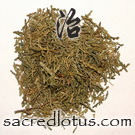 Ce Bai Ye9-15 gStop Bleeding
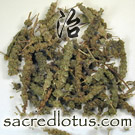 Jing Jie6-9 gWarm, Spicy Herbs that Release the Exterior
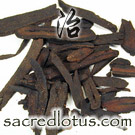 Zhi Ke6-9 gRegulate the Qi
Preparation & dosage
How is Huai Hua San prepared?
Classically Huai Hua San is a fine powder (san) of four herbs — Huai Hua and Jing Jie Sui charred, Ce Bai Ye and Zhi Ke dry-fried — taken with warm water or thin rice congee before meals. Sacred Lotus sources & references records the modern equivalent as a decoction, which is how the formula is most often administered in contemporary practice.
Source: Sacred Lotus sources & references + Bensky & Barolet, Formulas & Strategies. Traditional-use framing; not medical advice.
Classically a powder (san) of the four charred/dry-fried herbs in roughly equal parts, taken 6-9 g per dose with warm water or thin rice congee before meals. Modern decoction reference ranges (per Sacred Lotus sources & references): Huai Hua (charred) 9-30 g; Ce Bai Ye 9-15 g; Jing Jie Sui (charred) 6-9 g; Zhi Ke 6-9 g. Reference only; not a treatment recommendation.
Safety — read before use
What are the cautions for Huai Hua San?
As this formula is cold, do not use long term. Huai Hua San is designed for an acute heat/damp-heat pattern; its cooling, blood-stopping herbs can injure Spleen and Stomach yang if continued after the heat clears, and it is not appropriate for chronic, low-grade bleeding.
- Not for cold or deficiency-type bleeding: pale or dark, non-fresh blood with a dull ache, cold limbs, fatigue, or a pale tongue point to Spleen-yang or qi deficiency (e.g., the pattern treated by Huang Tu Tang) rather than the heat pattern this formula addresses — using Huai Hua San there would worsen the underlying cold/deficiency.
- Digestive caution: the cooling herbs can aggravate loose stools or poor appetite in patients with an already weak, cold digestion.
- Pregnancy and unclear bleeding: any rectal or gastrointestinal bleeding, and use during pregnancy, should be evaluated and guided by a qualified practitioner rather than self-treated.
Source: Sacred Lotus sources & references + Bensky & Barolet, Formulas & Strategies (cautions for cooling hemostatic formulas). Traditional-use framing; not medical advice.
Originally Appeared In:
- Formulas of Universal Benefit from My Practice (Pu Ji Ben Shi Fang)
Notes:
How is Huai Hua San different from Huang Tu Tang and Chi Xiao Dou Dang Gui San?
Huai Hua San treats intestinal bleeding from heat; Huang Tu Tang treats intestinal bleeding from cold and deficiency — the two sit at opposite ends of the same symptom (blood in the stool) and should not be confused. Chi Xiao Dou Dang Gui San overlaps in treating intestinal-wind bleeding and hemorrhoids but is built for a damp-heat-toxin pattern with a stronger tendency toward abscess or suppuration.
- vs Huang Tu Tang: choose Huang Tu Tang instead when the blood is pale or dusky, the abdomen is cold, and there are clear signs of Spleen-yang deficiency rather than heat — a chronic, deficient bleeding pattern.
- vs Chi Xiao Dou Dang Gui San: both address chang feng (intestinal wind) and hemorrhoidal bleeding; Chi Xiao Dou Dang Gui San is favored when there is more pronounced damp-heat toxin with swelling or a tendency toward abscess, while Huai Hua San is the more general formula for bright-red bleeding from wind-heat/damp-heat.
Preparation note: both Huai Hua and Jing Jie Sui are charred (chao tan) in this formula — a classic TCM processing method that increases an herb’s astringent, hemostatic action, which is why Sacred Lotus sources & references and traditional sources specify the charred form for these two herbs rather than the raw herb.
Source: Bensky & Barolet, Formulas & Strategies (comparison and processing notes for formulas that clear heat and stop bleeding).
Clinical Studies & Research:
Is there modern research on Huai Hua San?
Yes, but it is preclinical — network-pharmacology and cell/animal studies exploring how the formula may act on inflamed bowel tissue, plus herb-level pharmacology on its key flower ingredient. Two related 2021 studies used network pharmacology (predicting the formula’s active compounds and likely molecular targets) combined with laboratory validation to propose mechanisms for Huai Hua San in ulcerative colitis, an inflammatory bowel condition that also involves rectal bleeding. Neither is a human clinical trial of the formula.
- Ulcerative colitis mechanism (preclinical): network pharmacology plus experimental validation proposed anti-inflammatory pathways for Huai Hua San’s active compounds (PMID 34118340).
- Ulcerative colitis mechanism (preclinical): a separate network-pharmacology and molecular-docking study identified quercetin, luteolin, and nobiletin as candidate active compounds acting via the PI3K-AKT signaling pathway (PMID 34349502).
- Herb-level pharmacology (review): a review of Sophora japonica (Huai Hua) phytochemistry and pharmacology documents its traditional use for hemorrhoids and the capillary-stabilizing, hemostatic properties of its flavonoids (rutin, quercetin) — context for the chief herb, not a formula-level trial (PMID 27085938).
Sources: PubMed 34118340; PubMed 34349502; PubMed 27085938. Research context, not a therapeutic claim; direct human clinical-trial evidence for the whole formula remains limited/unverified and is not cited here.
Sources & References
Compiled and edited by Thomas Dehli, Founder & Editor, Sacred Lotus Updated
The information here is referenced from numerous sources — teachers, practitioners, class notes from Five Branches University, the books below, and the published research literature, with citations given as resolvable PubMed identifiers. Where sources disagree, I have flagged the discrepancies directly. If facts couldn't be verified, I have left them out. How we source our content.
Reference information for students and practitioners — not medical advice. Consult a qualified practitioner. Terms of use.
Chinese Formulas Books & References
 https://amzn.to/4fYI3f8
 https://amzn.to/4j55NRA
 https://amzn.to/4gMROyv
 https://amzn.to/4h7msSK