
Actions
What does Wu Pi San (Wu Pi Yin) do?
Wu Pi San promotes urination and drains superficial dampness to reduce skin-level edema, while regulating the qi and gently supporting the Spleen. Its distinguishing feature, per the Sacred Lotus record, is that every one of its five ingredients is a peel or bark/skin — the formula's whole strategy is built on the classical principle that skin-natured substances are best suited to treat swelling at the level of the skin.
- Fu Ling Pi & Da Fu Pi: leach out dampness through urination and move stagnant qi to relieve distension — the formula's principal water-draining action.
- Sang Bai Pi: descends Lung qi and opens the Lung's "upper source of water," helping regulate fluid distribution to the skin and pores.
- Chen Pi: regulates qi and gently supports the Spleen, helping the digestive qi keep pace with fluid movement.
- Sheng Jiang Pi: disperses water at the exterior/surface level without the heating, drying effect of fresh ginger itself.
Source: Sacred Lotus record (composition, category, existing action record); role analysis cross-referenced against multiple online sources describing the classical "five peel" strategy, in our own words. Traditional-use framing; not medical advice.
Indications
What is Wu Pi San (Wu Pi Yin) used for?
Wu Pi San treats generalized, pitting skin-level edema arising from Spleen qi deficiency with qi stagnation — swelling that sits at the surface (skin and superficial tissue) rather than reflecting deep organ-level fluid failure.
- Generalized or pitting edema, often most noticeable in the limbs and face, with a feeling of fullness, distension, or heaviness in the abdomen and epigastrium.
- Scanty, difficult urination alongside the swelling.
- A heavy sensation in the body and, when fluid affects the chest/diaphragm, labored or heavy breathing.
- A pale, swollen tongue with tooth marks and a greasy white coating, and a deep, moderate, slippery pulse — per the Sacred Lotus record, both pointing to Spleen-qi deficiency with dampness rather than a Kidney-yang or heat-type edema.
Source: Sacred Lotus indications and pattern/tongue/pulse record; cross-referenced against multiple online sources for the classical presentation. Reference only, not a diagnosis.
Western Uses:
What is Wu Pi San (Wu Pi Yin) used for in modern practice?
Per the Sacred Lotus record, it is referenced traditionally for edema, edema of pregnancy, protein-deficiency edema, ascites from cirrhosis, congestive heart failure, urticaria, and menopausal edema — a range of modern biomedical labels that share a common thread of fluid retention at or near the body's surface.
These are biomedical correlates of the formula's traditional pattern (superficial Spleen-qi-deficiency edema), not a claim that it treats any of these diagnosed conditions; edema in pregnancy, cirrhosis, or heart failure in particular can reflect a serious underlying medical condition and warrants evaluation and monitoring by a qualified clinician rather than self-treatment.
Source: Sacred Lotus record. Reference only, not a treatment claim.
Ingredients
5 substances in Wu Pi San (Wu Pi Yin) — each links to its full herb monograph.
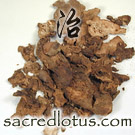 Fu Ling Pi15 gRegulate Water and Drain Dampness
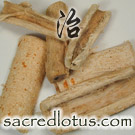 Sang Bai Pi15 gRelieve Coughing and Wheezing
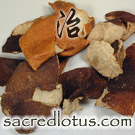 Chen Pi9 gRegulate the Qi
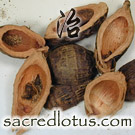 Da Fu Pi15 gRegulate the QiNo specimen photographSheng Jiang Pi6 gWarm, Spicy Herbs that Release the Exterior
Preparation & dosage
How is Wu Pi San (Wu Pi Yin) prepared?
Prepared as a decoction, per the Sacred Lotus record. All five peel/skin ingredients — Sang Bai Pi, Sheng Jiang Pi, Fu Ling Pi, Chen Pi, and Da Fu Pi — are decocted together; because peels and barks are lighter, more superficial plant parts, they are traditionally not simmered as long or as hard as dense root or mineral ingredients, consistent with the formula's overall "light and dispersing" strategy.
Source: Sacred Lotus preparation record; cross-referenced against multiple online sources for standard peel/bark decoction practice.
Safety — read before use
What are the cautions for Wu Pi San (Wu Pi Yin)?
Per the Sacred Lotus record, Wu Pi San does not strongly tonify the Spleen on its own, so it is commonly combined with additional Spleen-tonifying herbs when Spleen-qi deficiency is significant. Beyond that documented note, several general cautions apply.
- Not for deep/severe edema: because the formula's peel-based strategy is built for superficial, skin-level swelling, it is not suited to edema reflecting more severe Kidney-yang deficiency or advanced organ failure, which calls for stronger warming or tonifying formulas instead.
- Edema in pregnancy, cirrhosis, or heart failure: these conditions can involve serious underlying pathology; any such edema should be evaluated and monitored by a qualified clinician rather than self-treated.
- Not for heat-type or damp-heat edema: the formula's herbs are gently neutral to mild in temperature; it is not designed for a swelling pattern with clear heat signs.
Source: Sacred Lotus record; cross-referenced against multiple online sources for standard cautions on superficial dampness-draining formulas. Traditional-use framing; not medical advice.
Originally Appeared In:
- Treasury Classic (Zhong Zang Jing)
Notes:
Why does this formula have two names, and how does it compare to Wu Ling San?
"Wu Pi San" and "Wu Pi Yin" (Five Peel Powder/Drink) refer to the same core five-peel strategy across two overlapping formulary lineages. The Sacred Lotus record traces this version's origin to the Zhong Zang Jing (Treasury Classic); a separate, later lineage records a similarly named formula that substitutes Di Gu Pi for Sang Bai Pi. Because the two names and near-identical compositions are used somewhat interchangeably across formula sources, the Sacred Lotus record preserves both names together for this entry rather than presenting them as two unrelated formulas.
- vs Wu Ling San (Five Ingredient Powder with Poria): Wu Ling San (Ze Xie, Fu Ling, Zhu Ling, Bai Zhu, Gui Zhi) also promotes urination but targets water accumulation with impaired qi transformation in the Bladder/interior, typically with thirst; it uses no peel ingredients and works from the interior rather than the surface.
- vs Zhen Wu Tang (True Warrior Decoction): Zhen Wu Tang treats edema from a deeper, more severe Kidney-yang deficiency, using warming tonifying herbs (Fu Zi, Bai Zhu, Fu Ling, Bai Shao, Sheng Jiang) rather than a peel-based surface strategy; it is reserved for more advanced, cold-type fluid overload.
Source: Sacred Lotus origin record; cross-referenced against multiple online sources for the naming lineage and formula-family comparisons.
Clinical Studies & Research:
Is there modern research on Wu Pi San (Wu Pi Yin)?
Direct clinical research on the intact five-herb formula is limited; the clearest modern evidence is at the ingredient level, on Fu Ling Pi. A pharmacological study isolated fractions from Fu-Ling-Pi (the outer layer/peel of Poria cocos, one of this formula's five ingredients) and found that its ethyl acetate and n-butanol fractions significantly increased urine output and sodium/chloride excretion in rats, supporting the traditional use of this peel specifically for edema and pointing to lanostane-type triterpenoids as likely active compounds.
Source: PubMed 24184192 ("Diuretic activity of some fractions of the epidermis of Poria cocos," J Ethnopharmacol, 2013). Ingredient-level research context, not a therapeutic claim for the full formula; no clinical trial of the intact formula was found.
Sources & References
Compiled and edited by Thomas Dehli, Founder & Editor, Sacred Lotus Updated
The information here is referenced from numerous sources — teachers, practitioners, class notes from Five Branches University, the books below, and the published research literature, with citations given as resolvable PubMed identifiers. Where sources disagree, I have flagged the discrepancies directly. If facts couldn't be verified, I have left them out. How we source our content.
Reference information for students and practitioners — not medical advice. Consult a qualified practitioner. Terms of use.
Chinese Formulas Books & References
 https://amzn.to/4fYI3f8
 https://amzn.to/4j55NRA
 https://amzn.to/4gMROyv
 https://amzn.to/4h7msSK