

Pericarpium Arecae Catechu Betel Husk
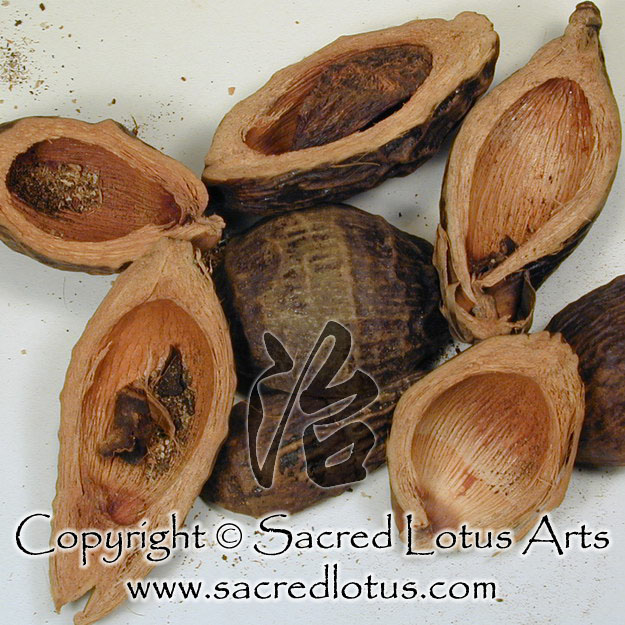
Materia Medica Data
- Category
- Herbs that Regulate the Qi
- Temperature
- Slightly Warm
- Nature & Flavour
- Spicy, Slightly Warm
- Channels Entered
- LI, SI, SP, ST
- Latin (pharmaceutical)
- Pericarpium Arecae Catechu
- Chinese
- 大腹皮
- Tone Marks
- dà fù pí
- Translation
- Big Abdomen Peel
Chinese Herb Actions
What is Da Fu Pi used for in Chinese medicine?
Da Fu Pi (Areca catechu pericarp, the dried husk of the areca palm fruit) is traditionally used to move Qi, reduce distention, and promote urination to resolve edema — for abdominal bloating and fullness, incomplete or irregular bowel evacuation, and superficial or generalized swelling.
Its main traditional actions:
- Directs Qi downward and eases the Middle Burner — for abdominal distention, oppression, and fullness, especially with incomplete or irregular evacuation; also traditionally used for morning sickness.
- Promotes diuresis and reduces edema — for edema with abdominal distention, superficial (skin-level) swelling, food stagnation, and Damp Leg Qi (a swollen-leg pattern).
Key formulas: Da Fu Pi is one of the five peel-type herbs in Wu Pi San (Five Peel Powder), the classical formula for generalized edema with abdominal distention, and it also appears in Huo Xiang Zheng Qi San (Agastache Powder to Rectify the Qi) for Qi-stagnation with digestive distention and nausea. (Traditional formula context, not treatment advice.)
Source: Sacred Lotus sources & references, cross-referenced against multiple online sources and materia medica consensus (Bensky & Barolet; Chen & Chen).
Chinese Herb Dosage
What is the typical dosage of Da Fu Pi?
Roughly 3–10 g in decoction, with sources giving slightly different standard ranges (about 3–10 g in one commonly cited reference, about 4.5–9 g in another) — both consistent with a moderate, food-adjacent dosage for a Qi-moving, distention-relieving herb.
Source: Sacred Lotus sources & references; standard materia medica dosage ranges. Reference only — not a prescription.
Chinese Herb Contraindications & Cautions
Are there cautions for Da Fu Pi?
Use caution during pregnancy — consistent with its Qi-moving, downward-directing action, Da Fu Pi is traditionally used carefully, if at all, in pregnant patients, and should be used under a qualified practitioner's guidance.
Source: Sacred Lotus sources & references, cross-referenced against multiple online sources and materia medica consensus.
Chinese Herb Toxicity & Overdose
Da Fu Pi (the husk) itself is not the subject of the areca-nut cancer research — that body of evidence concerns Bing Lang (the seed/betel nut) and the practice of chewing betel quid, not the pericarp used here as a decocted herb. The World Health Organization's International Agency for Research on Cancer (IARC) classifies betel-quid and areca-nut chewing as a Group 1 human carcinogen (sufficient evidence for oral and other cancers), a conclusion built on epidemiological and mechanistic study of the chewed seed/quid habit — a fundamentally different exposure from a short decoction of the husk taken as part of a formula. At standard decoction doses, materia medica sources do not report significant toxicity for Da Fu Pi itself; it does contain the same class of areca alkaloids (including arecoline) found in the seed, so it is still reserved for supervised, time-limited use rather than casual long-term consumption.
Source: IARC Monographs on the Evaluation of Carcinogenic Risks to Humans, Vol. 85 (2004), PMID 15635762 (betel-quid and areca-nut chewing classification); materia medica consensus for Da Fu Pi. Reference note, not a safety guarantee; this is a neutral disclosure, not a claim that the husk carries the same risk as chewed betel quid.
Herb-Drug Interactions
No well-established clinical herb–drug interactions are documented for Da Fu Pi specifically. Because areca-derived alkaloids (arecoline and related compounds) have cholinergic (parasympathomimetic) activity in pharmacological studies, theoretical caution is reasonable alongside other cholinergic-acting medications, but this is precautionary reasoning from the alkaloid class rather than a demonstrated clinical interaction for the husk. (Flagged for practitioner confirmation.)
Western / Biomedical Research
Chinese Herb Clinical Studies & Research
Provided as research context — a summary of published biomedical study, not a therapeutic or medical claim.
Is there modern research on Da Fu Pi (Pericarpium Arecae)?
Yes, though most modern Areca catechu research targets the seed rather than the husk specifically; direct clinical trials of the husk (Da Fu Pi) alone are limited. A 2025 review of Areca catechu noted that the seed (Arecae Semen) holds premier status among the classical "four major southern medicines," while the pericarp (Da Fu Pi) and the flower are also used as separate traditional medicines from the same plant, each recognized as having distinct therapeutic value despite overlapping chemistry.
- Alkaloid content of the husk (analytical chemistry) — a quantitative analysis specifically of Pericarpium Arecae (Da Fu Pi) confirmed the presence of four areca alkaloids — arecoline, arecaidine, guvacine, and guvacoline — establishing that the husk shares the seed's alkaloid class, though this analytical study did not report a direct concentration comparison between husk and seed.
- Broader Areca catechu pharmacology (mixed plant parts) — across the genus, reported activities include promoting gastrointestinal motility, antidepressant-like effects, antioxidant activity, lipid-lowering effects, anthelmintic (anti-parasitic) activity, and antibacterial activity; these findings span different plant parts and are not all specific to the husk.
Overall, the traditional Qi-moving and diuretic actions of Da Fu Pi have supportive context from the wider Areca catechu pharmacology literature, but dedicated clinical research on the husk in isolation is sparse; the well-known carcinogenicity literature (above) is a separate body of evidence concerning the chewed seed, not this herb.
Sources: PMID 41507738 (Zhongguo Zhong Yao Za Zhi, 2025, review of Areca catechu parts and pharmacology); PMID 27393441 (Pakistan Journal of Pharmaceutical Sciences, 2016, quantitative alkaloid analysis of Pericarpium Arecae); PMID 15635762 (IARC Monographs, Vol. 85, 2004, betel-quid/areca-nut chewing carcinogenicity). Research context, not a therapeutic claim.
Chinese Herb Notes
Is Da Fu Pi the same herb as Bing Lang (betel nut)?
No — Da Fu Pi and Bing Lang come from the same areca palm fruit but are different parts, prepared and used differently, and held as separate herbs. This distinction matters both clinically and for safety context, and is worth stating plainly.
- Da Fu Pi — the dried pericarp (husk) of the fruit; spicy and slightly warming; moves Qi and reduces distention/edema; used in decoction, never chewed.
- Bing Lang (Semen Arecae, betel nut/areca seed — see the separate Bing Lang entry) — the dried seed inside the fruit; spicy, bitter, and warming; a stronger herb traditionally used to kill intestinal parasites, move Qi, and unblock the bowels, with its own distinct cautions (including use with extreme caution in pregnancy).
Both parts contain areca-palm alkaloids of the same chemical family, but the husk is used only as a decocted herb at modest doses, never as a chewed product — a point directly relevant to the safety research below.
Source: Sacred Lotus sources & references, cross-referenced against multiple online sources and materia medica consensus (Bensky & Barolet; Chen & Chen).
Sources & References
Compiled and edited by Thomas Dehli, Founder & Editor, Sacred Lotus Updated
The information here is referenced from numerous sources — teachers, practitioners, class notes from Five Branches University, the books below, and the published research literature, with citations given as resolvable PubMed identifiers. Where sources disagree, I have flagged the discrepancies directly. If facts couldn't be verified, I have left them out. How we source our content.
Reference information for students and practitioners — not medical advice. Consult a qualified practitioner. Terms of use.
Chinese Herbs Books & References
 https://amzn.to/3WfB3DK
 https://amzn.to/3DR1VUh
 https://amzn.to/42aMz73
 https://amzn.to/3PuD4bt