
Actions
What does Zhu Ling Tang do?
Zhu Ling Tang promotes urination to drain water accumulation while simultaneously clearing heat and nourishing yin — it is built for the specific case where fluid has pooled internally at the same time that heat has already begun to damage the body’s fluids, so a plain diuretic would only make the yin damage worse.
- Promotes urination and drains water accumulation: Zhu Ling, Fu Ling, and Ze Xie work together as the formula’s core diuretic trio, unblocking the water passages.
- Clears heat from the lower burner and unblocks painful urinary dribbling: Hua Shi cools and drains damp-heat through the urine.
- Nourishes yin and blood while stopping bleeding: E Jiao protects the fluids that the diuretic herbs would otherwise further deplete, and addresses blood in the urine when heat has damaged the network vessels.
Source: cross-referenced against multiple online sources; Bensky & Barolet, Formulas & Strategies (chief/deputy/assistant analysis, attributed — not from Sacred Lotus composition data, which carries no role field).
Indications
What is Zhu Ling Tang used for?
Zhu Ling Tang treats water accumulation complicated by heat and yin damage — difficult or painful urination together with signs that heat has already begun to injure the body’s fluids, such as thirst and an inability to sleep. This combination is the key difference from formulas that drain water alone.
- Difficult, scanty, or painful urination (dysuria) with fever
- Marked thirst that persists despite drinking
- Vexation and insomnia from heat harassing the upper body
- Blood in the urine (hematuria) when heat has damaged the urinary network vessels
- Traditionally extended (Jin Gui Yao Lue) to cough, vomiting, or diarrhea when fluid metabolism is disrupted alongside these signs
Source: Sacred Lotus sources & references (pattern/tongue/pulse) + classical Shang Han Lun / Jin Gui Yao Lue presentation, cross-referenced against multiple online sources and Bensky & Barolet, Formulas & Strategies. Traditional-use framing; not medical advice.
Western Uses:
What conditions is Zhu Ling Tang used for in modern practice?
Zhu Ling Tang promotes urination while clearing heat and nourishing yin (difficult, scanty, hot or bloody urination with thirst, from water accumulation complicated by heat), so it is referenced for damp-heat urinary and fluid conditions: urinary tract infections, nephritis, painful/difficult urination (dysuria), and — in the classical record — haemorrhagic shock.
A critical safety note. Haemorrhagic shock (collapse from severe blood loss) is an immediately life-threatening EMERGENCY requiring resuscitation and hospital care — never herbs. Urinary tract infection and kidney inflammation need medical diagnosis and treatment, and blood in the urine always requires assessment. This formula is chosen for the damp-heat pattern, not for these diagnoses. Traditional-use correlates only, not a treatment claim.
Source: Sacred Lotus sources & references (pattern) + Bensky & Barolet, Formulas & Strategies; biomedical correlates as reference only. Not medical advice.
Ingredients
5 substances in Zhu Ling Tang — each links to its full herb monograph.
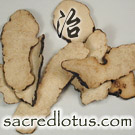 Zhu Ling3 gRegulate Water and Drain Dampness
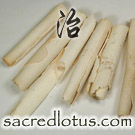 Fu Ling3 gRegulate Water and Drain Dampness
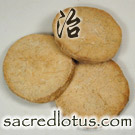 Ze Xie3 gRegulate Water and Drain Dampness
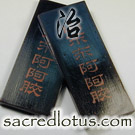 E Jiao3 gTonify Blood
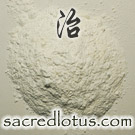 Hua Shi3 gRegulate Water and Drain Dampness
Preparation & dosage
How is Zhu Ling Tang prepared?
Classically the four mineral/fungal herbs are decocted together first, and E Jiao is dissolved into the strained hot liquid afterward rather than boiled with the rest. This two-stage method is standard for glue-like, gelatin-based tonics, which lose potency (and can scorch) if simmered directly with the other ingredients.
- Step one: Zhu Ling, Fu Ling, Ze Xie, and Hua Shi are decocted in water and the dregs are strained off.
- Step two: E Jiao is melted (dissolved) into the strained, still-hot liquid until fully incorporated — the classical instruction is often rendered as “dissolve E Jiao into the strained decoction” (烊化).
- Modern practice: a standard water decoction of the four herbs followed by dissolving E Jiao granules or shaved gelatin into the hot strained liquid, taken warm in divided doses.
Source: classical processing convention for gelatin-based tonics (E Jiao), as summarized in Bensky & Barolet, Formulas & Strategies, cross-referenced against multiple online sources. Reference only; not administration guidance.
Safety — read before use
What are the cautions for Zhu Ling Tang?
Zhu Ling Tang is intended for water accumulation with heat and yin damage, and is inappropriate once heat is absent or when cold-type water accumulation predominates. Using it for a plain cold water-accumulation pattern would not address the warming/qi-transformation problem that a formula such as Wu Ling San is built for.
- Avoid in Spleen-yang deficiency with cold, watery diarrhea or in dampness patterns without heat, where these cooling, draining herbs are not indicated.
- E Jiao (donkey-hide gelatin) is a rich, cloying tonic that can burden a weak, damp-prone digestion — caution in patients with poor appetite or loose stools from Spleen deficiency.
- Pregnancy: strongly draining diuretic formulas are traditionally used with caution in pregnancy; professional guidance is advised.
- No aconite, ephedra, or cinnabar-type restricted ingredient is present. E Jiao is a standard, unrestricted material, though as an animal-derived gelatin it warrants ordinary sourcing/allergen awareness, offered here as a neutral identity reference.
Source: Bensky & Barolet, Formulas & Strategies (cautions for draining/yin-nourishing combinations), cross-referenced against multiple online sources. Traditional-use framing; not medical advice.
Originally Appeared In:
- On Cold Damage (Shang Han Lun)
Notes:
How does Zhu Ling Tang differ from Wu Ling San?
Zhu Ling Tang and Wu Ling San share three herbs — Zhu Ling, Fu Ling, and Ze Xie — but they are built for opposite temperature pictures, and swapping the remaining ingredients is what makes the difference explicit.
- Wu Ling San keeps the shared diuretic trio and adds Gui Zhi (warms and restores Bladder qi transformation) and Bai Zhu (strengthens the Spleen) — a warming formula for water accumulation from failed qi transformation, often with a lingering exterior Wind-Cold sign.
- Zhu Ling Tang removes Gui Zhi and Bai Zhu and instead adds Hua Shi (clears damp-heat) and E Jiao (nourishes yin, stops bleeding) — a cooling, yin-preserving formula for water accumulation once heat has entered and begun to damage fluids, with thirst, vexation, and insomnia rather than exterior signs.
- Clinical takeaway: choose Wu Ling San when the picture is cold or qi-transformation failure; choose Zhu Ling Tang when heat and yin damage (thirst, insomnia, possible hematuria) are present instead.
Classical source: Zhu Ling Tang originates in Zhang Zhongjing’s Shang Han Lun (Treatise on Cold Damage, Eastern Han dynasty, compiled c. 200–220 CE), appearing in both the Yangming and Shaoyin chapters, and is also referenced in his Jin Gui Yao Lue for fluid-metabolism disorders with cough, vomiting, or diarrhea.
Source: classical attribution per Shang Han Lun / Jin Gui Yao Lue, cross-referenced against multiple online sources; Bensky & Barolet, Formulas & Strategies (comparative composition analysis, own words).
Clinical Studies & Research:
Is there modern research on Zhu Ling Tang?
Yes — a randomized controlled trial in heart failure plus mechanistic studies on its diuretic and anti-inflammatory action, none of which establishes it as a treatment for any diagnosed disease. Clinical and laboratory work both center on the formula’s traditional water-draining, damp-heat-clearing action.
- Diuretic resistance in heart failure (clinical, RCT): a randomized controlled trial found Zhuling decoction added to conventional treatment improved urine output, NT-proBNP, and NYHA functional class versus conventional treatment alone in patients with diuretic-resistant heart failure (PMID 35610014).
- Nephrotic syndrome mechanism (preclinical, computational): network-pharmacology and molecular-docking analysis identified several compounds (including polyporusterone E and alisol B) acting through PI3K-Akt, Ras, and related signaling pathways as a proposed mechanistic basis for the formula’s traditional use in water accumulation (PMID 38910482).
- Anti-inflammatory action (preclinical): isolated oligosaccharides from Zhu-Ling decoction significantly inhibited TNF-α and IL-6 in kidney cell models via NF-κB and Akt/mTOR pathways, offered as a mechanistic correlate to the formula’s heat-clearing action (PMID 39048245).
Sources: PMID 35610014; PMID 38910482; PMID 39048245. Research context on the formula’s traditional water-draining, heat-clearing action, not a therapeutic claim.
Sources & References
Compiled and edited by Thomas Dehli, Founder & Editor, Sacred Lotus Updated
The information here is referenced from numerous sources — teachers, practitioners, class notes from Five Branches University, the books below, and the published research literature, with citations given as resolvable PubMed identifiers. Where sources disagree, I have flagged the discrepancies directly. If facts couldn't be verified, I have left them out. How we source our content.
Reference information for students and practitioners — not medical advice. Consult a qualified practitioner. Terms of use.
Chinese Formulas Books & References
 https://amzn.to/4fYI3f8
 https://amzn.to/4j55NRA
 https://amzn.to/4gMROyv
 https://amzn.to/4h7msSK