
San Ren Tang
Three Nut Decoction
- Category
- Formulas that Expel Dampness
- Subcategory
- Formulas that Clear Damp-Heat
- Ingredients
- 8 herbs
Actions
What does San Ren Tang do?
San Ren Tang (“Three-Nut Decoction”) disperses and drains damp-heat by opening and regulating the qi of all three burners (san jiao). The three “nuts” (kernels/seeds) each work at one level: Xing Ren (apricot kernel) opens and diffuses Lung qi in the upper burner, Bai Dou Kou (cardamom) aromatically revives and transforms dampness in the middle burner, and Yi Yi Ren (coix) drains dampness through the lower burner. This light, aromatic approach frees the qi mechanism so dampness has an exit and heat can no longer steam and lodge.
Within the formula the roles divide as:
- Opens the upper burner — Xing Ren restores the diffusing and descending of Lung qi.
- Revives the middle burner — Bai Dou Kou with Hou Po and Ban Xia aromatically transform damp, move qi, and harmonize the Stomach.
- Drains the lower burner — Yi Yi Ren with Hua Shi, Tong Cao, and Dan Zhu Ye leach out damp-heat through the urine.
- Light, not purging — it disperses damp-heat gently rather than attacking with cold, bitter draining.
Source: Sacred Lotus formula record (composition confirmed); Bensky & Barolet, Chinese Herbal Medicine: Formulas & Strategies. Traditional-use framing; not medical advice.
Indications
What is San Ren Tang used for?
San Ren Tang is the classic formula for the early stage of damp-warmth (shi wen) or damp-heat, when dampness predominates and a lingering fever does not fully resolve. The picture is heavy and muffled rather than sharply hot: a heavy head as if wrapped, a heavy aching body, chest and epigastric stuffiness, poor appetite, little thirst (or thirst with no desire to drink), and an afternoon fever that feels worse but does not break. The tongue carries a white greasy coating.
Traditional presenting signs:
- Lingering low fever — often worse in the afternoon, not resolving with sweating.
- Heaviness — head “as if wrapped,” heavy and sore limbs and body.
- Middle-burner blockage — chest and epigastric fullness, no appetite, no thirst.
- Damp tongue and pulse — white greasy coating; a wiry, thin, or soggy pulse.
Source: Sacred Lotus formula record (tongue: white coating; pulse: wiry, thin, soggy); Bensky & Barolet, Formulas & Strategies; Wu Ju-tong, Systematic Differentiation of Warm Diseases (Wen Bing Tiao Bian, 1798).
Western Uses:
How is San Ren Tang used in modern practice?
In modern TCM practice San Ren Tang is applied to damp-heat patterns showing the classic heaviness, greasy tongue, and lingering low fever — matched to the pattern rather than to any single Western diagnosis. Practitioners commonly consider it for damp-heat presentations of digestive complaints such as gastritis, for urinary irritation, for certain fevers of unclear cause, and for some damp-heat skin conditions — always when the tongue and body signs conform. Modern experimental work has focused on spleen-stomach damp-heat and gastrointestinal models (see research).
Source: Bensky & Barolet, Formulas & Strategies (modern applications); pattern-based use as recorded in the Sacred Lotus formula record. Traditional-use framing; not a treatment claim.
Ingredients
8 substances in San Ren Tang — each links to its full herb monograph.
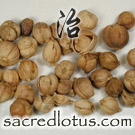 Bai Dou Kou6 gAromatic Herbs that Transform and Dissolve Dampness
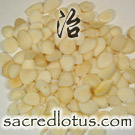 Xing Ren15 gRelieve Coughing and Wheezing
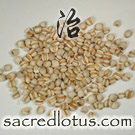 Yi Yi Ren18 gRegulate Water and Drain Dampness
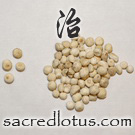 Ban Xia9 gWarm Herbs that Transform Phlegm-Cold
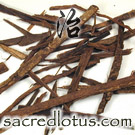 Hou Po6 gAromatic Herbs that Transform and Dissolve Dampness
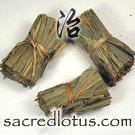 Dan Zhu Ye6 gDrain Fire
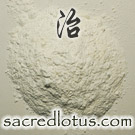 Hua Shi18 gRegulate Water and Drain Dampness
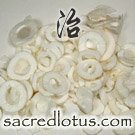 Tong Cao6 gRegulate Water and Drain Dampness
Preparation & dosage
How is San Ren Tang prepared?
San Ren Tang ("Three-Nut Decoction") is prepared as a water decoction (tang) built on its three "nuts" — Xing Ren (opening the upper burner), Bai Dou Kou (the middle) and Yi Yi Ren (the lower) — with Hou Po, Ban Xia, Tong Cao, Dan Zhu Ye and Hua Shi.
The three nuts fragrantly open damp-heat across all three burners at once, the formula's signature strategy. Hua Shi (talc), a mineral, is traditionally wrapped in cloth while cooking so it doesn't cloud the decoction. Doses are usually reduced by one-half to two-thirds of the classical amounts.
Source: Sacred Lotus sources & references (composition and preparation note) + Bensky & Barolet, Formulas & Strategies.
Traditional decoction (Wen Bing Tiao Bian): Xing Ren 15 g, Bai Dou Kou 6 g, Yi Yi Ren 18 g, Hua Shi 18 g, Ban Xia 9 g, Hou Po 6 g, Tong Cao 6 g, Dan Zhu Ye 6 g. Prepared as a decoction; classical dosing is often reduced by one-half to two-thirds. Reference only — not a prescription.
Safety — read before use
Are there cautions with San Ren Tang?
San Ren Tang is meant for damp-heat where dampness predominates, so it is not appropriate when the pattern is purely heat, nor when fever arises from yin deficiency. Its aromatic, drying, and draining herbs can consume fluids and yin if used longer than needed, so it is generally given for a limited course and stopped once the damp-heat clears. Classical texts warn that mistaking a damp-warmth fever for a simple exterior or yin-deficient fever, and treating it wrongly, can drive the disease deeper.
- Pattern must fit — dampness-predominant damp-heat with a greasy tongue; not dry-heat or yin-deficient fever.
- Contains Ban Xia (Pinellia) — used only in its properly prepared form; unprepared Pinellia is toxic.
- Short course — the drying, draining herbs can injure fluids with prolonged use.
Source: Bensky & Barolet, Formulas & Strategies (cautions & contraindications); standard materia medica on Ban Xia preparation. Not medical advice — consult a qualified practitioner.
Originally Appeared In:
- Systematic Differentiation of Warm Diseases (Wen Bing Tiao Bian)
Notes:
How does San Ren Tang compare with similar damp-heat formulas, and how is it modified?
San Ren Tang is the mildest and most broadly three-burner of the damp-heat formulas — reserved for the early stage where dampness clearly outweighs heat. As heat or toxin intensifies, practitioners move to stronger-clearing formulas.
- vs Gan Lu Xiao Du Dan — for more advanced damp-heat with pronounced heat and toxin (fever, sore throat, jaundice); it clears and resolves toxicity far more strongly.
- vs Lian Po Yin — for damp-heat lodged in the middle burner with acute nausea, vomiting, and diarrhea (sudden turmoil); more focused on harmonizing the Stomach and directing rebellion downward.
- vs Huo Xiang Zheng Qi San — for external damp with wind-cold and turbid damp obstructing the middle, not true damp-heat.
The “three prohibitions” (san jin): Wu Ju-tong warned that this damp-warmth must not be treated by (1) strong sweating — which mistakes it for an exterior cold pattern and harms the yang; (2) purging — which mistakes the chest fullness for interior excess and damages the Spleen; or (3) enriching, moistening tonics — which mistake the afternoon fever for yin deficiency and make the dampness more entrenched.
Common modifications generally add bitter, cooling herbs when heat becomes more marked, and emphasize aromatic, damp-transforming herbs when dampness and middle-burner blockage dominate — each adjusted to the individual pattern.
Source: Bensky & Barolet, Formulas & Strategies (comparisons & modifications); Wu Ju-tong, Wen Bing Tiao Bian (the three prohibitions).
Clinical Studies & Research:
Is there modern research on San Ren Tang?
Yes, but it is preclinical (animal and mechanistic), not human clinical-trial evidence. The most on-point studies use “spleen-stomach damp-heat” animal models — the very pattern the formula traditionally treats. In rats with a damp-heat syndrome model, Sanren decoction lowered raised rectal temperature and reduced elevated IFN-γ and IL-4, shifting the Th1/Th2 balance and protecting the gastrointestinal mucosa (PMID 22381753). A 2025 network-pharmacology and DSS-colitis study reported it eased colitis by shifting macrophages from an M1 to an M2 phenotype, strengthening the intestinal barrier, and modulating gut microbiota (PMID 40836347). A toxicity study found aqueous Sanren decoction produced no significant acute or 28-day toxicity in mice and rats at the doses tested (PMID 34968665).
Sources: PubMed 22381753 (Th1/Th2 cytokines in spleen-stomach damp-heat rats); PubMed 40836347 / PMC 12366350 (ulcerative colitis, gut microbiota & macrophage polarization); PubMed 34968665 (acute/subacute toxicity). Preclinical research context, not a therapeutic claim.
Sources & References
Compiled and edited by Thomas Dehli, Founder & Editor, Sacred Lotus Updated
The information here is referenced from numerous sources — teachers, practitioners, class notes from Five Branches University, the books below, and the published research literature, with citations given as resolvable PubMed identifiers. Where sources disagree, I have flagged the discrepancies directly. If facts couldn't be verified, I have left them out. How we source our content.
Reference information for students and practitioners — not medical advice. Consult a qualified practitioner. Terms of use.
Chinese Formulas Books & References
 https://amzn.to/4fYI3f8
 https://amzn.to/4j55NRA
 https://amzn.to/4gMROyv
 https://amzn.to/4h7msSK