
Semen Pruni Armeniacae Apricot Seed or Kernel
Also known as Ku Xing Ren
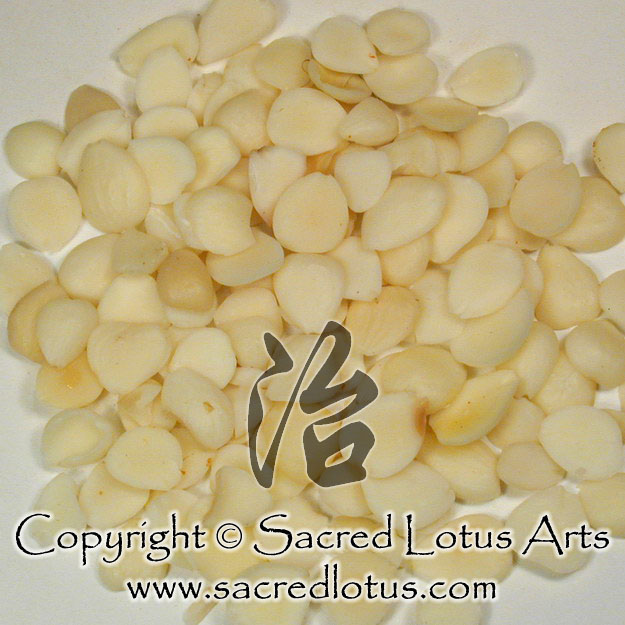
Materia Medica Data
- Temperature
- Warm
- Nature & Flavour
- Bitter, Slightly Warm, Slightly Toxic
- Channels Entered
- LI, LU
- Latin (pharmaceutical)
- Semen Pruni Armeniacae
- Chinese
- 杏仁
- Tone Marks
- xìng rén
- Also Known As
- Ku Xing Ren
Chinese Herb Actions
What is Xing Ren (bitter apricot kernel) used for in Chinese medicine?
Xing Ren (Ku Xing Ren, bitter apricot kernel) is traditionally used to stop cough and calm wheezing by descending and dispersing Lung qi, and to moisten the intestines and unblock the stool. It is a principal cough-and-wheeze herb, used across externally-contracted patterns — Wind-Cold, Wind-Heat, and dry-heat coughing — and, for its high oil content, for constipation from dry or qi-deficient intestines.
Its main traditional actions:
- Stops cough & calms wheezing — descends and disperses Lung qi for coughing and wheezing of many kinds (Wind-Cold, Wind-Heat, externally-contracted dry heat).
- Moistens the intestines & unblocks the bowels — the oil-rich kernel treats constipation from dry or deficient intestines.
The bitter (Ku) kernel is the stronger, descending, dose-limited form; the sweet (Tian) kernel is gentler and more moistening (see the comparison below).
Source: owner’s Five Branches notes (Reduce Coughing & Wheezing); reviewed against Bensky, Materia Medica (3rd ed.). Traditional-use framing; not medical advice.
Chinese Herb Dosage
What is the typical dosage of Xing Ren?
3–10 g in decoction (the notes give 1–3 chien). The kernel is crushed and, being oil-rich and cyanogenic, is conventionally added near the end of cooking rather than boiled long. As a slightly-toxic, dose-limited herb it is kept within range; the sweet kernel (Tian Xing Ren) is dosed similarly but is gentler.
Source: owner’s Five Branches notes (1–3 chien); standard materia medica range (Bensky 3–10 g). Reference only — not a prescription.
Chinese Herb Contraindications & Cautions
Are there cautions or contraindications for Xing Ren?
Use with care in deficiency (Xu) patients, and in those with loose stools or diarrhea — the moistening, descending kernel can aggravate them. It is classically noted as slightly toxic and dose-limited, so overdosing is cautioned against. Infants and young children (traditionally, under two years) are singled out as a particular caution because they are more sensitive to the kernel’s cyanogenic constituent (see Toxicity).
Source: owner’s Five Branches notes (Contra: Xu patient / diarrhea; infants under 2; “don’t OD — slightly toxic”). Reference facts, not self-use guidance.
Chinese Herb Toxicity & Overdose
Is bitter apricot kernel (Xing Ren) toxic?
Yes — bitter apricot kernel is classified as slightly toxic and is dose-limited. It contains amygdalin, a cyanogenic glycoside that releases hydrogen cyanide (HCN) on hydrolysis, which is the basis of its restricted dosing. This is a materia-medica reference fact: within the traditional dose range and after appropriate processing the herb is used clinically under professional guidance, but excess is recognized as dangerous.
Reference safety facts:
- Processing lowers toxicity — blanching and removing the skin (and tip) and brief cooking reduce free cyanogenic content; the kernel is traditionally not boiled long.
- Children are more sensitive — pediatric cyanide sensitivity is a recognized caution; a documented case describes severe cyanide poisoning in a 4-year-old given amygdalin and apricot kernels (PMID 25605411).
- Recognized overdose signs (cyanide toxicity, as reference facts) — headache, dizziness, nausea and vomiting, palpitations, and difficult breathing; in severe poisoning, cyanosis, convulsions, and coma.
Sources: owner’s Five Branches notes (slightly toxic; don’t OD; infants under 2); PubMed 25605411 (pediatric cyanide poisoning case); PMID 36806484 (Armeniacae Semen Amarum review). Reference framing — not preparation or self-use instructions.
-
This herb is considered slightly toxic.
(while some Chinese herbs are toxic, it must be noted that many come prepared, or are combined, to mitigate their toxicity)
Herb-Drug Interactions
No well-established clinical herb–drug interactions are documented for Xing Ren. On mechanistic grounds, its cyanogenic constituent and Lung-qi–descending action make practitioner caution reasonable alongside central respiratory or CNS depressants (e.g. opioids/sedatives), and it should not be combined with other cyanogenic kernels that would add to total cyanide load. (Flagged for practitioner confirmation — absence of documented interactions is not proof of safety.)
Western / Biomedical Research
Chinese Herb Clinical Studies & Research
Provided as research context — a summary of published biomedical study, not a therapeutic or medical claim.
Is there modern research on Xing Ren (bitter apricot kernel) and amygdalin?
Yes — research centers on its main constituent amygdalin, spanning both pharmacology and toxicology. A phytochemistry-and-pharmacology review of Armeniacae Semen Amarum documents its traditional use for relieving cough and asthma and moistening the intestines, and reports antitussive and anti-inflammatory activity for the herb and amygdalin, alongside the cyanogenic-glycoside toxicity that defines its safety profile (PMID 36806484). More recent mechanistic work explores amygdalin in pulmonary fibrosis via transcriptomics and metabolomics (PMID 40857957).
Myth flag: the promotion of amygdalin/“laetrile” (marketed as “vitamin B17”) as a cancer cure is not supported by evidence. A Cochrane systematic review found no reliable data of anti-cancer benefit and a considerable risk of cyanide poisoning (PMID 25918920). This is noted here only to correct the claim — it is not a therapeutic use of the herb.
Sources: PubMed 36806484 (J Ethnopharmacol 2023, ASA review); PubMed 40857957 (amygdalin anti-pulmonary-fibrosis mechanism); PubMed 25918920 (Cochrane, laetrile for cancer). Research context, not a therapeutic claim.
Chinese Herb Notes
What is the difference between bitter (Ku) and sweet (Tian) Xing Ren, and what does it combine with?
Bitter Xing Ren (Ku Xing Ren) is the stronger, dose-limited kernel — it descends Lung qi more forcefully to stop cough and calm wheezing; sweet Xing Ren (Tian Xing Ren) is gentler and more moistening, favored for deficiency (Xu) coughs and to moisten the Lung and bowels. Both moisten the intestines; the bitter form is the one carrying the toxicity caution.
It also differs from its close neighbors:
- vs Su Zi — Su Zi (spicy, warm) is preferred for cough and wheezing with copious phlegm and phlegm stagnation in the upper jiao; Xing Ren is the broader descending cough herb.
- vs Bai Bu — Bai Bu moistens the Lung for chronic or qi/yin-deficient cough (and expels parasites); Xing Ren descends Lung qi for cough with wheezing.
- vs Jie Geng — Jie Geng opens and disseminates Lung qi upward while transforming phlegm; Xing Ren descends, and is used specifically for cough and wheezing.
Common combinations: with Ma Huang and Gan Cao (San Ao Tang) for Wind-Cold cough and wheezing; with Ma Huang, Gui Zhi and Zhi Gan Cao (Ma Huang Tang) for Wind-Cold exterior with wheezing; with Ma Huang, Shi Gao and Gan Cao (Ma Xing Shi Gan Tang) for Lung-heat wheezing; and with Huo Ma Ren and Tao Ren to moisten the intestines and unblock the stool.
Source: owner’s Five Branches notes (differentiation set, comparisons & combinations).
Sources & References
Compiled and edited by Thomas Dehli, Founder & Editor, Sacred Lotus Updated
The information here is referenced from numerous sources — teachers, practitioners, class notes from Five Branches University, the books below, and the published research literature, with citations given as resolvable PubMed identifiers. Where sources disagree, I have flagged the discrepancies directly. If facts couldn't be verified, I have left them out. How we source our content.
Reference information for students and practitioners — not medical advice. Consult a qualified practitioner. Terms of use.
Chinese Herbs Books & References
 https://amzn.to/3WfB3DK
 https://amzn.to/3DR1VUh
 https://amzn.to/42aMz73
 https://amzn.to/3PuD4bt