
Radix Asteris Tatarici Purple Aster Root
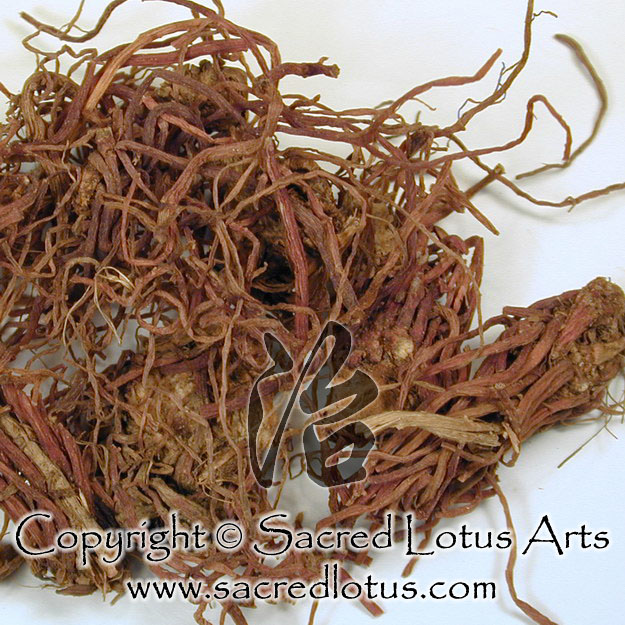
Materia Medica Data
- Temperature
- Slightly Warm
- Nature & Flavour
- Bitter, Slightly Warm, Sweet
- Channels Entered
- LU
- Latin (pharmaceutical)
- Radix Asteris Tatarici
- Chinese
- 紫菀
- Tone Marks
- zĭ wăn
Chinese Herb Actions
What is Zi Wan used for in Chinese medicine?
Zi Wan (Purple Aster Root) is traditionally used to stop cough and dispel phlegm while gently moistening the Lung. It is favored for cough with phlegm that is difficult or copious to expectorate — from externally-contracted wind-cold, from chronic Lung deficiency, or, with the right partners, in patterns with dryness or heat. Because it is warm yet not harshly drying, it suits both acute and chronic, deficient and excess coughs.
Its main traditional actions:
- Stops cough & dispels phlegm — cough with copious or difficult-to-expectorate sputum, including wind-cold cough.
- Moistens the Lung — chronic cough from Lung deficiency; usable in heat or dryness patterns when combined with cooling, moistening herbs.
- Directs Lung qi downward — addressing both acute and chronic cough.
Source: owner’s Five Branches notes, reviewed against Bensky, Materia Medica (3rd ed.). Traditional-use framing; not medical advice.
Chinese Herb Dosage
What is the typical dosage of Zi Wan?
5–10 g in decoction. The honey-processed form (mi zhi Zi Wan) is often preferred to enhance its moistening effect for chronic or dry coughs, while the raw herb is used where dispelling phlegm is the priority.
Source: owner’s Five Branches notes; standard materia medica ranges. Reference only — not a prescription.
Chinese Herb Contraindications & Cautions
Are there cautions or contraindications for Zi Wan?
Use Zi Wan with care in cough from Lung yin deficiency with heat. Because the herb is warm and drying by nature, in dry or heat patterns it should be paired with yin-nourishing, cooling, and moistening herbs rather than used alone.
Source: owner’s Five Branches notes; standard materia medica.
Chinese Herb Toxicity & Overdose
Low at normal oral therapeutic doses. A 2024 review reported a high acute-toxicity threshold in mice (LD50 15.74 g/kg), consistent with a wide margin at ordinary decoction doses. The same review flags that effects on the liver have been observed and that crude Aster saponins are strongly hemolytic — so raw saponin fractions are unsuitable for injection — and it calls for more thorough safety study.
Source: PubMed 39166058 / PMC 11334675 (comprehensive review, Heliyon 2024). Research context; oral decoction use is the traditional route.
Herb-Drug Interactions
No well-established clinical herb–drug interactions are documented. Modern data on Zi Wan is largely preclinical, and no reliable clinical interaction signal has been established. (Flagged for practitioner confirmation — absence of documented interactions is not proof of safety.)
Western / Biomedical Research
Chinese Herb Clinical Studies & Research
Provided as research context — a summary of published biomedical study, not a therapeutic or medical claim.
Is there modern research on Zi Wan (Aster tataricus)?
Yes, and it supports the traditional cough-and-phlegm use, though it is mostly preclinical. Characterized constituents include shionone and epi-friedelanol (triterpenes), astersaponins, caffeoylquinic acids, and astins (chlorinated cyclic peptides). An experimental study found the root has significant expectorant, antitussive, and anti-inflammatory effects, and concluded that caffeoylquinic acids, astersaponins, and aster peptides — rather than shionone — are likely the main active constituents, acting synergistically. A 2024 review corroborates the antitussive and expectorant activity alongside anti-inflammatory, antibacterial, antiviral, and antitumor findings, while noting that safety data remain incomplete. Human clinical evidence is limited.
Sources: PubMed 25701752 (expectorant, antitussive, anti-inflammatory activities & compositional analysis, J Ethnopharmacol 2015); PubMed 39166058 / PMC 11334675 (comprehensive review, Heliyon 2024). Research context, not a therapeutic claim.
Chinese Herb Notes
How does Zi Wan compare with Kuan Dong Hua and other cough herbs, and what is it combined with?
Zi Wan and Kuan Dong Hua are the classic cough-and-phlegm pair and are frequently combined. Zi Wan is the more warming, drying, phlegm-expelling of the two (better for cold, phlegm-laden cough), while Kuan Dong Hua stops cough and is more moistening and cooling (better for dry cough) — together they cover a broad range of coughs.
It also differs from its neighbors:
- vs Su Zi — both treat cold-induced cough; Su Zi additionally relieves a stifling sensation in the chest and directs qi downward.
- vs Bai Bu — both are used for chronic cough from internal injury; Bai Bu also expels parasites.
Common combinations: with Kuan Dong Hua for stubborn or chronic cough; with warming or moistening Lung herbs according to whether cold-phlegm or dryness predominates.
Source: owner’s Five Branches notes (comparison set & combinations); standard materia medica.
Sources & References
Compiled and edited by Thomas Dehli, Founder & Editor, Sacred Lotus Updated
The information here is referenced from numerous sources — teachers, practitioners, class notes from Five Branches University, the books below, and the published research literature, with citations given as resolvable PubMed identifiers. Where sources disagree, I have flagged the discrepancies directly. If facts couldn't be verified, I have left them out. How we source our content.
Reference information for students and practitioners — not medical advice. Consult a qualified practitioner. Terms of use.
Chinese Herbs Books & References
 https://amzn.to/3WfB3DK
 https://amzn.to/3DR1VUh
 https://amzn.to/42aMz73
 https://amzn.to/3PuD4bt