
Bu Fei Tang
Tonify the Lungs Decoction
- Category
- Formulas that Tonify
- Subcategory
- Formulas that Tonify the Qi
- Ingredients
- 6 herbs
Actions
What does Bu Fei Tang do?
Bu Fei Tang tonifies Lung qi, nourishes Lung Yin and Blood, and astringes Lung qi that has become loose and rebellious — treating a chronic, weak cough and shortness of breath that come from underlying deficiency, not from an invading pathogen. It builds up the Lung’s own qi rather than dispersing an external attack, which is what separates it from a surface-releasing cough formula.
- Tonifies Lung qi: the central action, restoring the qi that powers respiration and voice, carried chiefly by Huang Qi and Ren Shen.
- Nourishes Yin and Blood: Shu Di Huang enriches Blood and Yin so the tonification is not one-sidedly warming or drying for a condition that often runs alongside some fluid depletion.
- Astringes leaking Lung qi and calms wheeze: Wu Wei Zi’s sour astringency gathers scattered qi and reins in an overly loose breath.
- Directs Lung qi downward, stops cough: Zi Wan and Sang Bai Pi settle rebellious qi that is rising as cough and wheeze.
Source: Sacred Lotus sources & references (composition and identity; existing action note) + Bensky & Barolet, Formulas & Strategies; Chen & Chen, Chinese Herbal Formulas and Applications (action analysis). Traditional-use framing; not medical advice.
Indications
What is Bu Fei Tang used for?
Bu Fei Tang treats Lung qi deficiency — a chronic, low-grade pattern of weak breathing and cough that has been present long enough to exhaust the Lung’s own qi, rather than a fresh cough from wind-cold or wind-heat invasion.
- Chronic cough that is weak rather than forceful, worsening with exertion
- Shortness of breath and shallow breathing, aggravated by talking or activity
- A weak, low voice and general fatigue
- Spontaneous sweating and a tendency to catch colds easily (Wei-qi/exterior weakness alongside the Lung deficiency)
- A pale tongue and a deficient (weak, empty) pulse
Source: Sacred Lotus sources & references (pattern/tongue/pulse fields) + Bensky & Barolet, Formulas & Strategies. Traditional-use framing; not medical advice.
Ingredients
6 substances in Bu Fei Tang — each links to its full herb monograph.
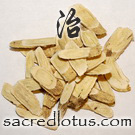 Huang Qi24 gTonify Qi
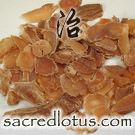 Ren Shen9 gTonify Qi
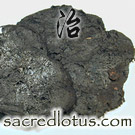 Shu Di Huang24 gTonify Blood
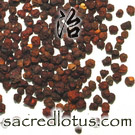 Wu Wei Zi6 gAstringe, Stabilize, Bind
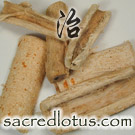 Sang Bai Pi12 gRelieve Coughing and Wheezing
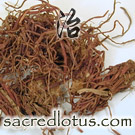 Zi Wan9 gRelieve Coughing and Wheezing
Preparation & dosage
How is Bu Fei Tang prepared?
Bu Fei Tang is taken as a decoction (tang), the herbs simmered together in water and the strained liquid drunk warm. Sacred Lotus sources & references record the reference proportions as Huang Qi 24 g, Shu Di Huang 24 g, Sang Bai Pi 12 g, Ren Shen 9 g, Zi Wan 9 g, and Wu Wei Zi 6 g — Huang Qi and Shu Di Huang at the highest doses, reflecting the formula’s dual qi-and-Yin/Blood tonifying emphasis.
- Herb substitution (per Sacred Lotus’s existing preparation note): 18–27 g of Dang Shen can be substituted for Ren Shen where a milder, more moderate qi tonic is preferred or Ren Shen is unavailable.
- Honey-fried (zhi) variants: Huang Qi and Zi Wan are each sometimes used in honey-fried form to reinforce their tonifying, moistening qualities, though the formula’s core recorded composition does not specify this processing.
Source: Sacred Lotus sources & references (composition and preparation) + Bensky & Barolet, Formulas & Strategies (decoction method).
Decoction. Reference relative amounts (Sacred Lotus sources & references): Huang Qi 24 g; Shu Di Huang 24 g; Sang Bai Pi 12 g; Ren Shen 9 g (18–27 g Dang Shen may be substituted); Zi Wan 9 g; Wu Wei Zi 6 g. Reference only; not a prescription.
Safety — read before use
What are the cautions for Bu Fei Tang?
Bu Fei Tang is a tonifying formula built for a genuine deficiency pattern and should not be used where cough or wheeze come from an active external pathogen (wind-cold, wind-heat) or from excess phlegm-heat, since its tonic, astringent herbs can “lock in” a pathogen that needs to be released, not sealed in.
- Avoid during an acute exterior invasion: fever, chills, or a floating pulse from a fresh wind-cold/wind-heat cough call for a releasing formula first, not a tonifying and astringing one.
- Avoid in excess, phlegm-heat, or damp-phlegm cough: a forceful cough with thick yellow or copious phlegm is not the deficiency pattern this formula is built for; tonifying herbs here can thicken phlegm or trap heat.
- Sacred Lotus’s existing caution notes “None Noted” for specific formal contraindications beyond standard pattern-matching; this should not be read as meaning the formula is appropriate for every cough — pattern differentiation still governs its use.
Source: Sacred Lotus sources & references (existing caution field) + Bensky & Barolet, Formulas & Strategies (deficiency-vs-excess pattern differentiation). Traditional-use framing; not medical advice.
Originally Appeared In:
- Everlasting Categorization of Seal Formulas (Yong Lei Qian Fang)
Notes:
How does Bu Fei Tang differ from Bu Zhong Yi Qi Tang and Yu Ping Feng San?
All three formulas use Huang Qi as a central herb, but they are built for three different problems: Bu Fei Tang tonifies and astringes Lung qi itself for chronic cough/wheeze; Bu Zhong Yi Qi Tang raises collapsed, sinking Middle-Jiao qi; and Yu Ping Feng San consolidates the exterior (Wei qi) to prevent recurrent colds. Confusing the three is the most common mistake made with this group of Huang Qi–based formulas.
- Bu Fei Tang (this formula): targets Lung qi deficiency directly — weak chronic cough, shortness of breath, and a low voice — using Ren Shen, Shu Di Huang, Wu Wei Zi, Zi Wan, and Sang Bai Pi alongside Huang Qi to tonify, nourish, astringe, and settle the Lung itself.
- Bu Zhong Yi Qi Tang (Tonify the Middle and Augment the Qi Decoction): uses Huang Qi with Sheng Ma and Chai Hu to lift qi that has sunk downward — organ prolapse, chronic diarrhea, or a sensation of sagging/heaviness — a sinking-qi problem, not a Lung-specific weak-cough problem.
- Yu Ping Feng San (Jade Windscreen Powder): just three herbs (Huang Qi, Bai Zhu, Fang Feng) that consolidate Wei qi at the body’s surface to reduce susceptibility to wind invasion and spontaneous sweating — a preventive, exterior-defense formula rather than a treatment for an already-established chronic cough.
Classical source and lineage: Bu Fei Tang is recorded in the Yong Lei Qian Fang (Formulas to Aid the Living), a Song-dynasty formulary compiled by Yan Yonghe (12th century) — one of several formulas of this name in the Chinese herbal literature, so composition should always be checked against the specific version referenced.
Source: Bensky & Barolet, Formulas & Strategies; Chen & Chen, Chinese Herbal Formulas and Applications (formula comparisons and classical source). Traditional-use framing.
Clinical Studies & Research:
Is there modern research on Bu Fei Tang and Huang Qi for Lung qi deficiency?
A 2014 systematic review in PLoS One of 25 randomized controlled trials (1,834 participants) found that oral Chinese herbal medicine added to standard pharmacotherapy for stable COPD improved the BODE index (by roughly 0.71 points) and six-minute walk distance (by roughly 55 meters) compared with pharmacotherapy alone, with Astragalus membranaceus (Huang Qi) the most frequently used herb, appearing in 18 of the formulas reviewed across 16 studies (PMID 24622390). This supports Huang Qi’s traditional role as a Lung/Qi tonic in chronic respiratory deficiency, though the authors cautioned that formula variation and methodological weaknesses in the underlying trials limit firm conclusions.
- Astragalus-based CHM + pharmacotherapy for stable COPD (systematic review/meta-analysis): improved BODE index and six-minute walk distance versus pharmacotherapy alone across 22 pooled RCTs (PMID 24622390).
- Shenqi Bufei Tang, COPD rat model with lung-qi-deficiency syndrome: a Bu Fei Tang–based formulation reduced NF-κB activity and MMP-9/TIMP-1 expression and narrowed airway-wall/smooth-muscle thickening versus untreated diseased rats in a smoke/SO2/papain-induced COPD model, though a glucocorticoid comparator performed better on some measures (PMID 19160802).
- Bufei Decoction, bleomycin-induced pulmonary fibrosis mouse model: reduced lung hydroxyproline content, inflammatory cell infiltration, and NF-κB activation versus untreated fibrotic mice over four weeks (PMID 32963571).
These studies use modified or Bu-Fei-Tang–family formulations in animal models or as an adjunct alongside standard pharmacotherapy, not the exact six-herb formula in isolation in human trials; they should be read as mechanistic and adjunctive-care context, not proof this specific formula treats COPD or pulmonary fibrosis.
Sources: PubMed 24622390 (PLoS One, 2014); PubMed 19160802 (Zhongguo Zhong Yao Za Zhi, 2008); PubMed 32963571 (Evidence-Based Complementary and Alternative Medicine, 2020). Research context, not a therapeutic claim.
Sources & References
Compiled and edited by Thomas Dehli, Founder & Editor, Sacred Lotus Updated
The information here is referenced from numerous sources — teachers, practitioners, class notes from Five Branches University, the books below, and the published research literature, with citations given as resolvable PubMed identifiers. Where sources disagree, I have flagged the discrepancies directly. If facts couldn't be verified, I have left them out. How we source our content.
Reference information for students and practitioners — not medical advice. Consult a qualified practitioner. Terms of use.
Chinese Formulas Books & References
 https://amzn.to/4fYI3f8
 https://amzn.to/4j55NRA
 https://amzn.to/4gMROyv
 https://amzn.to/4h7msSK