
Fructus Schisandrae Chinensis Schisandra Fruit
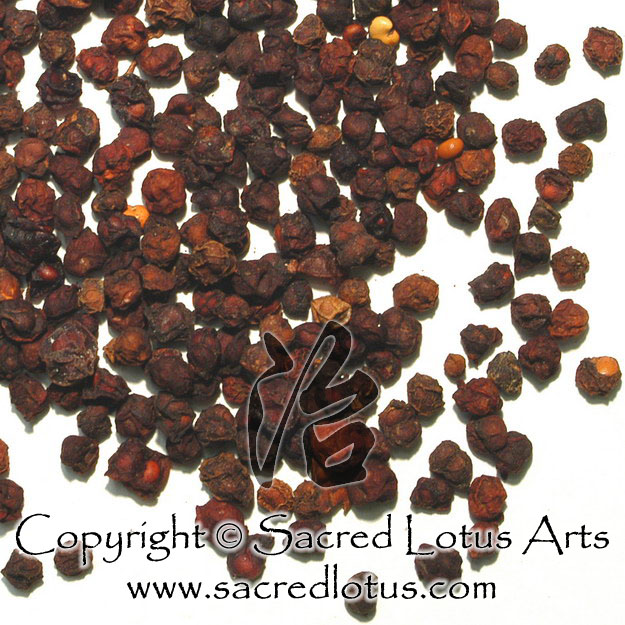
Materia Medica Data
- Category
- Herbs that Astringe, Stabilize, Bind
- Temperature
- Warm
- Nature & Flavour
- Sour, Warm
- Channels Entered
- HT, KI, LU
- Latin (pharmaceutical)
- Fructus Schisandrae Chinensis
- Chinese
- 五味子
- Tone Marks
- wŭ wèi zĭ
- Translation
- Five Flavored Seed
- Photo Note
- Nan Wu Wei Zi (Schisandra Sphenanthera Rehd. et Wils.) Shown
Chinese Herb Actions
What is Wu Wei Zi (Schisandra) used for in Chinese medicine?
Wu Wei Zi (Schisandra Fruit) is a sour, astringent fruit traditionally used to contain abnormal leakage — it astringes the Lung and stops chronic cough and wheezing, tonifies the Kidney and restrains Jing (essence) and fluids, checks excessive sweating and chronic diarrhea, generates fluids for thirst, and calms the Spirit.
Its main traditional actions:
- Astringes the Lung & tonifies the Kidney — chronic cough and wheezing from Lung and Kidney deficiency.
- Tonifies the Kidney & restrains Jing — spermatorrhea, nocturnal emission, chronic (daybreak) diarrhea, frequent urination, and vaginal discharge.
- Stops excessive sweating & generates fluids — spontaneous and night sweating; thirst and dry throat from fluid depletion.
- Calms the Spirit (Shen) — palpitations, insomnia, and irritability from Heart and Kidney disharmony.
Its name Wu Wei Zi means “five-flavor fruit” — all five tastes are detectable, with sour predominating.
Source: owner’s Five Branches notes (Bensky, Stabilize & Bind chapter); Sacred Lotus sources & references. Traditional-use framing; not medical advice.
Chinese Herb Dosage
What is the typical dosage of Wu Wei Zi?
1.5–6 g in decoction; 1–3 g when powdered. The fruit is traditionally crushed before decocting so the active constituents are released.
Source: owner’s Five Branches notes; standard materia medica ranges. Reference only — not a prescription.
Chinese Herb Contraindications & Cautions
Are there cautions or contraindications for Wu Wei Zi?
Because it is astringing, Wu Wei Zi is not used when a pathogen still needs to be released or heat cleared. It is traditionally contraindicated in early-stage exterior conditions (colds and flu), internal excess heat, and unexpressed or incompletely-vented rashes (e.g. measles), since trapping the pathogen can prolong or worsen these. It may occasionally cause heartburn.
Source: owner’s Five Branches notes (Stabilize & Bind cautions).
Chinese Herb Toxicity & Overdose
Low. No significant toxicity is reported at normal therapeutic doses; Schisandra fruit is regarded as a safe, food-grade substance. Mild heartburn or acid reflux is occasionally noted with the sour fruit.
Source: materia medica consensus; owner’s Five Branches notes. No toxicity signal in the reviewed research.
Herb-Drug Interactions
Yes — one clinically documented interaction class. Schisandra lignans strongly inhibit CYP3A (and intestinal P-glycoprotein), and clinical studies show Wu Wei Zi extract raises blood levels of the immunosuppressant tacrolimus (FK506) roughly 1.64–5.0-fold, with similar effects reported for cyclosporine. It should therefore not be combined with CYP3A4/P-gp–dependent drugs (e.g. tacrolimus, cyclosporine, certain statins, paclitaxel) without professional supervision; prolonged use can conversely induce CYP3A. (Flagged for practitioner confirmation.)
Source: PMC 8962666 (review of Schisandra lignan CYP450 / P-glycoprotein interactions, including human tacrolimus data). Practitioner reference, not a therapeutic claim.
Western / Biomedical Research
Chinese Herb Clinical Studies & Research
Provided as research context — a summary of published biomedical study, not a therapeutic or medical claim.
Is there modern research on Schisandra (Wu Wei Zi)?
Yes, though it is largely preclinical, with the strongest signal around the liver. A 2025 systematic review and meta-analysis of 54 animal studies (1,314 animals) found that Schisandra chinensis significantly lowered the liver-injury markers ALT and AST across acetaminophen, alcohol and carbon-tetrachloride models, while raising antioxidant defenses (SOD, GSH) and reducing inflammatory cytokines (TNF-α, IL-6). The authors flag significant heterogeneity, positive-result bias, and the absence of human trials.
Sources: PMC 12358260 (PMID 40832608; systematic review & preclinical meta-analysis, liver injury); PMC 8962666 (review of lignan pharmacology and CYP450/P-gp effects). Research context, not a therapeutic claim.
Chinese Herb Notes
How is Wu Wei Zi different from Shan Zhu Yu and other astringents?
Wu Wei Zi and Shan Zhu Yu are both sour astringents that also tonify, but they work on different systems. Wu Wei Zi centers on the Lung, Kidney and qi (cough, sweating, Jing, Shen), while Shan Zhu Yu centers on the Liver, Kidney and essence. This makes Wu Wei Zi the choice when leakage shows as chronic cough, sweating, or diarrhea.
It also differs from its close neighbors:
- vs Shan Zhu Yu — both tonify while astringing; Wu Wei Zi enters Lung/Kidney/qi, Shan Zhu Yu enters Liver/Kidney/essence.
- vs Wu Mei — Wu Mei also generates fluids and kills parasites and focuses on binding the intestines and Lung, without the same Kidney-tonifying action.
Common combinations:
- with Xi Xin and Gan Jiang — for chronic cough and wheezing with thin cold fluids in the Lung.
- with Mai Men Dong and Ren Shen (or Dang Shen) — the Sheng Mai San framework, for qi-and-fluid depletion with a weak pulse and palpitations.
- in Si Shen Wan (with Bu Gu Zhi, Rou Dou Kou, Wu Zhu Yu) — daybreak diarrhea from Spleen and Kidney yang deficiency.
- with tonic seeds (the Wu Zi Yan Zong framework) — to secure Kidney essence.
Source: owner’s Five Branches notes (differentiation set & combinations).
Sources & References
Compiled and edited by Thomas Dehli, Founder & Editor, Sacred Lotus Updated
The information here is referenced from numerous sources — teachers, practitioners, class notes from Five Branches University, the books below, and the published research literature, with citations given as resolvable PubMed identifiers. Where sources disagree, I have flagged the discrepancies directly. If facts couldn't be verified, I have left them out. How we source our content.
Reference information for students and practitioners — not medical advice. Consult a qualified practitioner. Terms of use.
Chinese Herbs Books & References
 https://amzn.to/3WfB3DK
 https://amzn.to/3DR1VUh
 https://amzn.to/42aMz73
 https://amzn.to/3PuD4bt