
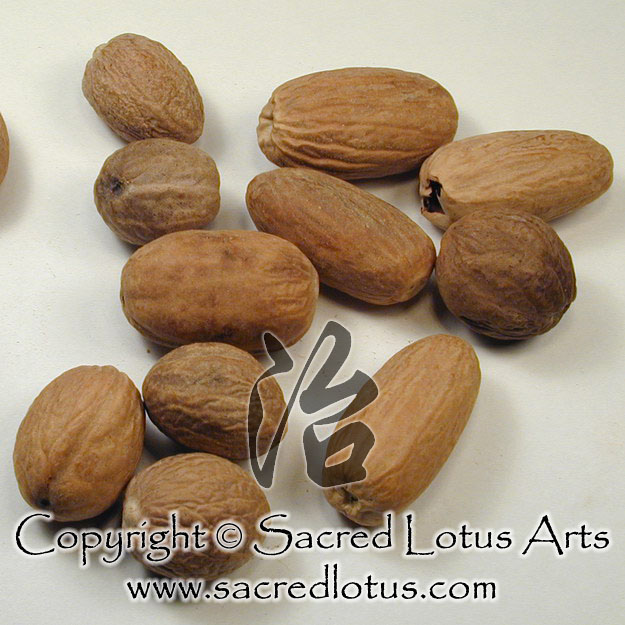
Materia Medica Data
- Category
- Herbs that Astringe, Stabilize, Bind
- Temperature
- Warm
- Nature & Flavour
- Spicy, Warm
- Channels Entered
- LI, SP, ST
- Latin (pharmaceutical)
- Semen Myristicae Fragrantis
- Chinese
- 肉豆蔻
- Tone Marks
- ròu dòu kòu
- Translation
- Fleshy Cardamom
Chinese Herb Actions
What is Rou Dou Kou (nutmeg) used for in Chinese medicine?
Rou Dou Kou (Nutmeg Seed) binds up the Intestines to stop chronic diarrhea and warms the Spleen and Stomach while moving qi. Its primary role is long-standing diarrhea from Spleen and Kidney yang deficiency — including daybreak (“cockcrow”) diarrhea — where its astringency checks the leakage and its warmth relieves the underlying cold. It is almost always used dry-roasted (see Cautions) so the warming, binding action predominates.
Its main traditional actions:
- Binds the Intestines, stops chronic diarrhea — chronic diarrhea and daybreak diarrhea from Spleen/Kidney yang deficiency; the key role in Si Shen Wan.
- Warms the Middle (Spleen & Stomach) — cold-from-deficiency with abdominal cold, pain, and reduced appetite.
- Moves qi — epigastric and abdominal distension, fullness, nausea, or vomiting from cold obstructing the Middle.
Source: owner’s Five Branches notes, reviewed against Bensky, Materia Medica (3rd ed.). Traditional-use framing; not medical advice.
Chinese Herb Dosage
What is the typical dosage of Rou Dou Kou?
1.5–6 g in decoction; 1.5–3 g when taken as powder. It should be used dry-roasted (wei, 煨) — wrapped in flour paste or bran and roasted to draw off the volatile oil — not raw. Sources differ modestly on the upper limit (some materia medica extend to ~9 g).
Source: owner’s Five Branches notes; standard materia medica ranges (range variance kept and flagged). Reference only — not a prescription.
Chinese Herb Contraindications & Cautions
Are there cautions or contraindications for Rou Dou Kou?
Do not use it for diarrhea or dysentery from heat or damp-heat, and use only the dry-roasted form. Its astringent, warming nature can trap a heat or damp-heat pathogen, so it is inappropriate where there is fever, foul or burning stool, or unresolved food stagnation. The raw seed is oily and irritating; roasting (wei) removes much of the volatile oil that would otherwise loosen the stool and carries the toxicity concern noted below.
Source: owner’s Five Branches notes; materia medica consensus.
Chinese Herb Toxicity & Overdose
Small, dry-roasted medicinal doses are considered safe; large doses of nutmeg are genuinely toxic because of myristicin. Nutmeg contains myristicin, a phenylpropanoid that at large recreational or accidental doses (well above culinary or medicinal amounts) produces a delayed neurotoxic syndrome — hallucinations, agitation or delirium, anticholinergic-type signs (dry mouth, flushing, dilated pupils), tachycardia and palpitations, nausea, and dizziness, with onset often several hours after ingestion; severe cases with seizures and electrolyte disturbance are on record. This is a real, honestly-noted toxicity, not a reason to avoid ordinary dry-roasted therapeutic use.
Sources: PubMed 33987899 (Myristicaceae phytochemistry & toxicity review, Phytother Res 2021); PubMed 26294051 (seizures in severe nutmeg intoxication); PubMed 37915877 & 39559662 (nutmeg intoxication case reports). Reference context, not a therapeutic or dosing claim.
-
This herb is considered toxic.
(while some Chinese herbs are toxic, it must be noted that many come prepared, or are combined, to mitigate their toxicity)
Herb-Drug Interactions
No well-established clinical herb–drug interactions are documented at therapeutic doses. Myristicin shows weak monoamine-oxidase-inhibiting activity in laboratory studies, so theoretical caution alongside MAO inhibitors or serotonergic drugs is reasonable, particularly with large doses. (Flagged for practitioner confirmation — absence of documented interactions is not proof of safety.)
Western / Biomedical Research
Chinese Herb Clinical Studies & Research
Provided as research context — a summary of published biomedical study, not a therapeutic or medical claim.
Is there modern research on Rou Dou Kou (nutmeg)?
Yes, mostly preclinical, and it aligns with the traditional antidiarrheal use. In a rat model of spleen-kidney yang-deficiency diarrhea, extract of Er Shen Wan — the two-herb Rou Dou Kou + Bu Gu Zhi formula — reduced diarrhea and normalized the intestinal water-transport proteins aquaporin-4 (AQP4) and NHE3, offering a fluid-metabolism mechanism for the classical indication. Broader reviews of Myristica fragrans catalogue antidiarrhoeal, anti-inflammatory, neuroprotective, and antimicrobial activity, while noting human clinical trials remain few.
Sources: PubMed 29571254 (Er Shen Wan reduces diarrhea, regulates AQP4/NHE3, Biomed Pharmacother 2018); PubMed 41275940 (Myristica fragrans comprehensive review, J Ethnopharmacol 2026); PubMed 33987899 (Myristicaceae pharmacology & toxicity review). Research context, not a therapeutic claim.
Chinese Herb Notes
How is Rou Dou Kou combined and how does it differ from similar herbs?
Rou Dou Kou is the warming, binding herb for cold-type chronic diarrhea; it is paired for daybreak diarrhea and distinguished from the aromatic “dou kou” herbs and from He Zi. Because it both astringes and warms, it fits patterns where leakage and interior cold occur together.
Common combinations:
- With Bu Gu Zhi, Wu Zhu Yu & Wu Wei Zi — the Si Shen Wan (“Four Miracle Pill”) framework for Spleen/Kidney-yang daybreak diarrhea; the Rou Dou Kou + Bu Gu Zhi core is Er Shen Wan.
- With Mu Xiang and dry ginger (Gan Jiang) — for cold abdominal pain, distension, and poor appetite.
How it differs:
- vs Bai Dou Kou / Cao Dou Kou — despite the shared “dou kou” name these are aromatic herbs that transform dampness in the Middle; Rou Dou Kou instead astringes the Intestines to bind diarrhea.
- vs He Zi — both bind the Intestines, but He Zi also astringes the Lung for chronic cough and loss of voice, whereas Rou Dou Kou warms the Middle and moves qi.
Source: owner’s Five Branches notes (combinations & differentiation set).
Sources & References
Compiled and edited by Thomas Dehli, Founder & Editor, Sacred Lotus Updated
The information here is referenced from numerous sources — teachers, practitioners, class notes from Five Branches University, the books below, and the published research literature, with citations given as resolvable PubMed identifiers. Where sources disagree, I have flagged the discrepancies directly. If facts couldn't be verified, I have left them out. How we source our content.
Reference information for students and practitioners — not medical advice. Consult a qualified practitioner. Terms of use.
Chinese Herbs Books & References
 https://amzn.to/3WfB3DK
 https://amzn.to/3DR1VUh
 https://amzn.to/42aMz73
 https://amzn.to/3PuD4bt