

Actions
What does Si Shen Wan do?
Si Shen Wan warms and tonifies Kidney yang, warms the Spleen, and astringes the Large Intestine to stop chronic early-morning diarrhea. Its four ingredients (hence “Four Miracle/Miraculous Pill”) form a tightly matched pair of warming tonics and a pair of astringents, aimed at the specific pattern where Kidney fire is too weak to warm the Spleen at the point in the daily cycle when yang is at its lowest ebb.
- Warms and tonifies Kidney yang — Bu Gu Zhi restores Mingmen (Life Gate) fire, the root of the pattern.
- Warms the Spleen and disperses cold — Wu Zhu Yu warms the middle and descends counterflow qi, reinforcing Bu Gu Zhi's warmth.
- Astringes the intestines to stop diarrhea — Rou Dou Kou and Wu Wei Zi bind and stabilize once the underlying cold is being addressed, rather than simply stopping the symptom in isolation.
Source: composition (4 herbs, confirmed amounts) from Sacred Lotus sources & references; action/role analysis cross-referenced against multiple online sources and Bensky & Barolet, Formulas & Strategies. Traditional-use framing; not medical advice.
Indications
What is Si Shen Wan used for?
Si Shen Wan treats “daybreak diarrhea,” also called cock-crow diarrhea — loose stool that reliably wakes the patient in the very early morning hours, caused by Kidney yang too weak to warm and hold the Spleen through the night. The timing is the clinical signature: the pattern is defined as much by when the diarrhea happens as by its character.
- Loose stool or diarrhea occurring in the pre-dawn hours (traditionally around the fifth night watch, roughly 3–5am), often waking the patient from sleep.
- Undigested food visible in the stool, reflecting weak digestive fire.
- Cold, sore, or weak lower back and knees — classic Kidney yang deficiency signs.
- Cold limbs and general fatigue, worse toward the end of the night.
- Poor appetite and a preference for warmth.
Tongue and pulse: pale tongue with a thin, white coat; a slow, deep, and weak pulse — both pointing to yang deficiency-cold rather than damp-heat or food-stagnation diarrhea.
Source: indications cross-referenced against multiple online sources and Bensky & Barolet, Formulas & Strategies; tongue/pulse fields from Sacred Lotus sources & references. Traditional-use framing; not medical advice.
Western Uses:
What conditions is Si Shen Wan used for in modern practice?
Si Shen Wan warms Spleen and Kidney yang to stop "cock-crow" (daybreak) diarrhoea — the early-morning, painless, chronic loose stools of yang deficiency — so it is referenced for chronic cold-type diarrhoeal conditions: chronic or habitual pre-dawn diarrhoea in chronic colitis, chronic dysentery, and intestinal tuberculosis.
It is chosen for the Spleen-Kidney-yang-deficiency pattern, not for a diagnosis. Chronic diarrhoea, a change in bowel habit, or blood in the stool require medical assessment (inflammatory bowel disease and cancer must be excluded), and intestinal tuberculosis needs medical treatment. Traditional-use correlates only, not a treatment claim.
Source: Sacred Lotus sources & references (pattern) + Bensky & Barolet, Formulas & Strategies; biomedical correlates as reference only. Not medical advice.
Ingredients
4 substances in Si Shen Wan — each links to its full herb monograph.
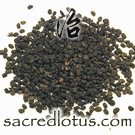 Bu Gu Zhi120 gTonify Yang
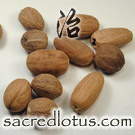 Rou Dou Kou60 gAstringe, Stabilize, Bind
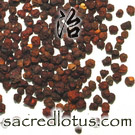 Wu Wei Zi60 gAstringe, Stabilize, Bind
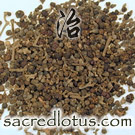 Wu Zhu Yu30 gWarm the Interior and Expel Cold
Preparation & dosage
How is Si Shen Wan prepared, and why is it taken before sleep?
Si Shen Wan is classically prepared as a pill: the four herbs are ground to a fine powder, then bound into pills using a paste made by decocting fresh ginger and jujube in water, and the dose is taken once daily just before bed. Taking the dose before sleep is deliberate — the pattern it treats is defined by diarrhea that strikes in the pre-dawn hours, so the medicinal is timed to be acting at full strength precisely when Kidney yang is at its weakest point in the daily cycle, rather than taken the next morning after the episode has already occurred.
In modern practice the same four herbs are also decocted as a standard tea in the same relative ratio and taken in the evening; some clinicians add fresh ginger and jujube directly into the decoction rather than using them only as a pill-binding paste.
Source: classical pill preparation and evening-dosing rationale cross-referenced against multiple online sources and Bensky & Barolet, Formulas & Strategies. Traditional-use framing; not medical advice.
Safety — read before use
What are the cautions for Si Shen Wan?
Si Shen Wan is a warming, astringent formula for deficiency-cold diarrhea — it is contraindicated in diarrhea or dysentery from damp-heat, food stagnation, or an active external pathogen, where warming and astringing could worsen the condition by trapping heat or undigested material inside.
- Not for damp-heat or infectious-type diarrhea — fever, a burning sensation, tenesmus, or foul-smelling stool point to heat rather than cold, and astringing a heat-type diarrhea traditionally risks trapping the pathogen.
- Not for acute food-stagnation diarrhea — undigested-food diarrhea from overeating needs to be cleared, not bound, before a tonifying/astringent approach is appropriate.
- Bu Gu Zhi (Psoralea) and liver safety: Psoralea corylifolia has been identified in modern case reports and pharmacovigilance literature as a potential cause of drug-induced liver injury; a 2026 study specifically addresses mitigating Psoralea-corylifolia-induced hepatotoxicity (PMID 41482088). This is a general herb-safety reference, not a statement about this formula's typical short-course clinical use, but supports professional supervision for extended use.
- Rou Dou Kou (nutmeg) dose sensitivity: nutmeg is well known to be toxic (myristicin, causing hallucination, tachycardia, or nausea) at doses well above typical formula amounts — this formula uses culinarily scaled, not raw high-dose, nutmeg, and the amount should not be exceeded.
- Pregnancy: traditionally used with caution given Wu Zhu Yu's warming, descending, blood-moving character; use should be supervised by a qualified practitioner.
Source: cautions cross-referenced against multiple online sources and Bensky & Barolet, Formulas & Strategies; PMID 41482088 (Psoralea corylifolia hepatotoxicity). Reference note, not medical advice.
Originally Appeared In:
- Standards of Patterns and Treatments (Zheng Zhi Zhun Sheng)
Notes:
How does Si Shen Wan differ from Li Zhong Wan and Zhen Ren Yang Zang Tang?
Si Shen Wan is distinguished from other warming diarrhea formulas by its narrow, time-specific target — Kidney yang deficiency causing diarrhea specifically before dawn — rather than a broader Spleen-centered cold or a more heavily astringent chronic-diarrhea pattern.
- vs Li Zhong Wan (Regulate the Middle Pill): Li Zhong Wan (Ren Shen, Bai Zhu, Gan Jiang, Zhi Gan Cao) treats Spleen yang/middle-jiao cold directly — vomiting, diarrhea, and abdominal cold that can occur at any time of day — and contains no astringent herbs. Si Shen Wan instead treats a Kidney-rooted, dawn-specific pattern and relies on Rou Dou Kou and Wu Wei Zi to bind the Intestines once the cold has been warmed.
- vs Zhen Ren Yang Zang Tang (True Man's Decoction to Nourish the Organs): Zhen Ren Yang Zang Tang is a far stronger astringent formula (built around Ying Su Ke, poppy husk) for long-standing, unremitting chronic diarrhea or dysentery with possible rectal prolapse, combined with qi and blood tonics — a more depleted, more advanced presentation than the relatively contained, time-specific pattern Si Shen Wan addresses.
Classical source: traditionally attributed to the Ming-dynasty physician Xue Ji (Xue Kai), from his text Nei Ke Zhai Yao (Essentials of Internal Medicine), early 16th century.
Source: formula comparison cross-referenced against multiple online sources and Bensky & Barolet, Formulas & Strategies; classical attribution from the same reference.
Clinical Studies & Research:
Is there modern research on Si Shen Wan?
Yes, though direct clinical trial evidence is limited to a modified-formula study in diarrhea-predominant IBS, alongside newer preclinical work exploring mechanisms in colon cancer and insomnia. The strongest clinical signal is a randomized trial testing a modified version of the formula against a placebo comparator.
- Diarrhea-predominant irritable bowel syndrome (multicenter RCT): a randomized, double-blind, placebo-controlled trial of 240 patients found a modified Sishen Wan (“warming the kidney and fortifying the spleen”) achieved a 92.2% total effective rate versus 49.1% for placebo, with a lower 6-month recurrence rate (15.8% vs 56.9%, P<0.01) (PMID 24660584).
- Colon cancer (preclinical mechanism): in colon cancer cell lines and a mouse tumor model, Sishen-Wan-treated serum induced apoptosis and suppressed proliferation, with the tumor model showing roughly 71% inhibition at a medium dose via dual PI3K/AKT/mTOR and STAT3-mitophagy pathway modulation (PMID 41490553; DOI 10.1016/j.jep.2025.121039).
- Insomnia (network pharmacology + animal model): in rat insomnia models, Sishen Wan increased non-REM sleep duration and shortened sleep latency in a dose-dependent manner, with bioinformatic analysis pointing to the 5-HT1A receptor as a key target (PMID 36288650; DOI 10.1016/j.phymed.2022.154500).
Sources: PMID 24660584; PMID 41490553 (DOI 10.1016/j.jep.2025.121039); PMID 36288650 (DOI 10.1016/j.phymed.2022.154500). Research context on modern GI, oncology, and sleep-mechanism study, not a therapeutic claim for the formula's classical daybreak-diarrhea indication specifically — the IBS-D trial used a modified version of the formula, not the classical four-herb prescription alone.
Sources & References
Compiled and edited by Thomas Dehli, Founder & Editor, Sacred Lotus Updated
The information here is referenced from numerous sources — teachers, practitioners, class notes from Five Branches University, the books below, and the published research literature, with citations given as resolvable PubMed identifiers. Where sources disagree, I have flagged the discrepancies directly. If facts couldn't be verified, I have left them out. How we source our content.
Reference information for students and practitioners — not medical advice. Consult a qualified practitioner. Terms of use.
Chinese Formulas Books & References
 https://amzn.to/4fYI3f8
 https://amzn.to/4j55NRA
 https://amzn.to/4gMROyv
 https://amzn.to/4h7msSK