
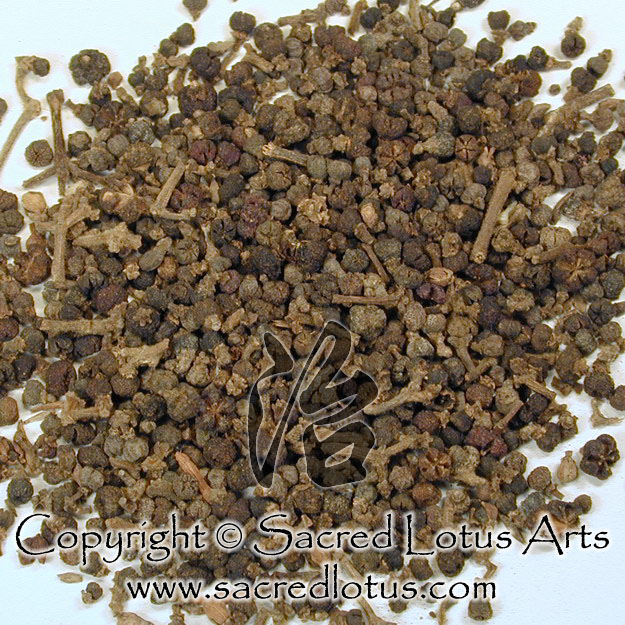
Materia Medica Data
- Temperature
- Hot
- Nature & Flavour
- Spicy, Bitter, Hot, Slightly Toxic, Very Dry
- Channels Entered
- KI, LIV, SP, ST
- Latin (pharmaceutical)
- Fructus Evodiae Rutaecarpae
- Chinese
- 吴茱萸
- Tone Marks
- wú zhū yú
Chinese Herb Actions
What is Wu Zhu Yu used for in Chinese medicine?
Wu Zhu Yu (Evodia Fruit) is a warm, acrid herb traditionally used to warm the Middle and disperse cold, direct rebellious qi downward, and stop pain and vomiting — for cold-type vertex headache, epigastric and flank pain, acid reflux, and cold hernia. It also warms the Spleen and Kidneys to stop cold or daybreak (cockcrow) diarrhea. Because it is hot and slightly toxic, it is used in small doses.
Its main traditional actions:
- Disperses cold, warms the Liver channel & stops pain — vertex (jue yin) headache, epigastric and abdominal pain, flank pain, cold hernia.
- Directs rebellious qi downward, stops vomiting & acid reflux — nausea, vomiting, and acid regurgitation from Liver–Stomach disharmony.
- Warms the Spleen & Kidneys, stops diarrhea — cold or early-morning (daybreak) diarrhea and damp-cold leg qi.
Source: owner’s Five Branches notes, reviewed against standard materia medica. Traditional-use framing; not medical advice.
Chinese Herb Dosage
What is the typical dosage of Wu Zhu Yu?
Small doses — typically 1.5–4.5 g in decoction, because the herb is hot, drying, and slightly toxic; the Chinese Pharmacopoeia lists 2–5 g. It is commonly stir-fried (often processed with licorice) to moderate its harshness, and used only for short courses.
Source: owner’s Five Branches notes; Chinese Pharmacopoeia dose via PubMed 36790599 (PMC 9931992). Reference only — not a prescription.
Chinese Herb Contraindications & Cautions
Are there cautions or contraindications for Wu Zhu Yu?
Wu Zhu Yu is hot, very drying, and slightly toxic, so it is used only in small doses and for short periods. It can injure qi and fluids and is traditionally avoided in patterns of heat from Yin deficiency; caution is advised in pregnancy. Do not exceed customary small doses.
Source: owner’s Five Branches notes; standard materia medica.
Chinese Herb Toxicity & Overdose
Slightly toxic — used deliberately in small, short-term doses. Wu Zhu Yu is classified as a slightly toxic, warm herb. Modern reviews report that irrational or high-dose use can cause dose-related adverse effects including stomach ache, vomiting, and blurred vision, and that its constituents — the alkaloids evodiamine and rutaecarpine, quinolone alkaloids, and the volatile oil — carry a hepatotoxicity signal in laboratory studies. Traditional processing (stir-frying, often with licorice) and small dosing are used to temper it. These are laboratory and case findings, not a concern at customary therapeutic doses.
Source: PubMed 36790599 (Euodiae Fructus review, Nat Prod Bioprospect 2023, PMC 9931992); PubMed 32738391 (evodiamine review, J Ethnopharmacol 2020). Research context, not medical advice.
-
This herb is considered slightly toxic.
(while some Chinese herbs are toxic, it must be noted that many come prepared, or are combined, to mitigate their toxicity)
Herb-Drug Interactions
No well-established clinical herb–drug interactions are documented, but caution is reasonable. Preclinical studies indicate Evodia alkaloids can modulate cytochrome P450 drug-metabolizing enzymes (notably CYP1A2), a theoretical basis for altered levels of drugs cleared by that pathway. (Flagged for practitioner confirmation — absence of documented clinical interactions is not proof of safety.)
Western / Biomedical Research
Chinese Herb Clinical Studies & Research
Provided as research context — a summary of published biomedical study, not a therapeutic or medical claim.
Is there modern research on Wu Zhu Yu (Evodia)?
Yes, but it is largely preclinical. The most-studied constituents are the alkaloids evodiamine and rutaecarpine, which show analgesic, anti-inflammatory, anti-tumor, and cardiovascular/vasodilatory activity in cell and animal models; rutaecarpine has been studied for cardiovascular protection via targets such as TRPV1 and CGRP. Human clinical evidence remains limited, and the same alkaloids carry the dose-related toxicity noted above.
Sources: PubMed 32738391 (evodiamine review, J Ethnopharmacol 2020); PubMed 30616017 (rutaecarpine cardiovascular review); PubMed 36790599 (Euodiae Fructus review, 2023). Research context, not a therapeutic claim.
Chinese Herb Notes
How does Wu Zhu Yu compare with other warming herbs, and what is it combined with?
Wu Zhu Yu, Gan Jiang, and Gao Liang Jiang all disperse cold from the Middle burner and ease cold epigastric pain — but Wu Zhu Yu is distinct. It also warms the Lower burner (for cold hernia and diarrhea) and, uniquely among them, directs rebellious Liver–Stomach qi downward to stop vertex headache, vomiting, and acid reflux.
Key differentiations:
- vs Gan Jiang — Gan Jiang more locally warms the Spleen and Lungs, transforms phlegm and stops cough.
- vs Gao Liang Jiang — warms the Stomach for epigastric pain and cold with belching or vomiting, without the Liver-channel headache action.
Common combinations: with Huang Lian in roughly a 6:1 ratio (Zuo Jin Wan) for Liver fire invading the Stomach with acid regurgitation — bitter, cold Huang Lian drains the fire while a little Wu Zhu Yu directs it downward; with Ren Shen, Sheng Jiang and Da Zao (Wu Zhu Yu Tang) for cold jue-yin headache with vomiting; with Sheng Jiang for cold-type nausea and vomiting.
Source: owner’s Five Branches notes (paired-herb differentiation & combinations).
Sources & References
Compiled and edited by Thomas Dehli, Founder & Editor, Sacred Lotus Updated
The information here is referenced from numerous sources — teachers, practitioners, class notes from Five Branches University, the books below, and the published research literature, with citations given as resolvable PubMed identifiers. Where sources disagree, I have flagged the discrepancies directly. If facts couldn't be verified, I have left them out. How we source our content.
Reference information for students and practitioners — not medical advice. Consult a qualified practitioner. Terms of use.
Chinese Herbs Books & References
 https://amzn.to/3WfB3DK
 https://amzn.to/3DR1VUh
 https://amzn.to/42aMz73
 https://amzn.to/3PuD4bt