
Actions
What does Ji Ming San do?
Ji Ming San (Cock’s Crow Powder) moves qi and drives cold-damp turbidity downward and out of the legs. It is the classic formula for jiao qi (“leg qi”) — cold-damp obstruction settling in the lower limbs — pairing strongly descending, qi-moving herbs with a single ascending herb that keeps the formula’s action from pulling entirely in one direction.
The seven ingredients divide by role:
- Chief: Bing Lang (Betel Nut) — the highest-dosed herb in the formula; it moves qi and drives damp-cold turbidity downward, out of the legs.
- Deputies: Mu Gua (Chinese Quince Fruit) relaxes the sinews, harmonizes the Stomach, and helps transform dampness, especially where there is cramping or spasm in the calves; Wu Zhu Yu (Evodia Fruit) warms and disperses cold and directs counterflow qi downward, reinforcing Bing Lang’s descending action.
- Assistants: Chen Pi (Tangerine Peel) and Zi Su Ye (Perilla Leaf) regulate qi and help resolve dampness and stagnation; Sheng Jiang (Fresh Ginger) warms the middle and disperses cold alongside Wu Zhu Yu.
- Envoy: Jie Geng (Root of the Balloon Flower) is the formula’s one ascending, opening herb — it raises qi through the chest, balancing the strongly downward action of the other six herbs so the qi mechanism is not driven entirely downward.
Source: this site’s own composition record/dosage + Bensky & Barolet, Formulas & Strategies (chief/deputy/assistant/envoy analysis for damp-expelling formulas), cross-checked against secondary formula summaries. Traditional-use framing; not medical advice.
Indications
What is Ji Ming San used for?
Ji Ming San treats jiao qi (“leg qi”) caused by cold-damp accumulation in the legs and feet. Its name, “Cock’s Crow Powder,” refers to the classical instruction to take it at dawn, before the day’s first food.
Its classic clinical presentation:
- Legs and feet: heaviness, weakness, swelling, numbness, or coldness of the calves and feet with difficulty walking; cramping or spasm that can travel upward toward the abdomen and chest in more severe cases.
- Middle and upper body (severe cases): fullness or oppression in the chest and epigastrium, nausea.
Because Wu Zhu Yu and Bing Lang are warming and moving rather than heat-clearing, the pattern addressed is specifically cold-damp; leg qi arising from damp-heat or from dryness/yin deficiency needs a different formula or substantial modification.
Source: this site’s own composition record + Bensky & Barolet, Formulas & Strategies. Traditional-use framing; not medical advice.
Western Uses:
What is Ji Ming San used for in modern practice?
Jiao Qi, the pattern Ji Ming San addresses, is the historical Chinese medical description that modern medical history identifies with beriberi (thiamine/vitamin B1 deficiency). The term jiao qi (“foot qi”) appears as early as the 3rd century, in Ge Hong’s Zhou Hou Bei Ji Fang, describing swelling, weakness, and numbness beginning in the feet and legs — the same territory Ji Ming San is classically used to treat.
This is offered as a historical/reference correlate for jiao qi as a traditional pattern, not a claim that Ji Ming San treats thiamine deficiency or any diagnosed disease: thiamine supplementation, not an herbal formula, is the appropriate treatment for confirmed deficiency, and TCM further divides beriberi-type presentations into several distinct patterns (of which cold-damp leg qi is only one) needing different formulas. A diagnosed nutritional or neurological condition belongs with a qualified medical provider.
Source: Wikipedia, “Thiamine deficiency” (historical jiao qi/beriberi terminology, Ge Hong, Zhou Hou Bei Ji Fang); TCM pattern differentiation cross-referenced against multiple online sources on beriberi in Chinese medicine. Reference only, not a treatment claim.
Ingredients
7 substances in Ji Ming San — each links to its full herb monograph.
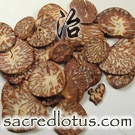 Bing Lang36-45 gExpel Parasites
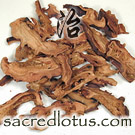 Mu Gua30 gDispel Wind-Dampness
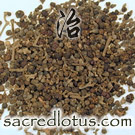 Wu Zhu Yu6 gWarm the Interior and Expel Cold
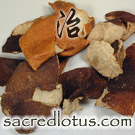 Chen Pi30 gRegulate the Qi
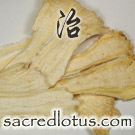 Jie Geng15 gWarm Herbs that Transform Phlegm-Cold
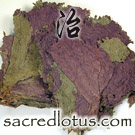 Zi Su Ye9 gWarm, Spicy Herbs that Release the Exterior
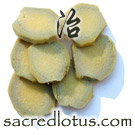 Sheng Jiang15 gWarm, Spicy Herbs that Release the Exterior
Preparation & dosage
How is Ji Ming San prepared?
Ji Ming San ("Powder Taken at the Fifth Watch / Rooster Crow") is classically a powder, though it is commonly prepared today as a water decoction (tang) of Bing Lang, Mu Gua, Wu Zhu Yu, Chen Pi, Zi Su Ye, Jie Geng and Sheng Jiang.
Its name records the traditional timing: it was taken in the pre-dawn hours ("at cock-crow"), on an empty stomach, for the damp leg-qi (jiao qi) it treats. Modern practice decreases all the doses by roughly two-thirds from the classical amounts. Available as granules.
Source: Sacred Lotus sources & references (composition and preparation note) + Bensky & Barolet, Formulas & Strategies.
Decoction, classically taken as a single dose at dawn on an empty stomach, before breakfast (see notes). Reference relative amounts from the current formula composition: Bing Lang 36-45 g; Chen Pi, Mu Gua 30 g; Jie Geng, Sheng Jiang 15 g; Zi Su Ye 9 g; Wu Zhu Yu 6 g. For standard modern decoction, dosages are commonly reduced (see preparation). Reference only.
Safety — read before use
What are the cautions for Ji Ming San?
Ji Ming San is a strongly warming, qi-moving, downward-directing formula, so it is not appropriate for leg qi from damp-heat or from dryness/yin deficiency without substantial modification. Two of its herbs carry individual cautions that shape the whole formula’s profile: Wu Zhu Yu is hot and very drying and is traditionally avoided in heat from yin deficiency; Bing Lang can weaken the qi and is used cautiously with Middle-Jiao qi deficiency or loose stools.
- Pregnancy: contains Bing Lang (used with extreme caution in pregnancy) and Wu Zhu Yu (also cautioned in pregnancy) — use only under professional guidance.
- Not for damp-heat or dry/yin-deficient leg qi without significant modification, since the formula’s warming, drying herbs would aggravate heat or dryness.
- Digestive fit: those with pre-existing qi deficiency or loose stools should use cautiously, given Bing Lang’s qi-breaking action.
Source: Sacred Lotus herb monographs for Bing Lang and Wu Zhu Yu, cross-checked against secondary formula summaries noting the damp-heat/dryness contraindication. Traditional-use framing; not medical advice.
Originally Appeared In:
- Effective Medical Formulas Arranged by Category by Doctor Zhu (Lei Bian Zhu Shi Ji Yan Yi Fang)
Notes:
Why is Ji Ming San taken at dawn, at “cock’s crow”?
Ji Ming San is classically taken as a single strong dose at daybreak, on an empty stomach, before any food. “Ji ming” means “cock’s crow,” the traditional marker of dawn. Dosing before breakfast, while yang qi is rising and the stomach is still empty, was intended to let the formula’s downward-moving, damp-dispersing action work unimpeded by the digestion of food.
Because the formula is built almost entirely around warming, moving, and drying herbs, it is generally modified rather than used unchanged once the cold-damp pattern shifts toward heat or dryness (see cautions).
Source: multiple online sources describing the classical dawn, empty-stomach dosing instruction. Traditional-use framing; not medical advice.
Clinical Studies & Research:
Is there modern research on Ji Ming San?
Yes, though it is limited to preclinical studies of the whole formula in animal and cell models, not clinical trials in people, and not in its classical jiao qi indication. Two recent lines of work tested Ji Ming San (the formula, not an isolated compound) against unrelated inflammatory endpoints.
- Osteoarthritis (preclinical): in macrophage and chondrocyte cell models and in rat models of joint inflammation, a Ji Ming San extract reduced inflammatory markers (iNOS, COX-2, MMP-13, PGE2) and decreased paw swelling and cartilage degradation (PMID 36584922, Journal of Ethnopharmacology, 2023).
- Intestinal circadian rhythm and colitis (preclinical): in a mouse model combining circadian disruption (jet lag) with colitis, Ji Ming San activated epithelial ROR-alpha, restored the clock proteins BMAL1 and PER2, and reduced colitis severity; the effect required epithelial ROR-alpha (PMID 40252431, Phytomedicine, 2025).
Sources: PubMed 36584922; PubMed 40252431. Research context on the formula in animal/cell models, not a therapeutic claim; direct clinical-trial evidence for Ji Ming San’s classical jiao qi indication was not found.
Sources & References
Compiled and edited by Thomas Dehli, Founder & Editor, Sacred Lotus Updated
The information here is referenced from numerous sources — teachers, practitioners, class notes from Five Branches University, the books below, and the published research literature, with citations given as resolvable PubMed identifiers. Where sources disagree, I have flagged the discrepancies directly. If facts couldn't be verified, I have left them out. How we source our content.
Reference information for students and practitioners — not medical advice. Consult a qualified practitioner. Terms of use.
Chinese Formulas Books & References
 https://amzn.to/4fYI3f8
 https://amzn.to/4j55NRA
 https://amzn.to/4gMROyv
 https://amzn.to/4h7msSK