
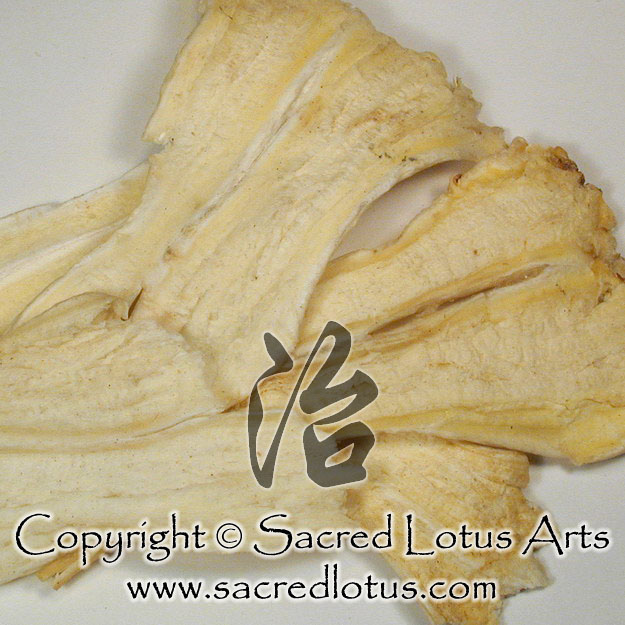
Platycodi Radix Root of the Balloon Flower
Also known as Ku Jie Geng, Bai Jie Geng, Yu Jie Geng
Materia Medica Data
- Temperature
- Neutral
- Nature & Flavour
- Bitter, Spicy, Neutral
- Channels Entered
- LU (ST)
- Latin (pharmaceutical)
- Platycodi Radix
- Chinese
- 桔梗
- Tone Marks
- jié gĕng
- Also Known As
- Ku Jie Geng, Bai Jie Geng, Yu Jie Geng
- Translation
- Solid and Straight Root
Chinese Herb Actions
What is Jie Geng used for in Chinese medicine?
Jie Geng (Balloon Flower Root) opens and disseminates Lung qi, transforms phlegm, and benefits the throat — it is considered one of the most important herbs for Lung disorders, treating cough or wheezing with profuse phlegm, sore throat or pain, and loss of voice or hoarseness. It is used for phlegm-cough due to either Wind-Heat or Wind-Cold.
Its main traditional actions:
- Opens/disseminates Lung qi, dispels phlegm, benefits the throat — cough or wheezing with profuse phlegm, sore or painful throat, loss of voice/hoarseness; effective whether the pattern is Wind-Heat or Wind-Cold.
- Expels pus — one of the strongest herbs for pus and abscess of the Lung and throat, especially with chest pain, fever, cough with blood and pus, thick yellow sticky sputum, and a foul fishy-smelling discharge (the Lung-abscess presentation).
- Raises Lung qi and Large Intestine qi — for diarrhea, rectal tenesmus, anuria, and edema and other patterns of Sunken Qi.
- Guides/directs other herbs upward — classically used as a “messenger” or guiding herb that carries a formula’s action to the upper body (Lung and throat), which is why it appears in so many unrelated formula categories.
Source: Sacred Lotus legacy content (Chen & Chen, Chinese Medical Herbology and Pharmacology; Bensky, Materia Medica, 3rd ed.), reformatted.
Chinese Herb Dosage
What is the typical dosage of Jie Geng?
3–9 g in decoction — this range is consistent across both Chen & Chen and Bensky, and matches our existing dosage record. As with most Lung-qi–raising herbs, it is typically used as one component of a formula rather than alone.
Source: Chen & Chen, Chinese Medical Herbology and Pharmacology; Bensky, Materia Medica (3rd ed.). Reference only — not a prescription.
Chinese Herb Contraindications & Cautions
Are there cautions for Jie Geng?
Use with caution in chronic cough due to Yin deficiency, and use with caution for cough with blood-streaked sputum — Jie Geng’s acrid, dispersing, and draining qualities can aggravate both patterns. It is generally not the first choice where the picture is dryness/deficiency rather than excess phlegm.
Source: Sacred Lotus legacy content (Chen & Chen; Bensky), reformatted.
Chinese Herb Toxicity & Overdose
Low at standard decoction doses, but overdose has recognized effects. The legacy materia-medica record notes that excessive dosing can cause nausea and vomiting, sweating, exhaustion, and restlessness. This is consistent with Jie Geng’s chemistry: its triterpenoid saponins (platycodin D and related platycosides) are GI-irritant and, in isolated/injected form, hemolytic — effects that are far more relevant to concentrated extracts than to a normal 3–9 g decoction dose taken orally.
Source: Sacred Lotus legacy content; saponin pharmacology reviewed in PMID 37089949 / PMC 10117678 / DOI 10.3389/fphar.2023.1148853. Reference note, not a safety guarantee.
Herb-Drug Interactions
No well-established clinical herb–drug interactions are documented for Jie Geng. Preclinical work reports that Platycodon grandiflorum saponins (including platycodin D) inhibit platelet aggregation and show anticoagulant activity in laboratory/animal studies; this has not been demonstrated as a clinical interaction, but it is a reasonable basis for practitioner awareness in patients on anticoagulant or antiplatelet therapy. (Precautionary, flagged for practitioner confirmation, not a demonstrated clinical interaction.)
Source: platycodin D pharmacology review, PMID 37089949 / PMC 10117678 / DOI 10.3389/fphar.2023.1148853.
Western / Biomedical Research
Chinese Herb Clinical Studies & Research
Provided as research context — a summary of published biomedical study, not a therapeutic or medical claim.
Is there modern research on Jie Geng (Platycodon grandiflorus)?
Yes — substantial preclinical (cell and animal) pharmacology on Jie Geng’s saponins supports several of its traditional Lung/throat actions, though controlled human clinical trials are still lacking. The best-studied active constituent is platycodin D, a triterpenoid saponin, alongside related platycosides, flavonoids, and polysaccharides.
- Pharmacology review (preclinical synthesis) — a 2023 review of platycodin D describes anti-inflammatory, antiviral, antioxidant, anticoagulant, antiobesity, and antitumor activity across multiple cell-signaling pathways, consistent with the breadth of traditional uses but drawn mainly from cell and animal studies.
- Cough and airway inflammation (animal models) — a fermented Platycodon grandiflorum extract reduced cough-reflex sensitivity in guinea pigs and lowered airway inflammatory markers (TNF-α, IL-6, IL-1β, IL-17E) in a mouse asthma/airway-inflammation model, offering preclinical support for the traditional “dispels phlegm, benefits the throat” action.
- Lung inflammation mechanism (cell/animal) — Platycodonis Radix reduced LPS-induced lung inflammation in mice via modulation of TRPA1 ion channels; among the platycodins tested, platycodin D3 showed the strongest TRPA1 binding and most effectively suppressed LPS-induced TRPA1 expression in bronchial epithelial cells.
Overall, the evidence base is preclinical and mechanistic rather than clinical; no controlled human trials establishing efficacy for cough, sore throat, or lung abscess were located.
Sources: PMID 37089949, PMC 10117678, DOI 10.3389/fphar.2023.1148853 (platycodin D pharmacology review); PMID 32758004, DOI 10.1089/jmf.2019.4595 (fermented Platycodon extract, cough reflex/airway inflammation, animal study); PMID 37446875, PMC 10343319, DOI 10.3390/molecules28135213 (Platycodonis Radix, LPS lung inflammation, TRPA1 modulation). Research context, not a therapeutic claim.
Chinese Herb Notes
Why is Jie Geng called a “guiding” or “messenger” herb, and what does it combine with?
Jie Geng is one of the classic examples of a “guiding” (envoy/messenger) herb in Chinese medicine — beyond its own actions on phlegm, cough, and the throat, it is added to formulas specifically to direct the combined action of the other ingredients upward to the Lung and throat, even in formulas whose main pattern lies elsewhere (e.g. skin, urinary, or Heart-related formulas below).
Classic pairing: Jie Geng combined with Gan Cao (Platycodon and Licorice Decoction, Jie Geng Tang, from the Shang Han Lun) is a textbook pair for sore, swollen throat — Gan Cao moderates Jie Geng’s dispersing, slightly harsh action while both herbs benefit the throat.
It appears in a wide range of formulas in the Sacred Lotus database, reflecting its guiding role, including: Yin Qiao San and Sang Ju Yin (Wind-Heat, sore throat/cough), Zhi Sou San and Xing Su San (cough with phlegm), Bai He Gu Jin Tang and Bei Mu Gua Lou San (Lung dryness/phlegm-heat), Ji Ming San, Jiu Xian San, Chai Ge Jie Ji Tang, Huo Xiang Zheng Qi San, Wu Ji San, Fang Feng Tong Sheng San, Pu Ji Xiao Du Yin and Qing Wen Bai Du Yin (toxic-heat/epidemic patterns), Ren Shen Bai Du San and Huang Long Tang (releasing the exterior while supporting the interior), Shen Ling Bai Zhu San (Spleen qi with some Lung involvement), Jia Jian Wei Rui Tang, Xue Fu Zhu Yu Tang (guides qi/blood-moving action upward in the chest), and Tian Wang Bu Xin Dan (guides the formula’s nourishing action upward). (Traditional formula context, not treatment advice.)
Source: Sacred Lotus formula–herb links; Bensky, Materia Medica (3rd ed.) and Formulas & Strategies (2nd ed.) for the guiding-herb concept and the Jie Geng–Gan Cao pair.
Sources & References
Compiled and edited by Thomas Dehli, Founder & Editor, Sacred Lotus Updated
The information here is referenced from numerous sources — teachers, practitioners, class notes from Five Branches University, the books below, and the published research literature, with citations given as resolvable PubMed identifiers. Where sources disagree, I have flagged the discrepancies directly. If facts couldn't be verified, I have left them out. How we source our content.
Reference information for students and practitioners — not medical advice. Consult a qualified practitioner. Terms of use.
Chinese Herbs Books & References
 https://amzn.to/3WfB3DK
 https://amzn.to/3DR1VUh
 https://amzn.to/42aMz73
 https://amzn.to/3PuD4bt