
Bei Mu Gua Lou San Bèi Mǔ Guā Lóu Sàn
Fritillaria and Trichosanthes Fruit Powder
- Category
- Formulas that Treat Phlegm
- Ingredients
- 6 herbs
Actions
What does Bei Mu Gua Lou San do?
Bei Mu Gua Lou San moistens Lung dryness while it transforms phlegm, clears residual heat, and gently redirects rebellious Lung qi so a dry, hard-to-clear cough settles. Its defining feature is doing all of this without the warm, drying herbs that ordinary phlegm formulas rely on — a dry-phlegm cough needs moisture added back in, not moisture driven off.
- Moistens Lung dryness: the primary action — restoring fluids to a Lung that has become dry, rather than draining dampness from a wet one.
- Transforms phlegm: loosens sputum that has become thick and sticky from dryness, so it can be raised and expectorated rather than staying lodged.
- Clears heat: addresses the mild residual heat that commonly accompanies Lung dryness and thickens the phlegm further.
- Regulates qi, directs Lung qi downward: eases the qi movement that carries phlegm out, easing the cough reflex itself.
Source: Sacred Lotus sources & references (composition and identity) + Bensky & Barolet, Formulas & Strategies; Chen & Chen, Chinese Herbal Formulas and Applications (action analysis). Traditional-use framing; not medical advice.
Indications
What is Bei Mu Gua Lou San used for?
Bei Mu Gua Lou San treats a dry cough from Lung dryness with phlegm present but hard to bring up — a pattern distinct from a wet, easily-expectorated phlegm cough, and one where drying phlegm formulas would make the underlying dryness worse.
- Dry, harsh cough with scant, sticky sputum that is difficult to expectorate
- A sensation of dryness or a “stuck” feeling in the throat and chest
- Dry mouth and throat, sometimes with mild thirst
- Occasional wheezing or a sense of tightness on breathing out
- A dry, red tongue with little coating and a thin, rapid or thin, slippery pulse
Source: Sacred Lotus sources & references (pattern/tongue/pulse fields) + Bensky & Barolet, Formulas & Strategies. Traditional-use framing; not medical advice.
Western Uses:
What conditions is Bei Mu Gua Lou San used for in modern practice?
Bei Mu Gua Lou San moistens the Lung and transforms the thick, hard-to-expectorate phlegm of a dryness-with-phlegm cough, so it is referenced for dry, sticky-phlegm respiratory pictures: sore throat, bronchitis, tracheitis, loss of voice (aphonia), and the chronic cough of pulmonary emphysema.
It is chosen for the Lung-dryness-with-phlegm pattern, not for a diagnosis. A cough lasting more than three weeks, or with blood, breathlessness, fever, or weight loss, requires medical assessment; emphysema (COPD) is a serious chronic condition needing medical management, and persistent hoarseness must be evaluated. Traditional-use correlates only, not a treatment claim.
Source: Sacred Lotus sources & references (pattern) + Bensky & Barolet, Formulas & Strategies; biomedical correlates as reference only. Not medical advice.
Ingredients
6 substances in Bei Mu Gua Lou San — each links to its full herb monograph.
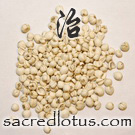 Chuan Bei Mu4.5 gCool and Transform Phlegm-Heat
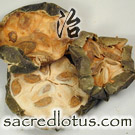 Gua Lou3 gCool and Transform Phlegm-Heat
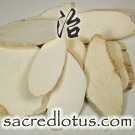 Tian Hua Fen2.4 gCool and Transform Phlegm-Heat
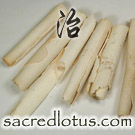 Fu Ling2.4 gRegulate Water and Drain Dampness
 Ju Hong2.4 gRegulate the Qi
 Jie Geng2.4 gWarm Herbs that Transform Phlegm-Cold
Preparation & dosage
How is Bei Mu Gua Lou San prepared?
Bei Mu Gua Lou San is classically a powder (san) — the herbs ground fine and taken as a draft, though it is very commonly decocted as a tea in modern practice, which is how it is generally used today. Sacred Lotus sources & references record the reference proportions as Chuan Bei Mu 4.5 g, Gua Lou 3 g, and Tian Hua Fen, Fu Ling, Ju Hong, and Jie Geng at 2.4 g each.
- Chuan Bei Mu: traditionally powdered and stirred into the strained decoction, or simmered briefly, since prolonged high-heat decoction can diminish its more volatile constituents.
- As a powder (the formula’s namesake form, “san”): the herbs are ground to a fine powder and taken in measured doses, traditionally with a thin rice-water or warm water vehicle.
- As a decoction (modern common practice): the herbs are simmered together and the strained liquid taken warm, in one to two divided doses per day.
Source: Sacred Lotus sources & references (composition and preparation) + Bensky & Barolet, Formulas & Strategies (classical powder form and modern decoction practice).
Classically a powder (san); commonly decocted as a tea in modern practice. Reference relative amounts (Sacred Lotus sources & references): Chuan Bei Mu 4.5 g; Gua Lou 3 g; Tian Hua Fen, Fu Ling, Ju Hong, and Jie Geng 2.4 g each. Reference only; not a prescription.
Safety — read before use
What are the cautions for Bei Mu Gua Lou San?
Bei Mu Gua Lou San is a moistening, phlegm-resolving formula for dryness and should not be used for a cough from Yin deficiency with pronounced empty-heat, thirst, and night sweating, where a more strongly fluid-nourishing approach is indicated instead. It is likewise not suited to a wet, copious phlegm-damp cough, which needs drying rather than moistening treatment.
- Avoid in Yin-deficiency patterns with pronounced dry cough, thirst, and night sweating (per Sacred Lotus’s existing caution), where the fluid deficit runs deeper than plain Lung dryness.
- Not for wet, damp-phlegm cough: copious, easily-expectorated white sputum calls for a warm, drying formula such as Er Chen Tang, not a moistening one.
- The eighteen incompatibilities (shi ba fan): Bei Mu-type herbs are classically listed as incompatible with aconite-type herbs (Wu Tou/Fu Zi) and should not be combined with them.
Source: Sacred Lotus sources & references (existing caution) + Bensky & Barolet, Formulas & Strategies (pattern-differentiation and eighteen-incompatibilities note). Traditional-use framing; not medical advice.
Originally Appeared In:
- Medical Revelations (Yi Xue Xin Wu)
Notes:
How does Bei Mu Gua Lou San differ from Er Chen Tang and other phlegm formulas?
The essential contrast is moistening versus drying: Bei Mu Gua Lou San moistens Lung dryness while it transforms phlegm; Er Chen Tang dries dampness while it transforms phlegm. The two sit at opposite ends of the phlegm-formula spectrum and are chosen by reading which direction the fluids have gone wrong, not simply by the presence of phlegm.
- Er Chen Tang (Two-Cured Decoction): built on warm, drying Ban Xia and aged citrus peel for damp-phlegm — copious, easily-expectorated white sputum, a swollen tongue with a greasy coating, and a slippery pulse. Using it on a dry, hard-to-clear cough would deplete fluids further and worsen the dryness.
- Sang Xing Tang / Sang Ju Yin-type formulas: address a milder, more superficial warm-dry pattern (early autumn-dryness cough with a thin coating), whereas Bei Mu Gua Lou San is reserved for dryness that has thickened phlegm enough to make it genuinely difficult to expectorate.
- Qing Zao Jiu Fei Tang (Eliminate Dryness and Rescue the Lung Decoction): treats a more severe warm/dry-pathogen pattern with more pronounced heat signs and greater fluid damage, often following a febrile disease, whereas Bei Mu Gua Lou San is used for a comparatively milder, chronic-leaning Lung-dryness cough.
Classical source: Bei Mu Gua Lou San is recorded in the Yi Xue Xin Wu (Medical Revelations), compiled by the Qing-dynasty physician Cheng Zhongling (Cheng Guo-Peng) in 1732 — an influential clinical formulary still referenced for its clear pattern-differentiation teaching.
Source: Bensky & Barolet, Formulas & Strategies; Chen & Chen, Chinese Herbal Formulas and Applications (formula comparisons and classical source). Traditional-use framing.
Clinical Studies & Research:
Is there modern research on Bei Mu Gua Lou San and its herbs?
There is no clinical trial of Bei Mu Gua Lou San as a whole formula in the PubMed literature we could verify, but its two chief herb pairs each have supporting pharmacological research consistent with the formula’s traditional antitussive, expectorant use. A 2020 systematic review of Fritillariae Cirrhosae Bulbus (Chuan Bei Mu) summarizes centuries of traditional use to “relieve cough and eliminate phlegm” and reports that its alkaloid constituents show antitussive, expectorant, and anti-inflammatory effects in pharmacological studies, alongside a favorable toxicity profile (PMID 33273948).
- Fritillariae Cirrhosae Bulbus (Chuan Bei Mu), systematic review: traditional antitussive/expectorant use supported by alkaloid-driven anti-inflammatory and antitussive activity in preclinical pharmacology, with respiratory conditions including asthma and COPD as areas of interest (PMID 33273948).
- Trichosanthis Pericarpium – Trichosanthis Radix compatibility study: screening the combination ratio of these two Trichosanthes kirilowii–derived herbs (the plant source shared with this formula’s Gua Lou and Tian Hua Fen) found a 1:2 ratio produced the strongest anti-inflammatory effect in a zebrafish model and significantly reduced cough frequency while prolonging cough latency in a mouse cough model, with proposed mechanisms via TLR4/STAT3/EGFR/AKT1 signaling (PMID 37634750).
This is herb-level and formula-adjacent evidence, not a clinical trial of the finished Bei Mu Gua Lou San formula; it should be read as mechanistic support for the traditional indication, not as proof of clinical efficacy.
Sources: PubMed 33273948 (Evidence-Based Complementary and Alternative Medicine, 2020); PubMed 37634750 (Journal of Ethnopharmacology, 2024). Research context, not a therapeutic claim.
Sources & References
Compiled and edited by Thomas Dehli, Founder & Editor, Sacred Lotus Updated
The information here is referenced from numerous sources — teachers, practitioners, class notes from Five Branches University, the books below, and the published research literature, with citations given as resolvable PubMed identifiers. Where sources disagree, I have flagged the discrepancies directly. If facts couldn't be verified, I have left them out. How we source our content.
Reference information for students and practitioners — not medical advice. Consult a qualified practitioner. Terms of use.
Chinese Formulas Books & References
 https://amzn.to/4fYI3f8
 https://amzn.to/4j55NRA
 https://amzn.to/4gMROyv
 https://amzn.to/4h7msSK