

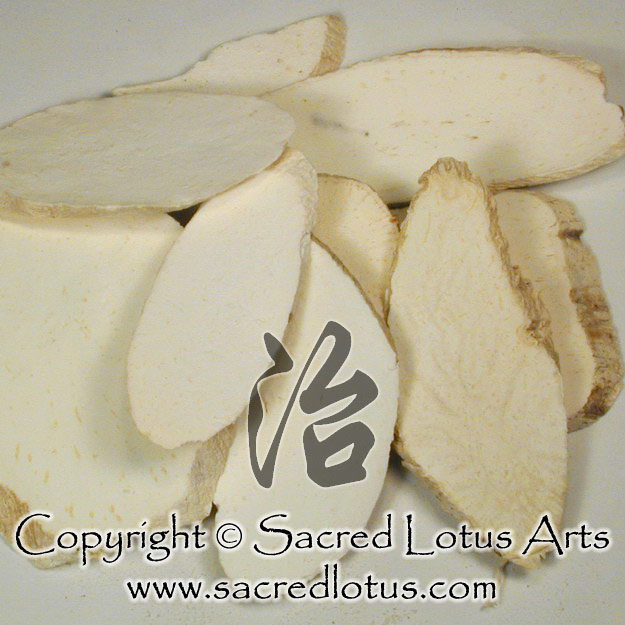
Tian Hua Fen (Trichosanthes Root)
Trichosanthis Kirlowii Radix Trichosanthes Root
Materia Medica Data
- Temperature
- Cold
- Nature & Flavour
- Bitter, Slightly Sweet, Cold
- Channels Entered
- LU, ST
- Latin (pharmaceutical)
- Trichosanthis Kirlowii Radix
- Chinese
- 天花粉
- Tone Marks
- tiān huā fēn
- Translation
- Heavenly Flower Powder
Chinese Herb Actions
What is Tian Hua Fen used for in Chinese medicine?
Tian Hua Fen (Trichosanthes root) is traditionally used to clear heat, generate fluids, reduce swelling, and expel pus — for thirst and dryness patterns (irritability, dry mouth/lips/tongue, desire for cold drinks), “wasting-and-thirsting” disorders, dry cough with thick or blood-streaked sputum, and sores or abscesses with heat and swelling. Sacred Lotus records its properties as bitter, slightly sweet, cold, entering the Lung and Stomach channels.
Its main traditional actions:
- Clears heat and generates fluids — irritability, dry lips/mouth/tongue, thirst with a desire for cold beverages, and wasting-thirst disorders.
- Clears Lung heat, transforms phlegm, moistens the Lung — dry cough with thick, sticky, or blood-streaked sputum that is difficult to expectorate.
- Reduces swelling and expels pus (used both internally and topically) — breast abscesses, carbuncles, and sores with redness, swelling, and pain; also traditionally used for hemorrhoids.
Source: Sacred Lotus sources & references; cross-referenced against multiple online sources and materia medica consensus (Bensky, Materia Medica, 3rd ed.; Chen & Chen, Chinese Herbal Medicine: Materia Medica). Traditional-use framing; not medical advice.
Chinese Herb Dosage
What is the typical dosage of Tian Hua Fen?
Roughly 10–15 g in decoction, with an upper ceiling near 30 g — consistent across sources: Chen & Chen give 10–15 g (maximum 30 g) and Bensky gives 10–15 g. The dried root is used, sometimes processed into a fine powder (the name “Tian Hua Fen” literally means “heavenly flower powder”).
Source: Sacred Lotus sources & references (Chen & Chen, Bensky ranges recorded); cross-referenced against multiple online sources. Reference only — not a prescription.
Chinese Herb Contraindications & Cautions
Are there cautions for Tian Hua Fen?
Tian Hua Fen must not be used in pregnancy — this is an explicit, well-documented contraindication. The Sacred Lotus record lists this directly, consistent with the abortifacient research literature on trichosanthin discussed below. It is also used cautiously in Spleen/Stomach cold-deficiency (poor appetite, loose stools, cold limbs) given its cold nature, and is traditionally listed as incompatible with the aconite herbs Wu Tou and Fu Zi.
- Pregnancy — absolute contraindication (see safety/research below for the supporting evidence).
- Cold/deficient Spleen–Stomach — use with caution; may aggravate digestive cold-deficiency.
- Herb incompatibility — traditionally not combined with Wu Tou or Fu Zi (aconite), part of the classical “eighteen incompatibilities” (shi ba fan) tradition.
Source: Sacred Lotus sources & references; cross-referenced against multiple online sources and materia medica consensus (incompatibility tradition, pregnancy contraindication). Neutral safety reference, not usage instructions.
Chinese Herb Toxicity & Overdose
Is Tian Hua Fen safe, and why is it contraindicated in pregnancy?
Tian Hua Fen’s pregnancy contraindication rests on trichosanthin, a ribosome-inactivating protein in the root that was purified and used clinically in China as an injectable to terminate pregnancy — animal studies documented abortion rates around 64–80% with purified trichosanthin, and it saw clinical use for mid-trimester pregnancy termination in China from the 1970s–90s. That evidence base concerns a concentrated, purified, injected protein extract, not the crude root taken as a typical decoction — but it is the scientific basis for why materia medica sources uniformly list pregnancy as an absolute contraindication for the whole herb as well, as a precaution.
- Purified/injectable trichosanthin (research and historical clinical use) — studied and used in China as a mid-trimester abortifacient, and separately studied experimentally (as “Compound Q”/GLQ223) in HIV research in the early 1990s; a distinct, concentrated pharmaceutical preparation, not the herb as traditionally decocted.
- Allergic reaction / anaphylaxis (documented, injectable route) — trichosanthin is highly immunogenic; case, clinical-trial, and animal literature describe hypersensitivity reactions and anaphylaxis with injectable dosing, prompting research into PEGylation and other modifications specifically to reduce this immunogenicity.
- Whole-herb toxicity (oral, traditional dose) — Sacred Lotus records note no significant toxicity for the whole herb at traditional decoction doses; rare reported side effects include headache, dermatitis, sore throat, and muscle stiffness, with rarer reports of swelling, low blood pressure, arrhythmia, or bleeding tendencies.
Source: Sacred Lotus sources & references; cross-referenced against multiple online sources and materia medica consensus. Research: PMID 8097505, PMID 7357871, PMID 3372132 (abortifacient/pregnancy-termination research, purified trichosanthin); PMID 21783570, PMID 3158165, PMID 10421422 (anaphylaxis/immunogenicity, injectable route); PMID 1572389 (clinical HIV-research context, injectable GLQ223). This is neutral safety/reference information, not usage instructions.
-
This herb is considered slightly toxic.
(while some Chinese herbs are toxic, it must be noted that many come prepared, or are combined, to mitigate their toxicity)
Herb-Drug Interactions
No well-established interaction data exist for oral Tian Hua Fen at traditional decoction doses. The relevant safety literature concerns the purified, injectable protein trichosanthin, which has documented immune/hypersensitivity effects and was studied experimentally alongside antiretroviral therapy in HIV research in the early 1990s — a specialized clinical-research context, not a typical herb–drug interaction. (Flagged for practitioner awareness; not applicable to routine oral use.)
Western / Biomedical Research
Chinese Herb Clinical Studies & Research
Provided as research context — a summary of published biomedical study, not a therapeutic or medical claim.
Is there modern research on Tian Hua Fen / trichosanthin (Trichosanthes kirilowii)?
Yes — but most modern research concerns trichosanthin, the purified ribosome-inactivating protein isolated from the root, studied for abortifacient, immunomodulatory/antitumor, and (experimentally) antiviral activity; this is largely separate from research on the crude decocted herb itself.
- Abortifacient / pregnancy termination (historical + preclinical) — studies in mice and rabbits documented reliable, reversible abortion with purified trichosanthin, and parallel work identified trichosanthin among a family of related abortifacient, ribosome-inactivating plant proteins. Purified protein, injectable route — not equivalent to oral herb dosing.
- Immunomodulatory / antitumor activity — laboratory research on trichosanthin isolated from Tian Hua Fen reports immunomodulatory and antitumor effects alongside its historic clinical abortifacient use in China.
- Reducing immunogenicity — site-directed PEGylation has been studied to reduce hypersensitivity reactions and extend activity, reflecting the recognized allergy/anaphylaxis problem with repeated injectable dosing.
- Clinical HIV research (historical) — trichosanthin (as GLQ223) was studied clinically for HIV-associated immune dysregulation in the early 1990s; hypersensitivity reactions were a limiting factor in this line of research, which did not lead to approved therapy.
Overall: a substantial pharmacological literature exists on the isolated protein trichosanthin; direct clinical research on the traditional decocted whole root is comparatively sparse.
Sources: PMID 8097505; PMID 7357871; PMID 3372132; PMID 3492210; PMID 10421422; PMID 1572389. Research context concerns the isolated protein trichosanthin; not evidence for, or a claim about, typical oral herb dosing.
Chinese Herb Notes
How is Tian Hua Fen different from Gua Lou (Trichosanthes fruit)?
Tian Hua Fen and Gua Lou come from the same plant, Trichosanthes kirilowii, but are different parts used for different emphases — Tian Hua Fen is the root, favored for generating fluids and treating thirst/dryness and pus-filled sores; Gua Lou is the fruit, favored for clearing phlegm-heat from the chest and moistening the intestines.
- Tian Hua Fen (root) — clears heat, generates fluids, reduces swelling, expels pus; the go-to herb for wasting-thirst dryness patterns.
- Gua Lou (fruit) / Gua Lou Ren (seed) — clears heat-phlegm from the chest, opens the chest, and (seed) moistens the intestines.
Common combinations: with Bei Mu (Fritillaria) to clear Lung heat, transform phlegm, and moisten Lung dryness — the pairing behind Bei Mu Gua Lou San (in the Sacred Lotus formula records). It also appears in Xian Fang Huo Ming Yin (clearing heat-toxin, reducing swelling, and expelling pus in early-stage sores), Yu Ye Tang (qi and yin deficiency with dryness / wasting-thirst disorder), and Fu Yuan Huo Xue Tang (invigorating blood after trauma) — all present in the Sacred Lotus formula records. (Traditional formula context, not treatment advice.)
Source: Sacred Lotus sources & references (Bei Mu Gua Lou San, Xian Fang Huo Ming Yin, Yu Ye Tang, Fu Yuan Huo Xue Tang formula links); cross-referenced against multiple online sources and materia medica consensus for the Tian Hua Fen/Gua Lou distinction.
This herb is incompatible with:
Sources & References
Compiled and edited by Thomas Dehli, Founder & Editor, Sacred Lotus Updated
The information here is referenced from numerous sources — teachers, practitioners, class notes from Five Branches University, the books below, and the published research literature, with citations given as resolvable PubMed identifiers. Where sources disagree, I have flagged the discrepancies directly. If facts couldn't be verified, I have left them out. How we source our content.
Reference information for students and practitioners — not medical advice. Consult a qualified practitioner. Terms of use.
Chinese Herbs Books & References
 https://amzn.to/3WfB3DK
 https://amzn.to/3DR1VUh
 https://amzn.to/42aMz73
 https://amzn.to/3PuD4bt