
Radix Lateralis Praeparatus Aconiti Carmichaeli Processed Aconite
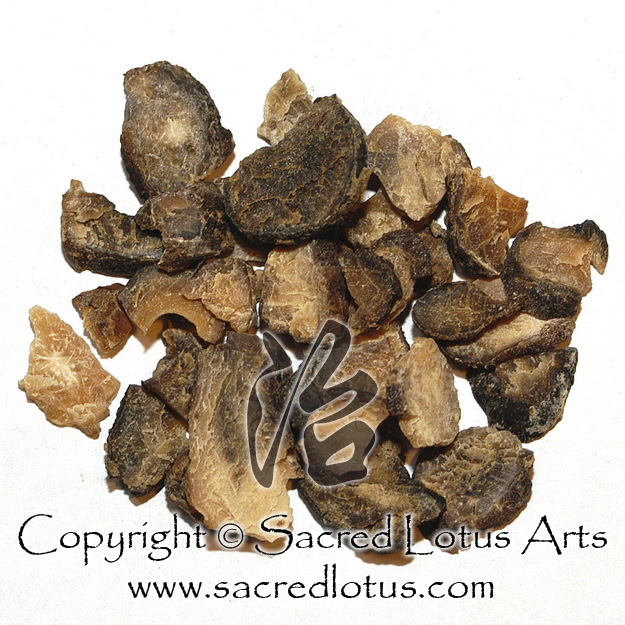
Materia Medica Data
- Temperature
- Hot
- Nature & Flavour
- Spicy, Hot, Toxic
- Channels Entered
- HT, KI, SP
- Latin (pharmaceutical)
- Radix Lateralis Praeparatus Aconiti Carmichaeli
- Chinese
- 附子
- Tone Marks
- fù zi
- Translation
- Appendage
Chinese Herb Actions
What is Fu Zi (processed aconite) used for in Chinese medicine?
Fu Zi’s signature action is to restore devastated (collapsed) yang — the classical materia medica reserves it for yang collapse marked by ice-cold limbs, a faint or minute pulse, cold profuse sweating, and watery diarrhea with undigested food. It also warms the fire and assists the yang of the Heart, Spleen and Kidney, dispels interior cold, warms the channels, and stops cold-type pain. Fu Zi is the processed lateral root of Aconitum carmichaelii; only processed forms are used.
Its main traditional actions, as recorded in the materia medica:
- Restores devastated yang — the defining indication for yang collapse (cold limbs, faint pulse, cold sweating, watery stools).
- Warms fire and assists yang — Heart, Spleen and Kidney yang deficiency with interior cold.
- Dispels cold, warms channels, stops pain — wind-damp-cold painful obstruction and cold lodged in the organs, channels, sinews and vessels.
Source: owner’s Five Branches notes (Warm the Interior chapter); Sacred Lotus sources & references (channels HT/KI/SP; nature Spicy, Hot, Toxic), reviewed against Bensky, Materia Medica (3rd ed.). Traditional-reference framing; not medical advice.
Chinese Herb Dosage
What is the dosage of Fu Zi, and why must it be decocted first and long?
The reference range for processed Fu Zi is about 3–15 g in decoction, and the materia medica records that it is decocted first and long — commonly 30–60 minutes (often longer) before the other herbs are added. This prolonged pre-decoction is documented as a further toxicity-reducing step, continuing the hydrolysis of the toxic alkaloids begun during processing. Only processed forms (e.g. Zhi Fu Zi, Hei Shun Pian, Bai Fu Pian, Yan Fu Zi) appear in the reference literature; raw aconite is not used internally.
Source: owner’s Five Branches notes (“boil 30–60 minutes before adding other ingredients”); standard materia medica ranges. Reference range for practitioners only — not a prescription or preparation instruction.
Chinese Herb Contraindications & Cautions
What are the contraindications and classical incompatibilities for Fu Zi?
The materia medica contraindicates Fu Zi in pregnancy and in yin deficiency with heat (and in true-heat / false-cold patterns). As a hot, toxic substance it can readily injure the fluids and is used only in processed form under qualified supervision. Under the classical Eighteen Incompatibilities, the aconite (Wu Tou) group is traditionally not combined with Ban Xia, Gua Lou, Bei Mu, Bai Lian, or Bai Ji.
Consistent with that rule, the site’s record lists Fu Zi as incompatible with the member species of those groups: Ban Xia; Gua Lou (with Gua Lou Pi, Gua Lou Ren and Tian Hua Fen); Chuan Bei Mu and Zhe Bei Mu; Bai Lian; and Bai Ji.
Source: owner’s Five Branches notes (contraindications: Yin Xu with heat, pregnancy; “against Ban Xia, Gua Lou, Bei Mu, Bai Ji”); Sacred Lotus incompatibility list; classical Eighteen Incompatibilities. Reference only.
Chinese Herb Toxicity & Overdose
Is Fu Zi toxic, and how does processing make it usable?
Raw aconite is highly toxic, and Fu Zi is the detoxified, processed lateral root — only processed forms are used internally. Toxicity is attributed to the diester diterpenoid alkaloids (aconitine, mesaconitine, hypaconitine). The reference pharmacology records that processing — brine-soaking followed by boiling or steaming — hydrolyzes these to the far less toxic monoester alkaloids and, ultimately, to the much weaker aconine-type compounds; prolonged decoction continues the same conversion. This chemistry is the central safety mechanism behind the herb’s traditional use.
The materia medica records the recognized signs of aconitine-type overdose (toxicity reference, not use guidance): numbness and tingling of the mouth, tongue and limbs, nausea and other GI upset, and cardiac arrhythmia. Fu Zi carries the site’s toxic-herb flag and is used only under qualified professional supervision.
Source: owner’s Five Branches notes (Toxic; “can cause numbness”; preparation reduces toxins); Sacred Lotus toxic-herb flag; PubMed 22053844 (metabolomic comparison of aconite root vs its processed products); PubMed 35240238 (systematic review of Aconitum carmichaelii chemistry and pharmacology). Toxicology reference, not a preparation or self-use instruction.
-
This herb is considered toxic.
(while some Chinese herbs are toxic, it must be noted that many come prepared, or are combined, to mitigate their toxicity)
Herb-Drug Interactions
The primary documented concern is cardiac. The aconitine-type diester alkaloids are recognized in the pharmacology literature as cardiotoxic and arrhythmogenic, so reference sources flag added caution where cardiac or antiarrhythmic drugs (and other agents affecting cardiac conduction) are involved. No comprehensive table of validated clinical herb–drug interactions for processed Fu Zi is established. (Flagged for practitioner confirmation — Fu Zi is used only in processed form under qualified supervision; absence of a documented interaction is not proof of safety.)
Source: pharmacology literature on aconitine cardiotoxicity (PubMed 30989863; 39233350). Reference caution, not a medical claim.
Western / Biomedical Research
Chinese Herb Clinical Studies & Research
Provided as research context — a summary of published biomedical study, not a therapeutic or medical claim.
What does modern research say about Fu Zi and aconite?
Yes — and the literature is dominated by aconitine toxicology, with preclinical signals for the processed root. Aconitine and related diester alkaloids are well characterized as cardiotoxic and arrhythmogenic, and case reports document acute aconitine poisoning from inadequately processed or misused aconite. A parallel body of work maps the detoxifying chemistry of processing: metabolomic studies show that boiling/steaming hydrolyzes the diester alkaloids to far less toxic forms, which is why only processed Fu Zi is used.
For the processed root itself, models report cardiotonic activity (correlated with its alkaloid fingerprint) and benefit in mouse acute-heart-failure models, and anti-inflammatory / anti–ventricular-remodeling effects when Fu Zi is paired with licorice. This evidence is preclinical and does not constitute a medical claim.
Sources: PubMed 39233350 (acute aconitine poisoning, case report); PubMed 30989863 (adverse-reaction analysis and cardiac-toxicity mechanism of Aconiti Lateralis Radix Praeparata); PubMed 22053844 (toxicity of aconite root vs processed products); PubMed 33522207 (cardiotonic activity vs alkaloid fingerprint); PubMed 39545061 (fuziline and acute heart failure in mice); PubMed 33132755 (Fuzi with Glycyrrhiza reduces inflammation and ventricular remodeling). Preclinical research context, not a therapeutic claim.
Chinese Herb Notes
How does Fu Zi differ from Gan Jiang, Rou Gui, and Chuan Wu?
Fu Zi is the premier herb to rescue collapsed yang; the herbs nearest to it warm the interior differently. The materia medica distinguishes them by strength, direction, and part of the plant used.
- vs Gan Jiang — both rescue yang from collapse; Gan Jiang (dried ginger) more locally warms the Spleen/Stomach and has a longer, steadier effect, while Fu Zi’s action is broader, warmer, and more immediate. They are classically paired (as in Si Ni Tang) to rescue yang and temper Fu Zi.
- vs Rou Gui — both warm the fire at the gate of vitality (ming men) for lower-burner yang deficiency; Rou Gui (cinnamon bark) is milder and leads fire back to its source, but is not used to rescue yang from collapse as Fu Zi is.
- vs Chuan Wu — Chuan Wu is the main/mother root of the same plant and is directed at wind-damp painful obstruction and cold pain, whereas Fu Zi is the lateral (daughter) root, is less toxic, and is the one used to restore yang.
Common combinations: with Gan Jiang and Zhi Gan Cao (Si Ni Tang) to rescue devastated yang; with Ren Shen (Shen Fu Tang) for yang collapse with severe qi deficiency; with tonify-yang herbs (as in Jin Gui Shen Qi Wan / You Gui Wan) for Kidney yang deficiency.
Source: owner’s Five Branches notes (comparative-functions set); Sacred Lotus relationships (appears in Si Ni Tang, Shen Fu Tang, Jin Gui Shen Qi Wan, You Gui Wan).
This herb is incompatible with:
- Bai Ji (Rhizoma Bletillae)
- Ban Xia (Rhizoma Pinelliae Tematae)
- Chuan Bei Mu (Bulbus Fritillariae Cirrhosae)
- Gua Lou (Fructus Trichosanthis Kirlowii)
- Gua Lou Pi (Pericarpium Trichosanthis Kirlowii)
- Gua Lou Ren (Semen Trichosanthis Kirlowii)
- Tian Hua Fen (Trichosanthis Kirlowii Radix)
- Zhe Bei Mu (Fritillariae Thunbergii Bulbus)
- Bai Lian (Radix Ampelopsis)
Sources & References
Compiled and edited by Thomas Dehli, Founder & Editor, Sacred Lotus Updated
The information here is referenced from numerous sources — teachers, practitioners, class notes from Five Branches University, the books below, and the published research literature, with citations given as resolvable PubMed identifiers. Where sources disagree, I have flagged the discrepancies directly. If facts couldn't be verified, I have left them out. How we source our content.
Reference information for students and practitioners — not medical advice. Consult a qualified practitioner. Terms of use.
Chinese Herbs Books & References
 https://amzn.to/3WfB3DK
 https://amzn.to/3DR1VUh
 https://amzn.to/42aMz73
 https://amzn.to/3PuD4bt