
Fritillariae Thunbergii Bulbus Thunberg Fritillaria Bulb
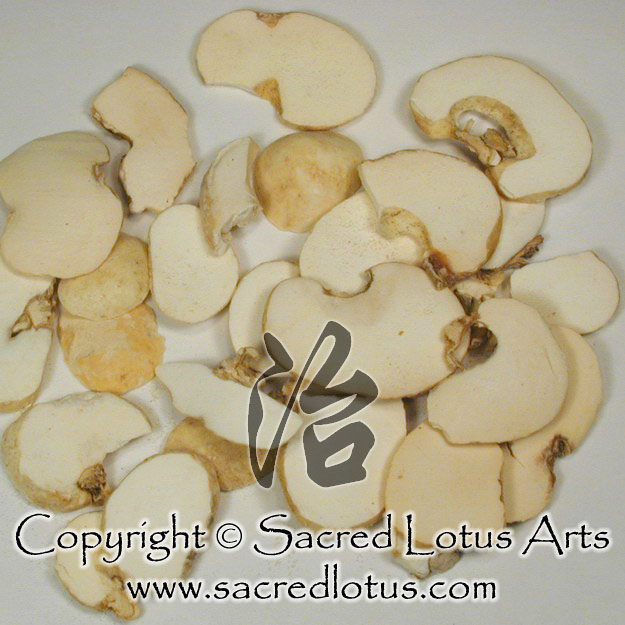
Materia Medica Data
- Temperature
- Cold
- Nature & Flavour
- Bitter, Cold
- Channels Entered
- HT, LU
- Latin (pharmaceutical)
- Fritillariae Thunbergii Bulbus
- Chinese
- 浙贝母
- Tone Marks
- Zhè bèi mŭ
- Translation
- Shell Mother from Zhejiang
Chinese Herb Actions
What is Zhe Bei Mu (Thunberg Fritillaria Bulb) used for in Chinese medicine?
Zhe Bei Mu is a bitter, cold herb traditionally used to clear heat, transform phlegm-heat, stop cough, and dissipate nodules and toxic swellings — it is one of the standard choices for acute, productive cough from Lung heat, and for heat-toxin swellings such as sores, abscesses, and scrofula.
Its main traditional actions:
- Transforms phlegm-heat and stops cough — for productive cough due to acute Lung-heat patterns, whether from an external pathogen or interior disharmony; considered one of the more effective herbs for this presentation.
- Clears heat and disperses nodules — for neck swellings, scrofula, sores, carbuncles, goiter, and Lung or breast abscesses, particularly sores/abscesses that have not yet ulcerated.
Source: Sacred Lotus sources & references; cross-referenced against multiple online sources and standard materia medica consensus (Bensky, Materia Medica, 3rd ed.; Chen & Chen, Chinese Medical Herbology and Pharmacology).
Chinese Herb Dosage
What is the typical dosage of Zhe Bei Mu?
Commonly cited ranges run from about 4.5–9 g up to 10–20 g in decoction, depending on the source text and the strength of the presentation being treated; standard materia medica references give ranges toward the lower end, while some clinical formularies extend to the higher end for more severe phlegm-heat or nodule-dissipating use.
Source: Sacred Lotus sources & references; standard materia medica dosage ranges (Bensky; Chen & Chen).
Chinese Herb Contraindications & Cautions
Are there cautions for Zhe Bei Mu, including the classical aconite incompatibility?
Zhe Bei Mu should not be combined with Wu Tou or Fu Zi (aconite/Aconitum products) — this pairing is one of the classical “eighteen incompatibilities” (shi ba fan) of Chinese materia medica, a traditional list of herb pairs held to conflict or potentiate harm when combined, and it applies to Fritillaria (Bei Mu) generally, not only to this species.
- Cold-and-Damp patterns — being a cold, bitter herb, Zhe Bei Mu is not appropriate for cough or phlegm presentations rooted in Cold or Damp rather than Heat.
Source: Sacred Lotus sources & references; classical eighteen-incompatibilities (shi ba fan) tradition; standard materia medica cautions (Bensky; Chen & Chen).
Chinese Herb Toxicity & Overdose
Low at standard decoction doses, but Zhe Bei Mu is an alkaloid-bearing bulb and a full modern toxicological profile has not been systematically established. A comprehensive review of its phytochemistry and pharmacology (below) attributes most of its pharmacological activity to steroidal alkaloids and notes toxicity as an area needing further systematic study, rather than reporting specific overdose data. Traditional caution against exceeding standard dosage, and against combining it with aconite products, is consistent with this alkaloid content.
Source: PMID 30987173 / PMC 6479889 (phytochemistry, pharmacodynamics, pharmacokinetics and toxicity review). Reference note, not a safety guarantee.
Herb-Drug Interactions
No well-established modern clinical herb–drug interactions are documented for Zhe Bei Mu. The one interaction with dedicated research attention is the classical incompatibility with aconite (Wu Tou/Fu Zi) products, which has been studied experimentally in combination (see Research) rather than as a modern pharmaceutical drug interaction. (Flagged for practitioner confirmation.)
Western / Biomedical Research
Chinese Herb Clinical Studies & Research
Provided as research context — a summary of published biomedical study, not a therapeutic or medical claim.
Is there modern research on Zhe Bei Mu (Fritillariae Thunbergii Bulbus)?
Yes — a substantial body of phytochemical and pharmacological research supports its traditional antitussive, expectorant, and anti-inflammatory uses, with over a dozen distinct pharmacological effects reported, though most evidence is preclinical (chemical, cell, or animal).
- Comprehensive review — a systematic review synthesizing 83 studies (from an initial pool of over 9,700) identified 134 chemical constituents, including 26 alkaloids, and reported thirteen pharmacological activities: anti-cancer, tracheobronchial relaxation, antitussive, expectorant, anti-muscarinic, anti-inflammatory, anti-thyroid, blood-rheology regulation, antiulcer, anti-diarrheal, pain-suppressing, antioxidant, and neuroprotective effects, mainly attributed to its alkaloid content.
- Antitussive/expectorant, animal model — a 2022 chemical-profiling study identified alkaloid quality markers (including zhebeininoside) and confirmed antitussive and expectorant effects in a mouse cough model, with proposed mechanisms including thinned respiratory secretions and enhanced mucociliary clearance.
- Classical incompatibility, experimentally tested — a study from the China Academy of Chinese Medical Sciences examined combining processed aconite (Aconiti Radix Cocta) with Fritillaria cirrhosa or Fritillaria thunbergii in mice, explicitly framed as investigating one of the “eighteen incompatible pairs” of classical Chinese materia medica; it found dose-ratio-dependent synergistic and antagonistic effects on analgesic, expectorant, and antitussive measures. This is laboratory research probing a traditional rule, not a recommendation to combine the herbs.
Overall, the pharmacological picture is well developed for a traditional herb, but clinical (human) trial evidence specific to Zhe Bei Mu remains limited.
Sources: PMID 30987173, PMC 6479889 (International Journal of Molecular Sciences, 2019, review); PMID 34653522 (Journal of Ethnopharmacology, 2022, chemical profiling/antitussive study, animal model); PMID 24228591 (Zhongguo Zhong Yao Za Zhi, 2013, Aconite–Fritillaria compatibility study, animal model). Research context, not a therapeutic claim.
Chinese Herb Notes
What is the difference between Zhe Bei Mu and Chuan Bei Mu?
Both are called “Bei Mu” (Fritillaria bulb) and both clear heat and transform phlegm, but Zhe Bei Mu is the stronger, colder herb for acute phlegm-heat and nodules, while Chuan Bei Mu is the gentler, moistening herb for chronic dry cough — and Chuan Bei Mu is far more expensive. This is one of the most important differentiations to keep straight in practice, since the two are easily confused by name alone.
- Zhe Bei Mu (Fritillaria thunbergii) — more bitter and colder; better at clearing heat and dissipating nodules/toxic swellings; the preferred choice for acute, productive, phlegm-heat cough and for sores, abscesses, scrofula, and goiter. Cultivated at larger scale and considerably less costly.
- Chuan Bei Mu (Fritillaria cirrhosa and related species) — sweeter and more moistening, milder in temperature; better suited to chronic, dry, unproductive cough from Lung-yin deficiency or a Lung-dryness pattern. Traditionally wild-collected at high altitude in limited supply, making it substantially more expensive than Zhe Bei Mu.
Formula context: Zhe Bei Mu appears in formulas including Xian Fang Huo Ming Yin (Sublime Formula for Sustaining Life, for toxic sores/abscesses), Sang Xing Tang (Mulberry Leaf and Apricot Kernel Decoction, for dryness-cough), Xiao Luo Wan (Reduce Scrofula Pill), and Hai Zao Yu Hu Tang (Sargassum Decoction for the Jade Flask, for goiter/nodules). (Traditional formula context, not treatment advice.)
Source: Sacred Lotus sources & references (herb identity and formula links); cross-referenced against multiple online sources and standard materia medica consensus (Bensky; Chen & Chen).
This herb is incompatible with:
Sources & References
Compiled and edited by Thomas Dehli, Founder & Editor, Sacred Lotus Updated
The information here is referenced from numerous sources — teachers, practitioners, class notes from Five Branches University, the books below, and the published research literature, with citations given as resolvable PubMed identifiers. Where sources disagree, I have flagged the discrepancies directly. If facts couldn't be verified, I have left them out. How we source our content.
Reference information for students and practitioners — not medical advice. Consult a qualified practitioner. Terms of use.
Chinese Herbs Books & References
 https://amzn.to/3WfB3DK
 https://amzn.to/3DR1VUh
 https://amzn.to/42aMz73
 https://amzn.to/3PuD4bt