
Bei Xie Fen Qing Yin Bèi Xiè Fēn Qīng Yīn
Dioscorea Hypoglauca Decoction to Separate the Clear
- Category
- Formulas that Expel Dampness
- Ingredients
- 4 herbs
Actions
What does Bei Xie Fen Qing Yin do?
Bei Xie Fen Qing Yin warms Kidney yang, dispels cold from the lower burner, and separates the clear from the turbid — the formula's namesake action, referring to restoring the Bladder's ability to keep clear fluid and turbid waste properly sorted so urine no longer appears cloudy.
The four ingredients divide by role, per Bensky & Barolet:
- Chief: Bei Xie directly targets turbid urination, its traditional specialty, by helping the Bladder separate clear from turbid.
- Deputy: Yi Zhi Ren warms Kidney yang and helps the Kidney secure and consolidate, addressing the underlying cold-deficiency that lets turbidity leak into the urine.
- Assistants: Wu Yao warms the lower burner and moves qi in the Kidney/Bladder, easing the qi stagnation that cold produces; Shi Chang Pu is aromatic and opens the orifices, helping to transform and clear dampness and turbidity from the urinary tract.
Source: Sacred Lotus sources & references (composition) + Bensky & Barolet, Formulas & Strategies (chief/deputy/assistant analysis, attributed to this formulary). Traditional-use framing; not medical advice.
Indications
What is Bei Xie Fen Qing Yin used for?
Bei Xie Fen Qing Yin treats gao lin — turbid, cloudy urine — caused by Kidney qi deficiency with cold in the lower burner, distinguished from painful, burning turbid urination by the absence of pain and by clear cold signs.
- Frequent urination that is turbid, cloudy, or milky-looking, without burning or pain.
- Possible sediment or a fatty appearance to the urine.
- Coldness or dull aching of the lower back and lower abdomen.
- General fatigue and a cold-deficiency picture rather than heat signs.
Source: Sacred Lotus sources & references (pattern field) + Bensky & Barolet, Formulas & Strategies; Chen & Chen, Chinese Medical Herbology and Pharmacology. Traditional-use framing; not medical advice.
Ingredients
4 substances in Bei Xie Fen Qing Yin — each links to its full herb monograph.
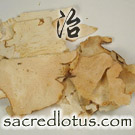 Bei Xie12 gRegulate Water and Drain Dampness
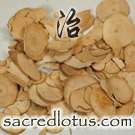 Wu Yao9 gRegulate the Qi
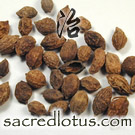 Yi Zhi Ren9 gTonify Yang
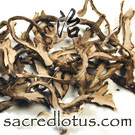 Shi Chang Pu9 gAromatic Substances that Open the Orifices
Preparation & dosage
How is Bei Xie Fen Qing Yin prepared?
Prepared as a decoction of the four herbs, taken warm. Some versions of this formula add a small amount of Gan Cao (licorice) as an envoy to harmonize; our composition does not include it (see composition note above).
- Preparation: standard water decoction; no unusual processing (wine-frying, deep-frying) is required for these four herbs, unlike the mineral/shell-heavy yin-tonic formulas.
- Administration: traditionally taken warm, consistent with the formula's warming strategy for a cold-pattern presentation.
Source: Sacred Lotus sources & references (preparation) + Bensky & Barolet, Formulas & Strategies.
Safety — read before use
What are the cautions for Bei Xie Fen Qing Yin?
This warming formula is not for turbid or painful urination caused by Bladder damp-heat — a pattern with burning, urgency, and a yellow, greasy tongue coating rather than cold signs, which needs a heat-clearing, dampness-draining strategy instead (see notes for the differently-composed formula that shares this name).
- Do not use for damp-heat turbid/painful urination — the warming herbs here (Yi Zhi Ren, Wu Yao) would aggravate heat signs if the pattern is actually damp-heat rather than cold-deficiency.
- Not for yin-deficiency-heat patterns presenting with turbid urine and other heat signs (night sweats, malar flush) — a different strategy is required.
- Professional diagnosis is important here specifically because two classical formulas share this name with opposite temperature strategies (warming vs. damp-heat-clearing) — using the wrong one for the pattern can aggravate symptoms.
Source: Sacred Lotus sources & references (existing caution) + Bensky & Barolet, Formulas & Strategies (differential diagnosis for gao lin patterns). Traditional-use framing; not medical advice.
Originally Appeared In:
- Teachings of Dan Xi (Dan Xi Xin Fa)
Notes:
Are there two different formulas called Bei Xie Fen Qing Yin?
Yes — two distinct classical formulas share this name, treating opposite patterns of the same symptom (turbid urine), and our composition matches the warming version. Cross-referencing multiple formulary sources confirms the four-herb composition in Sacred Lotus's data (Bei Xie, Yi Zhi Ren, Wu Yao, Shi Chang Pu) is the earlier, warming formula for Kidney-yang deficiency with cold, consistent with this formula's own pattern and caution fields.
- The version in our data (warming): Bei Xie, Yi Zhi Ren, Wu Yao, Shi Chang Pu — for gao lin from lower-burner cold and Kidney qi/yang deficiency, with no burning or pain.
- The later damp-heat version, commonly distinguished as “Cheng's Bei Xie Fen Qing Yin/San” (attributed to Cheng Guo-peng's Yi Xue Xin Wu, 1732): built instead around Bei Xie with Huang Bai, Che Qian Zi, Fu Ling, Bai Zhu, Lian Zi Xin, and Dan Shen — a heat-clearing, dampness-draining formula for turbid urination with burning or heat signs. This variant is not the one in Sacred Lotus's current composition data for this slug.
Readers searching for a damp-heat-type turbid urination formula should confirm which version a given source describes before comparing dosages or herbs — the two are not interchangeable.
Source: cross-referenced against multiple published formulary references, including Bensky & Barolet, Formulas & Strategies, for the distinction between the two same-named formulas.
Clinical Studies & Research:
Is there modern research on Bei Xie Fen Qing Yin?
No dedicated clinical or pharmacological studies on this specific classical compound formula were found in available searches. What has been reviewed is its chief herb's traditional and pharmacological profile.
- Bei Xie (component-level, review): a Chinese-language research review on Dioscorea hypoglauca/Dioscorea septemloba (Bei Xie) describes its traditional use for removing dampness, clearing turbidity, and treating stranguria (urinary tract conditions), summarizing pharmacological research on the herb (PMID 29218932) — evidence on the herb, not on this compound formula.
- Formula-specific: no PubMed-indexed clinical or pharmacological studies on Bei Xie Fen Qing Yin itself were identified as of this review (2026-07).
Sources: PubMed 29218932; PubMed searches conducted 2026-07 for “Bei Xie Fen Qing Yin” / “Bixie Fenqing” returned no formula-specific studies. Research context on a component herb, not a therapeutic claim for the formula.
Sources & References
Compiled and edited by Thomas Dehli, Founder & Editor, Sacred Lotus Updated
The information here is referenced from numerous sources — teachers, practitioners, class notes from Five Branches University, the books below, and the published research literature, with citations given as resolvable PubMed identifiers. Where sources disagree, I have flagged the discrepancies directly. If facts couldn't be verified, I have left them out. How we source our content.
Reference information for students and practitioners — not medical advice. Consult a qualified practitioner. Terms of use.
Chinese Formulas Books & References
 https://amzn.to/4fYI3f8
 https://amzn.to/4j55NRA
 https://amzn.to/4gMROyv
 https://amzn.to/4h7msSK