
Ling Gan Wu Wei Jiang Xin Tang
Poria, Schisandra, Ginger, and Asarum Decoction
- Category
- Formulas that Treat Phlegm
- Subcategory
- Formulas that Warm and Transform Cold-Phlegm
- Ingredients
- 5 herbs
Actions
What does Ling Gan Wu Wei Jiang Xin Tang do?
Ling Gan Wu Wei Jiang Xin Tang warms the Lungs and transforms cold, thin-mucus fluid retention (“cold-phlegm”). It comes from Zhang Zhong-Jing’s Jin Gui Yao Lue (Essential Prescriptions from the Golden Cabinet, c. 220 CE), where it evolved from Xiao Qing Long Tang through a documented sequence of modifications for a patient with recurring cough and rising qi, arriving at this five-herb formula once Gui Zhi was removed and Gan Jiang and Xi Xin were added.
The five ingredients divide by role:
- Chief: Gan Jiang (dried ginger) warms the Lungs and Middle and transforms thin, watery mucus at its cold root.
- Deputies: Xi Xin reinforces Gan Jiang’s warming, dispersing action and is especially effective at scattering cold-congealed fluid already lodged in the Lungs; Fu Ling drains the accumulated fluid downward through urination while strengthening the Spleen to stop new fluid from forming.
- Assistant: Wu Wei Zi is sour and astringent, restraining Lung qi so the pungent, dispersing action of Gan Jiang and Xi Xin does not over-scatter and deplete it — the classic pairing is often described as “one warms, one scatters, one restrains.”
- Envoy: Gan Cao harmonizes the formula and moderates the acrid intensity of Xi Xin.
Source: Sacred Lotus sources & references + Bensky & Barolet, Formulas & Strategies (chief/deputy/assistant/envoy analysis). Traditional-use framing; not medical advice.
Indications
What is Ling Gan Wu Wei Jiang Xin Tang used for?
Ling Gan Wu Wei Jiang Xin Tang treats cold, thin-mucus fluid retention in the Lungs arising from Spleen-yang deficiency. When the Spleen fails to warm and transport fluids, they accumulate and Cold congeals them into thin, watery phlegm that lodges in the Lungs and obstructs the Lung’s ability to disseminate and descend qi.
Its classic clinical presentation:
- Cough and wheezing with copious, thin, watery, white sputum that is easily produced.
- Chest and diaphragm discomfort or fullness, sometimes with frequent salivation.
- Often applied clinically to patterns seen in chronic bronchitis, emphysema, and other conditions marked by copious thin, clear phlegm (traditional-use correlate, not a diagnosis).
Tongue and pulse: the tongue has a white, slippery coating; the pulse is wiry and slippery.
Source: Sacred Lotus sources & references on pattern/tongue/pulse + Bensky & Barolet, Formulas & Strategies. Traditional-use framing; not medical advice.
Western Uses:
What is Ling Gan Wu Wei Jiang Xin Tang used for in modern practice?
In modern practice this formula is referenced for the pattern of copious, thin, clear sputum seen in chronic respiratory conditions such as chronic bronchitis, emphysema, and cold-type (non-heat) asthma. Practitioners have traditionally applied its Lung-warming, fluid-transforming action to these presentations, contexts where Western medicine recognizes excess airway secretions and cold-triggered bronchospasm.
These biomedical correlates are offered as a reference to the formula’s traditional use, not as a claim that it treats any disease. Contemporary study is preclinical (animal-model) research (see research). Any use for a diagnosed respiratory condition belongs with a qualified practitioner and appropriate medical care.
Source: traditional-use correlates summarized from Bensky & Barolet, Formulas & Strategies; reference only, not a treatment claim.
Ingredients
5 substances in Ling Gan Wu Wei Jiang Xin Tang — each links to its full herb monograph.
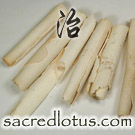 Fu Ling12 gRegulate Water and Drain Dampness
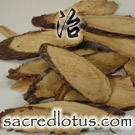 Gan Cao9 gTonify Qi
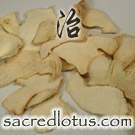 Gan Jiang9 gWarm the Interior and Expel Cold
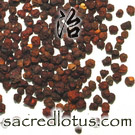 Wu Wei Zi6-12 gAstringe, Stabilize, Bind
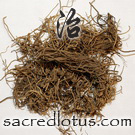 Xi Xin9 gWarm, Spicy Herbs that Release the Exterior
Preparation & dosage
How is Ling Gan Wu Wei Jiang Xin Tang prepared?
Ling Gan Wu Wei Jiang Xin Tang is prepared as a water decoction of the five herbs, taken warm. When phlegm is more copious or nausea is present, Ban Xia is classically added and decocted along with the rest.
Source: Sacred Lotus sources & references + Bensky & Barolet, Formulas & Strategies.
Decoction. Reference relative amounts: Fu Ling 12 g; Gan Cao (mix-fried), Gan Jiang, Xi Xin 9 g each; Wu Wei Zi 6-12 g. Xi Xin should be root/rhizome material only, at the lowest effective dose and for a limited course (see cautions). Reference only.
Safety — read before use
What are the cautions for Ling Gan Wu Wei Jiang Xin Tang?
This is a warming formula for cold, thin-mucus retention, so it is inappropriate for Lung heat, yin deficiency, or dry cough with scanty or blood-tinged sputum — its warming, drying herbs would aggravate heat or dryness patterns.
- Xi Xin (Asarum) dosing caution: Xi Xin contains aristolochic acid, a nephrotoxic and carcinogenic compound; case reports have linked Xi Xin-containing preparations to aristolochic-acid nephropathy and acute kidney injury (PMID 16523436). Traditional dosing guidance keeps Xi Xin low (root/rhizome only, historically ~1–3 g in many sources); some jurisdictions (e.g. UK, Switzerland, Germany) have restricted or banned its medicinal use. Any use should be root-and-rhizome material only (never stems/leaves, which carry higher aristolochic acid), at the lowest effective dose, for a limited duration, and under a qualified practitioner’s guidance.
- Pregnancy: Xi Xin and Gan Cao both warrant caution in pregnancy; use only under professional guidance.
- Avoid where there is clear heat, dryness, or yin deficiency without underlying cold-fluid retention.
Discrepancy note: Sacred Lotus records Xi Xin at 9 g in this formula, above the ~1–3 g figure some safety sources cite as traditional guidance; Bensky & Barolet and classical sources give 9 g for this decoction (a quantity used historically within a boiled, time-limited formula rather than as isolated raw powder). Both figures are kept here because the difference reflects dosing context (decocted formula vs. powdered/isolated use) rather than a factual conflict.
Source: Bensky & Barolet, Formulas & Strategies; aristolochic acid safety data from PubMed 16523436 and PubMed 34899315. Traditional-use framing; not medical advice.
Originally Appeared In:
- Essentials from the Golden Cabinet (Jin Gui Yao Lue)
Notes:
How is Ling Gan Wu Wei Jiang Xin Tang different from Xiao Qing Long Tang and Gui Ling Wu Wei Gan Cao Tang?
Ling Gan Wu Wei Jiang Xin Tang is one link in a documented Jin Gui Yao Lue chain of modifications that began with Xiao Qing Long Tang. Zhang Zhong-Jing describes treating a patient’s severe cough with Xiao Qing Long Tang, then addressing resulting uprushing qi with Gui Ling Wu Wei Gan Cao Tang; when coughing and chest fullness returned after the surging qi settled, he removed Gui Zhi and added Gan Jiang and Xi Xin to arrive at this formula.
- vs Xiao Qing Long Tang: Xiao Qing Long Tang releases the exterior while warming interior cold-fluid retention (an eight-herb formula for cold-fluid retention with an exterior wind-cold presentation); this formula has no exterior-releasing herbs and is used once the exterior sign has resolved but cold-fluid cough remains.
- vs Gui Ling Wu Wei Gan Cao Tang: that formula uses Gui Zhi to warm and direct downward qi that has rushed upward; here Gui Zhi is removed and Gan Jiang/Xi Xin are added once the uprushing-qi pattern has resolved but cough with thin mucus persists.
Key modifications: add Ban Xia for nausea or more copious phlegm (yielding Ling Gan Wu Wei Jiang Xin Xia Tang); further add Xing Ren for prominent wheezing; further add Da Huang if cited case series would show heat signs emerging. These build a documented classical modification sequence rather than a fixed recipe.
Source: Jin Gui Yao Lue formula lineage as summarized in Bensky & Barolet, Formulas & Strategies.
Clinical Studies & Research:
Is there modern research on Ling Gan Wu Wei Jiang Xin Tang?
Yes, but it is limited and preclinical — animal-model and metabolomics studies rather than clinical trials. A GC-MS metabolomics study in an OVA/ice-water “cold asthma” rat model compared Gan Jiang alone with the full Linggan Wuwei Jiangxin decoction; both reduced airway inflammation, but the full decoction outperformed Gan Jiang alone at alleviating airway wall thickening and inflammatory cell infiltration, and regulated more carbohydrate- and fatty-acid-related metabolites tied to energy metabolism and oxidative stress (PMID 31031619).
- Cold-asthma model (preclinical): full decoction outperformed dried ginger alone on airway pathology and metabolite regulation in a rat cold-asthma model; 37 metabolites (15 serum, 22 urine) and 7 related metabolic pathways were identified (PMID 31031619).
- Xi Xin safety data (relevant to this formula’s key ingredient): a documented human case of acute kidney injury after a Xi Xin-containing preparation (PMID 16523436), and quantitative HPLC measurement of aristolochic acid analogues in Asarum heterotropoides root material, concluding controlled-dose, time-limited use is comparatively safer than uncontrolled/long-term use (PMID 34899315).
Sources: PubMed 31031619; PubMed 16523436; PubMed 34899315. Research context, not a therapeutic claim; direct clinical trial evidence for this formula remains limited.
Sources & References
Compiled and edited by Thomas Dehli, Founder & Editor, Sacred Lotus Updated
The information here is referenced from numerous sources — teachers, practitioners, class notes from Five Branches University, the books below, and the published research literature, with citations given as resolvable PubMed identifiers. Where sources disagree, I have flagged the discrepancies directly. If facts couldn't be verified, I have left them out. How we source our content.
Reference information for students and practitioners — not medical advice. Consult a qualified practitioner. Terms of use.
Chinese Formulas Books & References
 https://amzn.to/4fYI3f8
 https://amzn.to/4j55NRA
 https://amzn.to/4gMROyv
 https://amzn.to/4h7msSK