

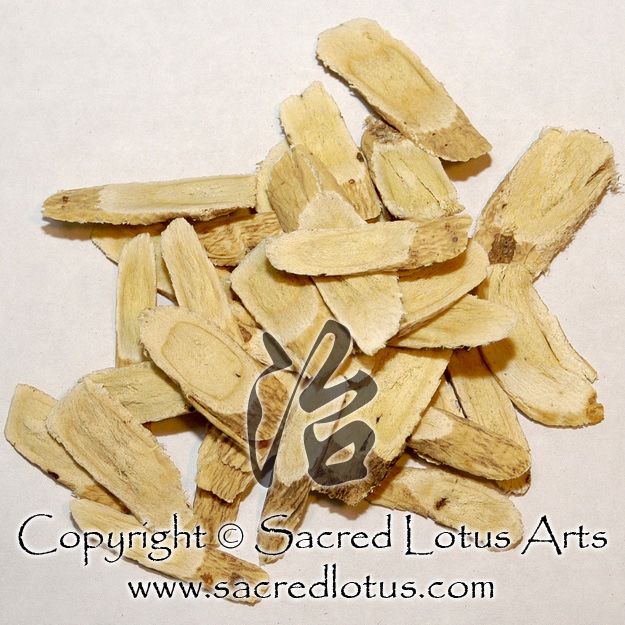
Materia Medica Data
- Category
- Herbs that Tonify Qi
- Temperature
- Slightly Warm
- Nature & Flavour
- Sweet, Slightly Warm
- Channels Entered
- LU, SP
- Latin (pharmaceutical)
- Radix Astragali Membranacei
- Chinese
- 黄芪
- Tone Marks
- huáng qí
Chinese Herb Actions
What is Huang Qi (Astragalus) used for in Chinese medicine?
Huang Qi is a premier Qi tonic that also raises Yang, stabilizes the exterior to stop sweating, promotes urination, and expels pus/generates flesh — used for Spleen-qi-deficiency fatigue and pallor, spontaneous sweating and frequent colds, organ prolapse, edema, slow-healing sores, and combined qi-and-blood deficiency with dizziness and low energy.
Its core traditional actions:
- Tonifies Qi and Blood — pale/sallow complexion, fatigue, tired limbs, and diarrhea from Spleen deficiency; Spleen failing to hold blood (easy bruising/bleeding, hematemesis, hematochezia, uterine bleeding); postpartum fever from qi-and-blood deficiency; Lung/Spleen-deficiency cough, wheezing, and shortness of breath with profuse thin white sputum; and qi-and-blood deficiency dizziness, sallow face, vertigo, low energy, reluctance to speak, spontaneous sweating, palpitations, insomnia, and low-grade fever.
- Raises Yang — organ prolapse (rectal, uterine).
- Tonifies Wei Qi and stabilizes the exterior — spontaneous sweating, frequent colds, shortness of breath; qi-, yin-, or yang-deficiency–type sweating.
- Promotes urination and reduces edema — superficial or facial edema, heaviness of the body, decreased urination.
- Expels pus and generates flesh — chronic ulcers/sores that are slow to form pus or drain.
- Treats Xiao Ke (wasting-and-thirsting) — thirst with fatigue.
- Treats numbness, pain, or paralysis — from insufficient nourishment or circulation of qi and blood.
Source: Sacred Lotus reference notes, cross-checked against Bensky & Barolet, Chinese Herbal Medicine: Materia Medica (3rd ed.) and Chen & Chen, Chinese Medical Herbology and Pharmacology — both list Huang Qi under Herbs that Tonify Qi with these core action categories.
Chinese Herb Dosage
What is the typical dosage of Huang Qi (Astragalus)?
Roughly 9–15 g in decoction for general qi-tonic use, though clinical dosing varies widely by goal: materia medica sources give 9–15 g up to ~30 g when a stronger tonifying/exterior-stabilizing effect is needed, and up to as much as ~120 g in specific high-dose formula contexts.
- Standard range — 9–15 g, up to 30 g if required.
- High-dose formula use — up to 120 g, as in Bu Yang Huan Wu Tang, where raw Huang Qi is the dominant chief herb for qi-deficiency with blood stasis (post-stroke numbness/paralysis).
Source: Sacred Lotus reference notes; ranges consistent with Bensky & Barolet, Materia Medica (3rd ed.) and Chen & Chen, Chinese Medical Herbology and Pharmacology. Reference only — not a prescription.
Chinese Herb Contraindications & Cautions
Are there cautions for Huang Qi (Astragalus)?
Huang Qi is contraindicated in excess-type patterns — it is not for excess exterior pathogens, excess Yang with Yin deficiency, upper-jiao heat with lower-jiao cold, excess-qi patterns, or sores caused by heat in the blood, and it should be avoided by patients with known allergies to it.
- Excess exterior pathogens — a Wei-Qi-stabilizing, sweat-stopping herb can lock in an unresolved external pathogen.
- Excess Yang with Yin deficiency and upper-jiao heat with lower-jiao cold — its warming, raising nature can aggravate these patterns.
- Excess-qi conditions and sores due to heat in the blood — a tonifying, pus-generating herb is not appropriate where the underlying issue is excess or heat.
- Known allergy — discontinue if hypersensitivity reactions occur.
- Pregnancy — Sacred Lotus reference notes give a caution against use in the third trimester specifically; general herb-safety references note only that astragalus’s effects in pregnancy are not well studied and recommend professional supervision rather than naming a specific trimester (see discrepancy note).
Note: we could not find a third-trimester-specific contraindication for Huang Qi in general safety references (which instead give a blanket "insufficient data, use only under professional supervision" caution for pregnancy). The existing site guidance is kept as the more specific, practitioner-oriented caution, with this broader context added for transparency.
Source: Sacred Lotus reference notes (contraindication list); pregnancy safety context cross-checked against general herb-safety references (e.g., consumer drug-interaction/safety databases). Reference only — consult a qualified practitioner, especially in pregnancy.
Chinese Herb Toxicity & Overdose
Fairly non-toxic at standard doses. Materia medica sources describe Huang Qi as low in toxicity; reported overdose symptoms include headache, tightness in the chest, insomnia, dizziness, flushing, and elevated blood pressure. Modern safety reviews likewise describe astragalus as generally well tolerated, with severe allergic reactions (breathing difficulty, swelling, hives) possible but uncommon.
Source: Sacred Lotus reference notes; consistent with general materia medica consensus and consumer herb-safety references. Reference note, not a safety guarantee.
Herb-Drug Interactions
Yes — Huang Qi (astragalus) has a documented interaction with tacrolimus and theoretical interactions with anti-diabetic and anticoagulant/antiplatelet medications. A published case report describes a nearly 50% drop in tacrolimus blood levels in a patient taking a compound Chinese herbal granule, with Radix Astragali identified as the most likely cause (PMID 32930420) — consistent with astragalus’s immune-stimulating action working against immunosuppressive therapy; relevant for transplant recipients and others on immunosuppressants.
- Anti-diabetic/hypoglycemic drugs — preclinical research shows astragalus polysaccharides lower blood glucose and improve insulin sensitivity (e.g., via AMPK activation, PMID 19960007); combined with pharmaceutical hypoglycemics this raises a theoretical risk of additive blood-glucose lowering.
- Immunosuppressants — astragalus’s immune-stimulating polysaccharides may work against drugs intended to suppress immune activity (anti-rejection drugs, corticosteroids, and related agents); the tacrolimus case above is the clearest documented example.
- Anticoagulants/antiplatelets — some safety references note mild anticoagulant-type activity, raising a theoretical bleeding-risk consideration with warfarin-type or antiplatelet drugs; evidence here is weaker than for the interactions above.
Sources: PMID 32930420 (tacrolimus case report naming Radix Astragali); PMID 19960007 (glucose/AMPK mechanism); general consumer herb-safety references (interaction categories). Flagged for practitioner/physician confirmation, not a demonstrated interaction in every case.
Western / Biomedical Research
Chinese Herb Clinical Studies & Research
Provided as research context — a summary of published biomedical study, not a therapeutic or medical claim.
Is there modern research on Huang Qi (Astragalus membranaceus)?
Yes — Huang Qi is among the most studied Chinese herbs, with clinical meta-analyses supporting adjunctive use for cancer-related fatigue and diabetic kidney disease, alongside laboratory research on its immune- and glucose-modulating polysaccharides. Human clinical evidence is generally promising but rated low-to-moderate quality by the reviews themselves.
- Cancer-related fatigue (clinical meta-analysis) — a 2025 systematic review and meta-analysis of 8 randomized controlled trials (804 patients) found astragalus significantly reduced cancer-related fatigue (SMD −1.63) and improved quality of life (SMD 0.86) versus controls; the authors noted the included studies were small and lower-quality and called for larger, higher-quality trials. This aligns with Huang Qi’s traditional and modern use supporting patients through chemotherapy and radiation.
- Diabetic kidney disease (clinical meta-analyses) — a 2011 meta-analysis of 25 studies (1,804 patients) found astragalus injection, added to conventional therapy, improved renal markers (BUN, serum creatinine, creatinine clearance, urine protein) and serum albumin versus conventional therapy alone. An updated 2019 review of 66 studies (4,785 participants) similarly found adjunctive astragalus reduced albuminuria, proteinuria, and serum creatinine in the short term, but flagged low study quality, heterogeneity, and publication bias as limiting confidence in the results.
- Mechanism (network pharmacology) — a 2020 study modeling astragalus’s active compounds (including calycosin, formononetin, and quercetin) against diabetic-nephropathy–related genes found effects converging on inflammatory (TNF, IL-6), oxidative-stress, and angiogenesis (VEGFA) pathways — a computational plausibility model, not clinical proof.
- Glucose and immune activity (preclinical) — laboratory studies report astragalus polysaccharides lower blood glucose and improve insulin sensitivity via AMPK activation in diabetic animal models, and separately show immune-modulating effects on T-cell subsets — findings consistent with, but not a substitute for, controlled human evidence.
Overall, clinical meta-analyses are consistently positive in direction, but the authors of the largest reviews themselves caution that most primary trials are small, often unblinded, and carry heterogeneity/publication-bias risk — treat these findings as preliminary and adjunctive, not as a therapeutic claim.
Sources: PMID 40302232 (cancer-related-fatigue meta-analysis, Integrative Cancer Therapies, 2025); PMID 20951192 (diabetic-nephropathy meta-analysis, Journal of Ethnopharmacology, 2011); PMID 31034954 (updated diabetic-kidney-disease systematic review, Journal of Ethnopharmacology, 2019); PMID 32215271 (network-pharmacology mechanism study, Journal of Diabetes Research, 2020); PMID 19960007 (glucose/AMPK mechanism, Acta Pharmacologica Sinica, 2009). Research context, not a therapeutic claim.
Chinese Herb Notes
What are Huang Qi’s key formula combinations, and how does it differ from Ren Shen (Ginseng)?
Huang Qi and Ren Shen are the two leading Qi tonics, but Huang Qi specializes in raising Yang, stabilizing the exterior/Wei Qi, and promoting pus drainage/flesh generation, while Ren Shen is the stronger central Qi tonic for collapse and prostration. Huang Qi is correspondingly built into formulas targeting sweating, prolapse, edema, and slow-healing sores rather than acute qi collapse.
- Dang Gui Bu Xue Tang — the classic Huang Qi–Dang Gui pair (traditionally ~5:1 by weight) that tonifies qi to generate blood, for blood deficiency with floating heat signs.
- Yu Ping Feng San — with Bai Zhu and Fang Feng, to tonify Wei Qi and stabilize the exterior for spontaneous sweating and frequent colds.
- Bu Zhong Yi Qi Tang — with Ren Shen, Chai Hu, and Sheng Ma, to raise sunken Yang Qi for organ prolapse and related fatigue patterns.
- Bu Yang Huan Wu Tang — large-dose Huang Qi with Dang Gui Wei, Chuan Xiong, Chi Shao, Tao Ren, Hong Hua, and Di Long, for qi deficiency with blood stasis (post-stroke numbness, paralysis).
- Fang Ji Huang Qi Tang — for edema and heaviness with Wei-qi/Spleen deficiency.
- Yu Ye Tang — for Xiao Ke (wasting-and-thirsting) with thirst and fatigue.
- Gui Pi Tang and Shi Quan Da Bu Tang — broader qi-and-blood tonic formulas that include Huang Qi alongside Ren Shen/Dang Gui.
Huang Qi is also a frequently used qi-tonifying ingredient in modern integrative-oncology combination therapies for patients recovering from chemotherapy and radiation (see research below); this is a contemporary clinical-support use, not a classical indication.
Source: Sacred Lotus reference notes; formula pairings cross-checked against the Sacred Lotus formulas database and Bensky & Barolet, Chinese Herbal Medicine: Formulas & Strategies (2nd ed.).
Sources & References
Compiled and edited by Thomas Dehli, Founder & Editor, Sacred Lotus Updated
The information here is referenced from numerous sources — teachers, practitioners, class notes from Five Branches University, the books below, and the published research literature, with citations given as resolvable PubMed identifiers. Where sources disagree, I have flagged the discrepancies directly. If facts couldn't be verified, I have left them out. How we source our content.
Reference information for students and practitioners — not medical advice. Consult a qualified practitioner. Terms of use.
Chinese Herbs Books & References
 https://amzn.to/3WfB3DK
 https://amzn.to/3DR1VUh
 https://amzn.to/42aMz73
 https://amzn.to/3PuD4bt