
Actions
What does Mu Li San do?
Mu Li San astringes the exterior to stop sweating while tonifying qi and settling deficient yang that has become unmoored and is forcing fluids out through the pores. It combines direct astringent action against active sweating with root-level tonification, so the exterior is stabilized rather than merely blocked.
- Astringes the exterior and stops sweating — Mu Li, Ma Huang Gen, and Fu Xiao Mai each contribute a targeted anti-sweating action, addressing spontaneous and night sweating together.
- Anchors and subdues unmoored yang — Mu Li's heavy, salty, settling nature calms the restless, floating quality that accompanies deficiency-driven sweating.
- Tonifies qi and consolidates the exterior — Huang Qi rebuilds the underlying qi deficiency and strengthens Defensive (Wei) qi so the pores close properly instead of leaking.
- Clears mild deficiency heat — Fu Xiao Mai's cooling, Heart-nourishing action addresses the low-grade heat that often accompanies yin-deficiency night sweating.
Source: composition confirmed from Sacred Lotus sources & references; action analysis cross-referenced against multiple online sources and Bensky & Barolet, Formulas & Strategies. Traditional-use framing; not medical advice.
Indications
What is Mu Li San used for?
Mu Li San treats spontaneous sweating and night sweating that occur together, from an unstable exterior combined with underlying deficiency — a presentation where qi deficiency has weakened the exterior's ability to hold the pores closed while a mild deficiency heat helps drive fluid loss during sleep.
- Spontaneous sweating (sweating during waking hours without exertion or heat).
- Night sweating (sweating during sleep that resolves on waking).
- General fatigue, low energy, and a tendency toward frequent colds from a weakened exterior.
- Restlessness or a subjective sensation of unease accompanying the sweating episodes.
- Sweating that has become chronic or recurrent rather than a brief, self-limiting episode.
Tongue and pulse: a pale red tongue and a thin, frail pulse — the pale-red tongue reflecting a mixed deficiency picture rather than pronounced heat, the thin frail pulse pointing to underlying qi and yin depletion.
Source: tongue/pulse from Sacred Lotus sources & references; clinical presentation cross-referenced against multiple online sources plus Bensky & Barolet, Formulas & Strategies, and the classical source text (Tai Ping Hui Min He Ji Ju Fang). Traditional-use framing; not medical advice.
Ingredients
4 substances in Mu Li San — each links to its full herb monograph.
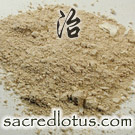 Mu Li15-30 gAnchor, Settle, and Calm the Spirit
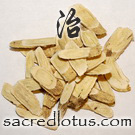 Huang Qi9-15 gTonify Qi
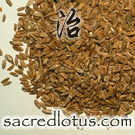 Fu Xiao Mai15-30 gAstringe, Stabilize, Bind
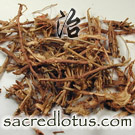 Ma Huang Gen3-9 gAstringe, Stabilize, Bind
Preparation & dosage
How is Mu Li San prepared?
Mu Li San (“San” meaning powder) is classically ground into a fine powder and taken as a draft, with Mu Li calcined (fired) before grinding; in current practice it is very commonly decocted as a tea instead. The classical Song-dynasty method called for the four ingredients to be ground together and taken as a measured dose of powder, often stirred into warm water, rather than boiled as a standard decoction.
Mu Li (oyster shell) is processed by calcining — firing the raw shell — before grinding, which softens the mineral for easier preparation and is standard practice across formulas containing this substance; when Mu Li is decocted rather than powdered, it is also typically added first and simmered longer than the other ingredients, consistent with standard practice for heavy mineral/shell substances in a decoction.
Source: classical preparation method (Tai Ping Hui Min He Ji Ju Fang) and modern practice cross-referenced against multiple online sources and Bensky & Barolet, Formulas & Strategies. Traditional-use framing; not medical advice.
Safety — read before use
What are the cautions for Mu Li San?
This formula is an astringent for an unstable exterior with sweating — it is not appropriate where sweating is caused by an active external pathogen (an unresolved exterior condition) or by pronounced excess heat, since astringing the exterior in either case could trap the pathogen or heat inside. Correctly confirming that sweating is deficiency-driven, rather than due to an unresolved external invasion or florid heat, is central to its traditional use.
- Not for sweating during an active external (exterior) disorder: using astringents while an exterior pathogen is still present risks trapping the pathogen inside the body; this formula is for chronic, deficiency-type sweating, not sweating that accompanies an acute cold or fever.
- Not for pronounced excess-heat night sweating: marked heat signs (high fever, strong thirst, a deep red tongue) call for heat-clearing treatment rather than an astringing strategy.
- Ma Huang Gen distinction: this is the root of the ephedra plant, which stops sweating — the opposite action of Ma Huang (the stalk), which induces sweating and contains the stimulant alkaloids for which Ma Huang is restricted in some jurisdictions; the root itself is not associated with those stimulant effects, but care should be taken not to confuse the two parts when sourcing.
- Huang Qi (Astragalus) content: traditionally used with caution in the presence of an active exterior excess condition or pronounced heat, for the same reason astringents are avoided in those cases.
- Persistent or unexplained sweating: excessive sweating can have causes beyond a TCM deficiency pattern; persistent, severe, or new-onset sweating — especially with weight loss, fever, or night sweats of unclear cause — warrants proper medical evaluation.
Source: cautions cross-referenced against multiple online sources and Bensky & Barolet, Formulas & Strategies (contraindications; herb-part distinctions); Sacred Lotus sources & references confirm the formula's Ma Huang Gen and Huang Qi content. Reference note, not medical advice.
Originally Appeared In:
- Imperial Grace Formulary of the Tai Ping Era (Tai Ping Hui Min He Ji Ju Fang)
Notes:
How does Mu Li San differ from Yu Ping Feng San and Dang Gui Liu Huang Tang?
All three formulas address sweating or a weakened exterior, but they diverge sharply in strategy: Mu Li San astringes sweat directly, Yu Ping Feng San defends against external pathogens rather than astringing, and Dang Gui Liu Huang Tang drains fire rather than astringing. Choosing between them depends on whether the core problem is an open exterior, a defenseless exterior, or florid deficiency heat.
- vs Yu Ping Feng San (Jade Windscreen Powder): shares only Huang Qi with this formula; its other two ingredients, Bai Zhu and Fang Feng, tonify qi and consolidate the Defensive (Wei) qi against external wind rather than astringing sweat directly — it contains no dedicated astringent herb. It is used mainly for qi-deficiency sweating with a marked susceptibility to catching colds, whereas Mu Li San is built specifically to stop active, already-occurring sweating (spontaneous and/or night sweating) through direct astringent action.
- vs Dang Gui Liu Huang Tang (Tangkuei and Six Yellows Decoction): also treats night sweating and shares Huang Qi, but is built around three bitter-cold, fire-draining herbs (Huang Qin, Huang Lian, Huang Bai) plus yin-nourishing Dang Gui, Sheng Di Huang, and Shu Di Huang — a heat-clearing, yin-nourishing strategy for night sweating with pronounced deficiency-heat signs (malar flush, thirst, a deep red tongue, rapid pulse). Mu Li San's presentation is milder, without prominent heat signs, and its strategy leads with astringing and anchoring rather than draining fire.
Classical source: Tai Ping Hui Min He Ji Ju Fang (Imperial Grace Formulary of the Tai Ping Era), the Song-dynasty imperial pharmacy formulary compiled under the Chinese Song Imperial Medical Bureau.
Source: formula-family differentiation cross-referenced against multiple online sources and Bensky & Barolet, Formulas & Strategies; classical attribution from the Tai Ping Hui Min He Ji Ju Fang.
Sources & References
Compiled and edited by Thomas Dehli, Founder & Editor, Sacred Lotus Updated
The information here is referenced from numerous sources — teachers, practitioners, class notes from Five Branches University, the books below, and the published research literature, with citations given as resolvable PubMed identifiers. Where sources disagree, I have flagged the discrepancies directly. If facts couldn't be verified, I have left them out. How we source our content.
Reference information for students and practitioners — not medical advice. Consult a qualified practitioner. Terms of use.
Chinese Formulas Books & References
 https://amzn.to/4fYI3f8
 https://amzn.to/4j55NRA
 https://amzn.to/4gMROyv
 https://amzn.to/4h7msSK