
Dang Gui Liu Huang Tang
Tangkuei and Six Yellow Decoction
- Category
- Formulas that Stabilize and Bind
- Ingredients
- 7 herbs
Actions
What does Dang Gui Liu Huang Tang do?
Dang Gui Liu Huang Tang (Tangkuei and Six Yellow Decoction) enriches yin, drains fire, and stops sweating. It targets night sweating that arises when a deficiency of Kidney yin allows Heart/deficiency fire to flare unchecked, forcing fluids out through the pores while the person sleeps.
The seven ingredients divide by role:
- Chief: Sheng Di Huang and Shu Di Huang enrich Kidney yin and nourish blood, rebuilding the water needed to hold fire in check.
- Deputies: Huang Qin, Huang Lian, and Huang Bai — the “three yellows” (san huang) — drain effulgent fire from the upper, middle, and lower burners respectively, directly extinguishing the heat that is forcing the sweat out.
- Assistant: Dang Gui nourishes and moves the blood, supporting the Di Huang pair and softening the dryness of the bitter, cold three yellows.
- Envoy: Huang Qi, used in a notably larger dose than the other six herbs, secures the exterior (consolidating defensive/wei qi) to close the pores and stop the sweating, while its sweet warmth tempers the harshness of the bitter-cold herbs.
Source: Sacred Lotus sources & references + Bensky & Barolet, Formulas & Strategies (chief/deputy/assistant/envoy analysis for yin-deficiency-fire night-sweat formulas). Traditional-use framing; not medical advice.
Indications
What is Dang Gui Liu Huang Tang used for?
Dang Gui Liu Huang Tang treats night sweating (and sometimes daytime sweating) caused by yin deficiency with vigorous internal fire. When Kidney water is too depleted to restrain Heart/deficiency fire, the fire flares upward and outward, especially at night when yin should be dominant, pushing fluids out as sweat.
Its classic clinical presentation:
- Sweating: profuse night sweats (dao han) that soak the bedding; daytime spontaneous sweating can also occur.
- Heat/fire signs: a flushed red face, dry mouth and lips, dysphoria/irritability, and dry stool.
- Constitutional pattern: the underlying picture is yin and blood deficiency with fire, rather than a purely exterior or qi-deficient sweat.
Tongue and pulse: the tongue is red and dry; the pulse is rapid.
Source: Sacred Lotus sources & references on pattern/tongue/pulse + Bensky & Barolet, Formulas & Strategies. Traditional-use framing; not medical advice.
Western Uses:
What is Dang Gui Liu Huang Tang used for in modern practice?
In modern practice Dang Gui Liu Huang Tang is referenced for night sweating and heat-intolerance patterns, most often menopausal/perimenopausal night sweats and hot flashes, and as an adjunct alongside antithyroid drugs for hyperthyroidism (Graves’ disease), where Western medicine recognizes vasomotor sweating and heat intolerance.
These biomedical correlates are offered as a reference to the formula’s traditional use, not as a claim that it treats any disease. A small body of randomized-trial evidence exists for menopausal symptoms and as a hyperthyroidism adjunct (see research), but overall trial quality remains low. Any use for a diagnosed condition belongs with a qualified practitioner and appropriate medical care.
Source: traditional-use correlates summarized from Bensky & Barolet, Formulas & Strategies, cross-checked against PubMed clinical literature (see research); reference only, not a treatment claim.
Ingredients
7 substances in Dang Gui Liu Huang Tang — each links to its full herb monograph.
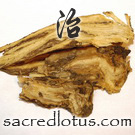 Dang Gui6-9 gTonify Blood
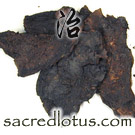 Sheng Di Huang9-15 gCool the Blood
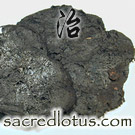 Shu Di Huang9-15 gTonify Blood
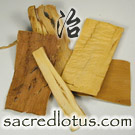 Huang Bai6-12 gClear Heat and Dry Dampness
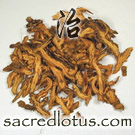 Huang Lian3-6 gClear Heat and Dry Dampness
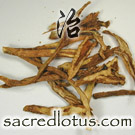 Huang Qin6-12 gClear Heat and Dry Dampness
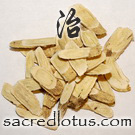 Huang Qi12-24 gTonify Qi
Preparation & dosage
How is Dang Gui Liu Huang Tang prepared?
Dang Gui Liu Huang Tang is taken as a water decoction (tang). The classical formula uses roughly equal amounts of Dang Gui, Sheng Di Huang, Shu Di Huang, Huang Qin, Huang Lian, and Huang Bai, with Huang Qi dosed distinctly higher than the rest to strongly secure the exterior and stop the sweating — a proportion still reflected in the wider reference range given for Huang Qi below.
Source: Bensky & Barolet, Formulas & Strategies (classical preparation); Sacred Lotus dosage ranges.
Decoction. Reference relative amounts: Dang Gui 6-9 g; Sheng Di Huang, Shu Di Huang 9-15 g; Huang Qin, Huang Bai 6-12 g; Huang Lian 3-6 g; Huang Qi 12-24 g (dosed highest of the seven, classically to secure the exterior and stop sweating). Reference only.
Safety — read before use
What are the cautions for Dang Gui Liu Huang Tang?
Dang Gui Liu Huang Tang is a bitter, cold formula built around three fire-draining herbs, so it can injure Spleen-Stomach yang with prolonged use, producing poor appetite, epigastric discomfort, or loose stools. It is intended for sweating driven by deficiency fire, not for sweating from pure qi or yang deficiency (cold, clammy sweat with cold limbs and no heat signs), which calls for a different strategy (e.g., Mu Li San).
- Avoid or modify in patients with weak, cold digestion, since the three yellows are strongly bitter-cold.
- Not for exterior-deficiency sweating without fire — the formula’s cold herbs are inappropriate without genuine heat signs (red face, dry mouth, irritability, red tongue).
- Pregnancy and long-term use: contains multiple bitter-cold, potentially Stomach-taxing herbs — use only under professional guidance, typically discontinuing or modifying once sweating resolves.
Source: Bensky & Barolet, Formulas & Strategies (cautions for bitter-cold fire-draining formulas). Traditional-use framing; not medical advice.
Originally Appeared In:
- Secrets from the Orchid Chamber (Lan Shi Mi Cang)
Notes:
Where does the name Dang Gui Liu Huang Tang come from, and how does it compare with other sweat-stopping formulas?
“Six Yellow” (liu huang) refers to the six ingredients whose names contain the character huang (yellow): Huang Qin, Huang Lian, Huang Bai, Huang Qi, Sheng Di Huang, and Shu Di Huang — Dang Gui is the seventh, unnamed herb that rounds out the formula. It was recorded by Li Dongyuan in Lan Shi Mi Cang (Secret Records from the Orchid Chamber, Jin dynasty) as the classic formula for night sweats due to yin deficiency with effulgent fire.
- vs Mu Li San: Mu Li San (Calcined Oyster Shell Powder, with Huang Qi, Ma Huang Gen, Fu Xiao Mai) stabilizes and astringes sweat from wei-qi/exterior deficiency without heat; Dang Gui Liu Huang Tang is for sweat driven by fire, with clear heat signs.
- vs Liu Wei Di Huang Wan / Zhi Bai Di Huang Wan: those nourish Kidney yin (and, with Zhi Mu/Huang Bai added, drain deficiency fire more broadly) but are not specifically built to stop sweating the way the three-yellows-plus-Huang-Qi combination here is.
Key point: the formula’s Huang Qi is given in a distinctly larger dose than the other six herbs specifically to secure the exterior and stop the sweat, not primarily to tonify qi.
Source: Bensky & Barolet, Formulas & Strategies; formula origin cross-checked against Qiu J et al., Medicine (Baltimore) 2024 (PMID 39252269), which dates the formula to Lan Shi Mi Cang, 1276.
Clinical Studies & Research:
Is there modern research on Dang Gui Liu Huang Tang?
Yes — a modest body of randomized-trial evidence plus network-pharmacology and cell-based mechanistic work, though overall quality is described as low. A systematic review of five RCTs found Danggui Liuhuang decoctions may improve Kupperman-index menopausal symptom scores comparably to conventional drug therapy, though the certainty of evidence was rated very low. A larger meta-analysis of 20 RCTs (1,757 patients) found the formula added to antithyroid drugs improved thyroid function markers and symptom scores versus antithyroid drugs alone in hyperthyroidism, with fewer adverse events, again with generally low methodological quality in the source trials.
- Menopausal symptoms (clinical, low-certainty): systematic review of 5 RCTs, Kupperman index outcomes (PMID 32613007).
- Hyperthyroidism adjunct (clinical meta-analysis): 20 RCTs, 1,757 patients, combined with antithyroid drugs vs antithyroid drugs alone (PMID 39732298).
- Night sweats mechanism (preclinical/computational): network pharmacology and molecular docking identified baicalein, quercetin, and other constituents acting on IL-6, TNF, and PI3K-Akt-related targets (PMID 39252269).
Sources: PubMed 32613007; PubMed 39732298; PubMed 39252269 / PMC 11384048. Research context, not a therapeutic claim; direct high-quality clinical trial evidence remains limited.
Sources & References
Compiled and edited by Thomas Dehli, Founder & Editor, Sacred Lotus Updated
The information here is referenced from numerous sources — teachers, practitioners, class notes from Five Branches University, the books below, and the published research literature, with citations given as resolvable PubMed identifiers. Where sources disagree, I have flagged the discrepancies directly. If facts couldn't be verified, I have left them out. How we source our content.
Reference information for students and practitioners — not medical advice. Consult a qualified practitioner. Terms of use.
Chinese Formulas Books & References
 https://amzn.to/4fYI3f8
 https://amzn.to/4j55NRA
 https://amzn.to/4gMROyv
 https://amzn.to/4h7msSK