
Ren Shen Ge Jie San
Ginseng and Gecko Powder
- Category
- Formulas that Tonify
- Subcategory
- Formulas that Tonify the Qi
- Ingredients
- 8 herbs
Actions
What does Ren Shen Ge Jie San do?
Ren Shen Ge Jie San (Ginseng and Gecko Powder) tonifies Lung and Kidney qi, restores the Kidney’s grasp of qi, and clears lingering Lung heat and phlegm to relieve chronic, deficiency-type wheezing and cough. It targets long-standing asthma/wheezing where the root has shifted from the Lung alone down to the Kidney’s ability to hold inhaled qi, with residual heat and phlegm still present in the Lung.
The eight ingredients divide by role:
- Chief: Ge Jie (restores the Kidney’s grasping of qi and tonifies Lung and Kidney together) and Ren Shen (powerfully tonifies source qi, supporting both Lung and Spleen) — the pairing the formula is named for.
- Deputy: Fu Ling strengthens the Spleen and drains dampness, cutting off the source of phlegm production.
- Assistants: Xing Ren and Sang Bai Pi descend Lung qi and calm wheezing; Zhi Mu and Chuan Bei Mu clear heat, nourish yin, and transform phlegm to stop cough.
- Envoy: Zhi Gan Cao harmonizes the formula and supports the middle burner.
Source: Sacred Lotus sources & references + Bensky & Barolet, Formulas & Strategies (chief/deputy/assistant/envoy analysis), cross-checked against classical fangji (君臣佐使) commentary. Traditional-use framing; not medical advice.
Indications
What is Ren Shen Ge Jie San used for?
Ren Shen Ge Jie San treats chronic, deficiency-type wheezing and cough from combined Lung and Kidney qi deficiency with residual phlegm-heat in the Lung — typically a long-standing case where an original Lung-qi-deficiency cough has progressed until the Kidney can no longer “grasp” (hold down) inhaled qi.
Its classic clinical presentation:
- Kidney not grasping qi: chronic wheezing and shortness of breath, worse on exertion or inhalation, gradual emaciation.
- Residual phlegm-heat: cough with thick, sometimes yellow sputum (occasionally blood-tinged), a sensation of heat or vexation in the chest.
- General deficiency: fatigue, and in more advanced or longstanding cases, facial or lower-limb edema.
Tongue and pulse: purple tongue with a thin white or thin yellow greasy coat; a floating, deficient (weak) pulse.
Source: Sacred Lotus sources & references on pattern/tongue/pulse + Bensky & Barolet, Formulas & Strategies. Traditional-use framing; not medical advice.
Western Uses:
What is Ren Shen Ge Jie San used for in modern practice?
In modern practice Ren Shen Ge Jie San is referenced for the stable or chronic phase of deficiency-type respiratory conditions — practitioners have traditionally applied its Lung-Kidney-deficiency-with-phlegm-heat pattern to presentations resembling chronic or stable-phase asthma, COPD, chronic bronchitis, and bronchiectasis, where Western medicine recognizes persistent breathlessness, cough, and sputum production.
These biomedical correlates are offered as a reference to the formula’s traditional use, not as a claim that it treats any diagnosed disease. Direct clinical-trial evidence on the full formula is limited in PubMed-indexed literature (see research); any use for a diagnosed respiratory condition belongs with a qualified practitioner and appropriate medical care.
Source: traditional-use correlates summarized from Bensky & Barolet, Formulas & Strategies; reference only, not a treatment claim.
Ingredients
8 substances in Ren Shen Ge Jie San — each links to its full herb monograph.
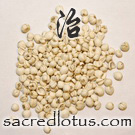 Chuan Bei Mu60 gCool and Transform Phlegm-Heat
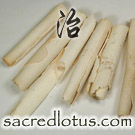 Fu Ling60 gRegulate Water and Drain DampnessNo specimen photographGe Jie1 PairTonify Yang
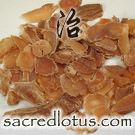 Ren Shen60 gTonify Qi
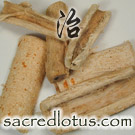 Sang Bai Pi60 gRelieve Coughing and Wheezing
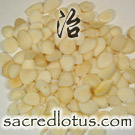 Xing Ren150 gRelieve Coughing and Wheezing
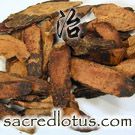 Zhi Gan Cao150 gTonify Qi
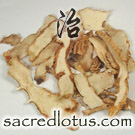 Zhi Mu60 gDrain Fire
Preparation & dosage
How is Ren Shen Ge Jie San prepared?
Ren Shen Ge Jie San ("Ginseng and Gecko Powder") is a powder: all the ingredients — including the chief Ge Jie (dried gecko) and Ren Shen — are ground to an even powder and taken in 3–6 g doses with warm water, twice a day on an empty stomach.
The powder form suits Ge Jie, whose Lung- and Kidney-tonifying, wheeze-calming action is best delivered ground rather than boiled. Used for chronic cough and wheeze of Lung-Kidney deficiency. Available as concentrated granules.
Source: Sacred Lotus sources & references (composition and preparation note) + Bensky & Barolet, Formulas & Strategies.
Powder: Ge Jie 1 pair; Ren Shen, Fu Ling, Sang Bai Pi, Chuan Bei Mu, Zhi Mu 60 g each; Xing Ren, Zhi Gan Cao 150 g each. Grind to a fine, even powder; take 3–6 g doses with warm water twice daily on an empty stomach. Reference relative amounts only.
Safety — read before use
What are the cautions for Ren Shen Ge Jie San?
Ren Shen Ge Jie San is a tonifying formula for a deficiency pattern, so it is inappropriate whenever an exterior (wind-cold or wind-heat) invasion or a purely excess-type wheeze is present — its rich tonics can “lock in” a pathogen or aggravate an excess presentation rather than resolve it.
- Avoid during acute exterior invasion (e.g., a cold or flu with cough) or in wheezing that is purely excess in nature, without an underlying deficiency.
- Pregnancy: use only under professional guidance.
- Contains an animal-derived ingredient (Ge Jie / gecko): beyond the clinical picture, practitioners and suppliers should confirm legally traceable, sustainably sourced Ge Jie — see notes for conservation context.
Source: Bensky & Barolet, Formulas & Strategies, cross-checked against classical fangji commentary (contraindication in exterior conditions). Traditional-use framing; not medical advice.
Originally Appeared In:
- Precious Mirror of Health (Wei Sheng Bao Jian)
Notes:
What should practitioners know about Ge Jie sourcing in this formula, and how does it compare to related formulas?
Ge Jie is the tokay gecko (Gekko gecko), and its use in this and other TCM formulas is a genuine conservation concern. The tokay gecko is globally assessed as Least Concern by the IUCN, but heavy demand from the TCM and exotic-pet trades has driven it to be listed as Endangered in China’s own Red Data Book, and it was added to CITES Appendix II in 2019 specifically to bring international trade in geckos (including dried/processed parts) under permit controls. Practitioners and suppliers sourcing Ge Jie for this formula should confirm legal, CITES-compliant, traceable origin.
Ren Shen Ge Jie San sits among several Lung/Kidney formulas for wheezing and cough, distinguished by the deficiency-with-phlegm-heat pattern and its use of Ge Jie to restore Kidney qi-grasping:
- vs Ding Chuan Tang: Ding Chuan Tang treats an acute, excess-type wheeze from wind-cold constraining the exterior with phlegm-heat brewing internally — not a chronic deficiency pattern.
- vs Su Zi Jiang Qi Tang: Su Zi Jiang Qi Tang addresses upper excess/lower deficiency with cold-phlegm and Kidney yang deficiency, rather than the Lung-Kidney qi deficiency with phlegm-heat seen here.
Source: conservation facts summarized from the IUCN Red List, China Red Data Book status, and the CITES CoP18 (2019) Gekko gecko Appendix-II listing (via Wikipedia “Tokay gecko” and CITES CoP18 proceedings); formula comparisons summarized from Bensky & Barolet, Formulas & Strategies.
Clinical Studies & Research:
Is there modern research on Ren Shen Ge Jie San?
Direct clinical-trial evidence on the complete formula is not found in PubMed-indexed literature, but its chief herb, Gekko gecko, has documented anti-asthmatic pharmacology. A 2022 study found that Gekko gecko extract reduced airway inflammation and mucus overproduction in an ovalbumin-induced mouse model of asthma, attenuating inflammatory cell infiltration and Th2-cytokine expression — a mechanistic correlate for the herb’s traditional role in calming wheezing.
- Gekko gecko extract in asthma (preclinical): attenuated airway inflammation and mucus hypersecretion via reduced Th2 cell activation in an ovalbumin-induced murine asthma model (PMID 34461187).
- Panax ginseng in COPD (clinical, component herb only): a placebo-controlled pilot trial of ginseng extract in moderate-to-very-severe COPD found no significant differences in outcome measures over 10 weeks, though the authors judged a full-scale trial warranted (PMID 25161696) — a reminder that single-herb data does not establish the whole formula’s effect.
Sources: PubMed 34461187; PubMed 25161696. Research context, not a therapeutic claim; formula-level randomized trials (reported in Chinese-language journals) were not included because they lack a resolvable PMID/PMC/DOI.
Sources & References
Compiled and edited by Thomas Dehli, Founder & Editor, Sacred Lotus Updated
The information here is referenced from numerous sources — teachers, practitioners, class notes from Five Branches University, the books below, and the published research literature, with citations given as resolvable PubMed identifiers. Where sources disagree, I have flagged the discrepancies directly. If facts couldn't be verified, I have left them out. How we source our content.
Reference information for students and practitioners — not medical advice. Consult a qualified practitioner. Terms of use.
Chinese Formulas Books & References
 https://amzn.to/4fYI3f8
 https://amzn.to/4j55NRA
 https://amzn.to/4gMROyv
 https://amzn.to/4h7msSK