
Fructus Perillae Frutescentis Purple Perilla Fruit, Perilla Seed
Also known as Su Zi
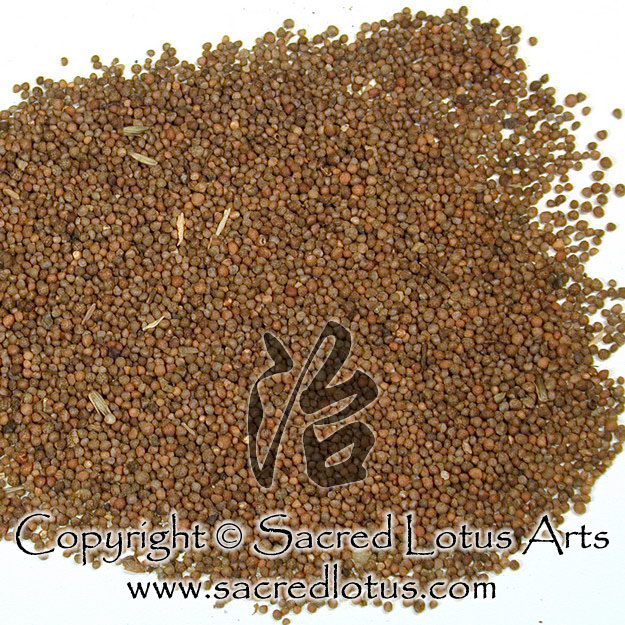
Materia Medica Data
- Temperature
- Warm
- Nature & Flavour
- Spicy, Warm
- Channels Entered
- LI, LU
- Latin (pharmaceutical)
- Fructus Perillae Frutescentis
- Chinese
- 紫苏子
- Tone Marks
- zĭ sū zĭ
- Also Known As
- Su Zi
Chinese Herb Actions
What is Zi Su Zi (perilla seed) used for in Chinese medicine?
Zi Su Zi (Perilla Fruit/Seed) descends rebellious Lung qi to stop coughing and calm wheezing, transforms phlegm, and moistens the Intestines. It is the go-to seed for cough and wheezing with copious phlegm, chest and diaphragm fullness, and labored breathing — especially phlegm-cold or a “excess above, deficiency below” pattern. Its oily nature also unblocks dry, constipated Intestines, so it suits cough or wheeze that occurs together with constipation.
Its main traditional actions:
- Descends qi, stops cough & calms wheezing — rebellious Lung qi with cough, dyspnea, and a stifling sensation in the chest.
- Transforms phlegm — copious, thin or phlegm-cold sputum obstructing the Lung.
- Moistens the Intestines, unblocks the bowels — constipation from dry Intestines, often paired with the cough it is already treating.
Source: owner’s Five Branches notes, reviewed against Bensky, Materia Medica (3rd ed.). Traditional-use framing; not medical advice.
Chinese Herb Dosage
What is the typical dosage of Zi Su Zi?
4.5–9 g in decoction. It is usually crushed before decocting to release the oil. Sources differ modestly on the range (some materia medica give roughly 3–10 g).
Source: owner’s Five Branches notes; standard materia medica ranges (range variance kept and flagged). Reference only — not a prescription.
Chinese Herb Contraindications & Cautions
Are there cautions or contraindications for Zi Su Zi?
Use with caution where cough is from qi deficiency or yin deficiency, and in loose stools or diarrhea. It is best suited to phlegm and rebellious-qi excess patterns; a dry, non-productive cough from Lung yin deficiency or a weak cough from qi deficiency calls for tonifying or moistening methods instead. Because the seed is oily and moves the bowels, it can aggravate diarrhea or loose stools.
Source: owner’s Five Branches notes; materia medica consensus.
Chinese Herb Toxicity & Overdose
Low. Perilla seed is a food-grade material — the source of culinary perilla (egoma) seed oil — and no significant toxicity is reported at normal therapeutic doses.
Source: materia medica consensus; no toxicity signal in the reviewed research.
Herb-Drug Interactions
No well-established clinical herb–drug interactions are documented. Perilla seed and its oil are rich in the omega-3 fatty acid alpha-linolenic acid, so at high supplemental-oil intakes a theoretical additive effect with anticoagulant or antiplatelet drugs is reasonable to keep in mind, though this is not documented at medicinal seed doses. (Flagged for practitioner confirmation — absence of documented interactions is not proof of safety.)
Western / Biomedical Research
Chinese Herb Clinical Studies & Research
Provided as research context — a summary of published biomedical study, not a therapeutic or medical claim.
Is there modern research on Zi Su Zi (perilla seed)?
Yes, largely preclinical, centered on the seed’s fatty acids and phenolics. Perilla seed and its oil are among the richest plant sources of the omega-3 alpha-linolenic acid, and the plant also yields rosmarinic acid, luteolin, and apigenin. Reviews of Perilla frutescens describe anti-inflammatory, anti-allergic, and anti-asthmatic activity in laboratory and animal studies, consistent with its traditional use for cough, wheezing, and phlegm; a systematic review has examined perilla among herbal medicines for allergic rhinitis. Human clinical evidence remains limited.
Sources: PubMed 30597896 (Perilla frutescens phytochemical & pharmacological review, Molecules 2018); PubMed 18219828 (herbal medicines for allergic rhinitis, systematic review, Ann Allergy Asthma Immunol 2007); PubMed 10683915 (pharmacological effects of zisu and baisu). Research context, not a therapeutic claim.
Chinese Herb Notes
How is Zi Su Zi combined, and how does it differ from Zi Su Ye (perilla leaf)?
Zi Su Zi (the seed) descends qi to stop cough and wheeze, whereas Zi Su Ye (the leaf) ascends and disperses to release the exterior — opposite directions from the same plant. The seed is chosen for rebellious Lung qi, phlegm, and cough; the leaf for wind-cold exterior patterns, chest/qi stagnation, calming a restless fetus, and resolving fish- or crab-toxin.
Common combinations:
- Su Zi Jiang Qi Tang — the classic formula built on Zi Su Zi to direct rebellious qi downward for cough and wheeze with phlegm (excess above, deficiency below).
- San Zi Yang Qin Tang — with Bai Jie Zi and Lai Fu Zi, for cough and wheezing with copious phlegm and food stagnation, classically in the elderly.
- With Xing Ren and Gua Lou Ren — for cough accompanied by dry-Intestine constipation.
Source: owner’s Five Branches notes (combinations & the seed-vs-leaf differentiation).
Sources & References
Compiled and edited by Thomas Dehli, Founder & Editor, Sacred Lotus Updated
The information here is referenced from numerous sources — teachers, practitioners, class notes from Five Branches University, the books below, and the published research literature, with citations given as resolvable PubMed identifiers. Where sources disagree, I have flagged the discrepancies directly. If facts couldn't be verified, I have left them out. How we source our content.
Reference information for students and practitioners — not medical advice. Consult a qualified practitioner. Terms of use.
Chinese Herbs Books & References
 https://amzn.to/3WfB3DK
 https://amzn.to/3DR1VUh
 https://amzn.to/42aMz73
 https://amzn.to/3PuD4bt