

Ma Zi Ren Wan (Hemp Seed Pill)
Actions
What does Ma Zi Ren Wan do?
Ma Zi Ren Wan gently moistens the intestines and lubricates dry stool while mildly draining Stomach/Intestine heat, rather than forcing a strong purge. It is the "gentle" moistening counterpart to harsh attack-purgative decoctions such as Da Cheng Qi Tang, built for chronic dryness rather than acute excess.
- Moistens the Intestines and softens the stool — Huo Ma Ren, reinforced by the oil content of Xing Ren.
- Mildly drains Stomach/Intestine heat and unblocks the bowel — via the embedded Xiao Cheng Qi Tang trio (Da Huang, Zhi Shi, Hou Po), dosed and delivered as a pill to restrain their harshness.
- Nourishes Yin/Blood and protects fluids — Bai Shao offsets the drying tendency of the purgative herbs.
- Directs Lung Qi downward to assist the Large Intestine — Xing Ren, reflecting the paired Lung–Large Intestine relationship.
Source: cross-referenced against multiple online sources; Bensky & Barolet, Formulas & Strategies; classical formulation from the Shang Han Lun (Treatise on Cold Damage, Zhang Zhongjing, ~200 CE).
Indications
What is Ma Zi Ren Wan used for?
Ma Zi Ren Wan is used for chronic, dry constipation from intestinal dryness with mild Stomach/Intestine heat — classically the "Spleen-constrained" pattern in which normal or frequent urination diverts fluids away from the stool. It is common in the elderly, postpartum patients, and those recovering from febrile illness or fluid loss.
- Dry, hard stool with infrequent, difficult bowel movements not driven by severe heat-excess.
- Normal or increased urination alongside constipation — fluids diverted to the bladder rather than moistening the stool (the classic "Spleen-restriction," pi yue, presentation).
- Chronic functional constipation in elderly or debilitated patients for whom a harsh purgative is unsuitable.
- Constipation following childbirth, surgery, febrile illness, or other fluid-depleting events.
- Mild abdominal fullness with dry stool, but without the acute high fever or hard, painful mass of Yangming Fu-organ excess.
Source: cross-referenced against multiple online sources; Bensky & Barolet, Formulas & Strategies; Shang Han Lun.
Ingredients
6 substances in Ma Zi Ren Wan — each links to its full herb monograph.
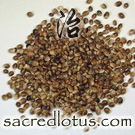 Huo Ma Ren500-600 gMoist Laxatives
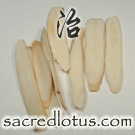 Bai Shao150-250 gTonify Blood
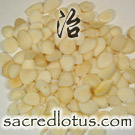 Xing Ren150-250 gRelieve Coughing and Wheezing
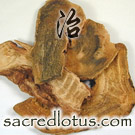 Da Huang300-500 gPurgatives
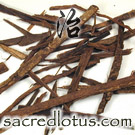 Hou Po150-250 gAromatic Herbs that Transform and Dissolve Dampness
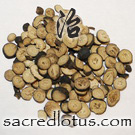 Zhi Shi150-250 gRegulate the Qi
Preparation & dosage
How is Ma Zi Ren Wan prepared?
Classically the six herbs are ground to a fine powder and formed into small pills bound with honey, taken in modest doses once or twice daily and adjusted until normal bowel movements resume, rather than decocted and drunk as a single strong purge.
- Pill form (Wan) — the name itself signals gentle, sustained action; grinding and honey-binding are intended to slow and moderate release of the purgative herbs compared with a decoction.
- Honey binder — beyond serving as the pill's vehicle, honey's own moistening, harmonizing quality is described by commentators as reinforcing the formula's lubricating strategy; our composition data lists the six core herbs above and does not carry honey as a separate ingredient entry.
- Xing Ren processing — some formularies note Xing Ren is stir-processed to remove the skin and tip before grinding, reducing its mild toxicity and improving the smoothness of the paste.
- Modern forms — manufactured proprietary versions ("MaZiRenWan") are produced as standardized tablets/pills for consistent dosing in clinical research.
- Dosing is titrated to effect and stopped once regular, comfortable bowel movements are restored, rather than continued indefinitely without reassessment.
Source: cross-referenced against multiple online sources; Bensky & Barolet, Formulas & Strategies; Shang Han Lun.
Safety — read before use
What are the cautions for Ma Zi Ren Wan?
Ma Zi Ren Wan is intended for dryness-type constipation with mild heat, not for constipation from Qi, Blood, or Yang deficiency and cold, and — like other formulas containing Da Huang — it is contraindicated in pregnancy. The following points are widely noted as neutral public-safety reference, not administration guidance.
- Contraindicated in pregnancy — contains Da Huang, whose purgative, blood-moving action is considered unsafe in pregnant patients.
- Not appropriate for Yang- or Qi-deficiency constipation (cold limbs, fatigue, loose-stool tendency) — the formula assumes dryness/mild heat, not cold-deficiency, and could aggravate digestive weakness if misapplied.
- Not for acute, severe Yangming Fu-organ excess (hard, painful distention with high tidal fever) — that presentation calls for stronger decoctions such as Da Cheng Qi Tang, not this gentle pill.
- Caution with prolonged or habitual use — as with other Da-Huang-containing formulas, extended unsupervised use is generally discouraged; it is intended for short courses until normal movements resume, with reassessment of the underlying cause of chronic constipation.
- Use care in patients with existing diarrhea, weak digestion, or known sensitivity to any component herb.
Source: cross-referenced against multiple online sources; Bensky & Barolet, Formulas & Strategies; Shang Han Lun.
Originally Appeared In:
- On Cold Damage (Shang Han Lun)
Notes:
How does Ma Zi Ren Wan differ from related formulas?
Ma Zi Ren Wan sits at the gentle, moistening end of the purgative spectrum, distinguished from the harsher Cheng Qi decoctions by dose, form, and its added moistening herbs, and from purely tonifying laxatives by still containing a restrained purgative core.
- Xiao Cheng Qi Tang (Minor Order the Qi Decoction) — the exact three-herb purgative trio (Da Huang, Zhi Shi, Hou Po) is embedded inside Ma Zi Ren Wan; alone, in decoction and at fuller dose, it is meant for early/incomplete Yangming Fu-excess with fullness and distention but not-yet-hardened stool — noticeably stronger and faster than the same three herbs diluted inside Ma Zi Ren Wan's pill.
- Da Cheng Qi Tang (Major Order the Qi Decoction) — the strongest Cheng Qi decoction (adds Mang Xiao, staged cooking); used for full Yangming Fu-excess with hard, painful distention and tidal fever — an acute attack formula, in contrast to Ma Zi Ren Wan's gentle, sustained moistening for chronic dry constipation.
- Run Chang Wan (Moisten the Intestines Pill, Li Dongyuan) — a related but distinct moistening laxative built around Dang Gui and Huo Ma Ren for Blood-deficiency constipation (typically postpartum or elderly) without Stomach/Intestine heat; it carries no Da Huang–Zhi Shi–Hou Po purgative core, making it gentler still and more appropriate when heat is absent and Blood deficiency predominates.
- Classical source and lineage — Ma Zi Ren Wan (also known as Pi Yue Wan, "Spleen-restriction Pill") originates in Zhang Zhongjing's Shang Han Lun (Treatise on Cold Damage, ~200 CE), where it treats the Yangming "Spleen-constrained" (pi yue) pattern: Stomach heat drying fluids that are diverted into frequent urination, leaving the stool dry despite otherwise normal digestion.
Source: cross-referenced against multiple online sources; Bensky & Barolet, Formulas & Strategies; Shang Han Lun.
Clinical Studies & Research:
Is there modern research on Ma Zi Ren Wan?
Ma Zi Ren Wan (studied under the name "MaZiRenWan") has been evaluated in randomized controlled trials for functional constipation, making it one of the more clinically-tested classical Chinese formulas for this indication. This research is presented as scientific context on traditional use, not a therapeutic claim.
- A multi-center randomized controlled trial found MaZiRenWan improved complete spontaneous bowel movement frequency and constipation-related quality-of-life measures compared with placebo in patients with functional constipation.
- A systematic review evaluated MaZiRenWan trials for functional constipation and summarized efficacy and safety signals across the available randomized evidence.
- Related trial-protocol and clinical-associations literature has examined pattern (zheng)-based herb prescribing for constipation in Chinese medicine, providing further clinical context for MaZiRenWan's use.
Sources: PMID 29654915; PMID 24473591; PMID 33486266; PMID 24180235.
Sources & References
Compiled and edited by Thomas Dehli, Founder & Editor, Sacred Lotus Updated
The information here is referenced from numerous sources — teachers, practitioners, class notes from Five Branches University, the books below, and the published research literature, with citations given as resolvable PubMed identifiers. Where sources disagree, I have flagged the discrepancies directly. If facts couldn't be verified, I have left them out. How we source our content.
Reference information for students and practitioners — not medical advice. Consult a qualified practitioner. Terms of use.
Chinese Formulas Books & References
 https://amzn.to/4fYI3f8
 https://amzn.to/4j55NRA
 https://amzn.to/4gMROyv
 https://amzn.to/4h7msSK