
Gan Lu Xiao Du Dan
Sweet Dew Special Pill to Eliminate Toxins
- Category
- Formulas that Expel Dampness
- Subcategory
- Formulas that Clear Damp-Heat
- Ingredients
- 11 herbs
Actions
What does Gan Lu Xiao Du Dan do?
Gan Lu Xiao Du Dan (“Sweet Dew Special Pill to Eliminate Toxin,” also known as Pu Ji Jie Yi Dan) clears damp-heat, resolves toxin, and unblocks the triple burner — it is often called the master formula for damp-heat epidemic (warm) disease, treating dampness and heat together rather than favoring one over the other.
The eleven ingredients divide by role:
- Chief: Hua Shi, Yin Chen (Hao), and Huang Qin form the core damp-heat-clearing trio — Hua Shi drains damp-heat through urination and relieves summer-heat, Yin Chen Hao specifically clears damp-heat from the Liver and Gallbladder and resolves jaundice, and Huang Qin dries dampness and clears heat-toxin with its bitter-cold action.
- Deputies: Shi Chang Pu, Huo Xiang, and Bai Dou Kou are aromatic herbs that transform turbid dampness and revive Spleen function in the middle burner; Mu Tong reinforces the chief herbs by draining damp-heat through the urine.
- Assistants: Lian Qiao, She Gan, Chuan Bei Mu, and Bo He clear heat-toxin and disperse the swelling it causes in the throat and upper body — She Gan and Chuan Bei Mu target throat pain and phlegm-heat specifically, while Bo He (added toward the end of cooking) vents heat outward from the upper burner.
Together the formula addresses damp-heat at all three levels: aromatic transformation and drainage clear it from the middle and lower burner, while the heat-toxin-resolving herbs clear it from the upper burner (throat, head, skin).
Source: Sacred Lotus sources & references + Bensky & Barolet, Formulas & Strategies (chief/deputy/assistant analysis). Traditional-use framing; not medical advice.
Indications
What is Gan Lu Xiao Du Dan used for?
Gan Lu Xiao Du Dan treats damp-heat epidemic (warm) disease, classically associated with early summer — a pattern where dampness and heat are roughly balanced (neither clearly dominant), obstructing the free flow of qi through the triple burner and allowing toxin to accumulate.
Its classic clinical presentation:
- Systemic damp-heat signs: fever, a heavy or lethargic feeling in the body and limbs, chest and epigastric fullness or distension.
- Liver/Gallbladder involvement: jaundice (yellowing of the eyes and skin), dark and scanty urine.
- Toxin rising to the upper body: sore, swollen throat; mouth and tongue sores or ulcers; skin rashes or eruptions.
Tongue and pulse (per Sacred Lotus sources & references): a white, thick, greasy tongue coat (dampness more prominent) or a yellow, dry tongue coat (heat more prominent); a soggy, rapid pulse.
Source: Sacred Lotus sources & references on pattern/tongue/pulse + Bensky & Barolet, Formulas & Strategies. Traditional-use framing; not medical advice.
Western Uses:
What is Gan Lu Xiao Du Dan used for in modern practice?
In modern practice, practitioners have traditionally reached for Gan Lu Xiao Du Dan’s damp-heat, epidemic-toxin pattern in conditions such as viral hepatitis with jaundice, mumps, acute tonsillitis or pharyngitis, and damp-heat-type skin eruptions (eczema, urticaria) — contexts where Western medicine recognizes fever, hepatic inflammation, or infectious/inflammatory throat and skin presentations.
These biomedical correlates are offered as a reference to the formula’s traditional use, not as a claim that it treats any disease. Contemporary study of the formula includes a large retrospective clinical dataset from COVID-19 and mechanistic (network-pharmacology/animal) work on viral infection (see research). Any use for a diagnosed condition belongs with a qualified practitioner and appropriate medical care.
Source: traditional-use correlates summarized from Bensky & Barolet, Formulas & Strategies; reference only, not a treatment claim.
Ingredients
11 substances in Gan Lu Xiao Du Dan — each links to its full herb monograph.
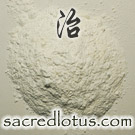 Hua Shi18-21 gRegulate Water and Drain Dampness
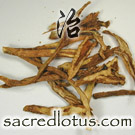 Huang Qin12-15 gClear Heat and Dry Dampness
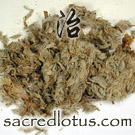 Yin Chen24-30 gRegulate Water and Drain Dampness
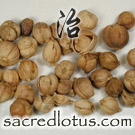 Bai Dou Kou10-12 gAromatic Herbs that Transform and Dissolve Dampness
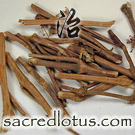 Huo Xiang9-12 gAromatic Herbs that Transform and Dissolve Dampness
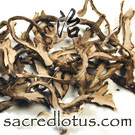 Shi Chang Pu4-6 gAromatic Substances that Open the Orifices
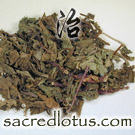 Bo He6-9 gCool, Spicy Herbs that Release the Exterior
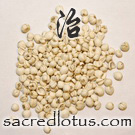 Chuan Bei Mu6-9 gCool and Transform Phlegm-Heat
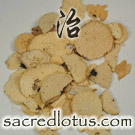 Chuan Mu Tong9-12 gRegulate Water and Drain Dampness
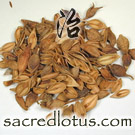 Lian Qiao12-15 gClear Heat and Eliminate Toxins
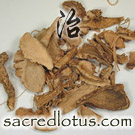 She Gan9-12 gClear Heat and Eliminate Toxins
Preparation & dosage
How is Gan Lu Xiao Du Dan prepared?
Traditionally the eleven herbs are sun-dried (not heat-dried) and ground into a fine powder — the name Dan (“special pill”) reflects this original powder/pill form, though the formula is also widely decocted in modern practice.
- Powder form: 9 g of the powder taken in boiled water, twice daily.
- Pill form: the powder is bound into pills (traditionally with a Shen Qu paste), roughly 9 g each, dissolved in boiled water before drinking.
- Decoction form: aromatic herbs are added late in cooking to preserve their volatile oils — Bo He and Bai Dou Kou are added in the last five to ten minutes.
Source: Bensky & Barolet, Formulas & Strategies (traditional powder/pill preparation and modern decoction adaptation).
Traditionally a powder/pill (9 g powder in boiled water 2x daily, or ~9 g pills bound with Shen Qu paste); commonly decocted in modern practice with Bo He and Bai Dou Kou added in the last 5-10 minutes. Reference relative amounts (per Sacred Lotus sources & references): Yin Chen (Hao) 24-30 g; Hua Shi 18-21 g; Huang Qin, Lian Qiao 12-15 g; Bai Dou Kou 10-12 g; Chuan Mu Tong, Huo Xiang, She Gan 9-12 g; Chuan Bei Mu, Bo He 6-9 g; Shi Chang Pu 4-6 g. Reference only.
Safety — read before use
What are the cautions for Gan Lu Xiao Du Dan?
Gan Lu Xiao Du Dan is a bitter, cold, draining formula for damp-heat, so it is inappropriate wherever dampness and heat are not both present. Because it contains no tonifying herbs, its clearing and diuretic action can further deplete an already-weak constitution.
- Avoid in Cold-Damp or Spleen-Yang deficiency (watery diarrhea, cold limbs, pale tongue with a white slippery coat) — the formula’s cold, bitter, diuretic herbs would further injure Spleen Yang.
- Avoid in significant Yin deficiency without dampness — the drying and diuretic herbs can further deplete fluids.
- Avoid in Qi or Blood deficiency without concurrent damp-heat — without a damp-heat pattern to clear, the draining action can consume qi and damage the Spleen.
- Mu Tong identity matters: the formula calls for Chuan Mu Tong (Clematis armandii), not the toxic substitute historically sold as Guan Mu Tong (Aristolochia manshuriensis), which contains aristolochic acid, a confirmed carcinogen linked to irreversible kidney damage (“Chinese herbs nephropathy”). Guan Mu Tong has been banned from the Chinese Pharmacopoeia and prohibited or restricted in the EU, US, and elsewhere since the early 2000s. Sacred Lotus formulas reference the correct, non-toxic Mu Tong species.
- Pregnancy: use only under professional guidance given the formula’s draining, diuretic action.
Source: Bensky & Barolet, Formulas & Strategies (cautions for damp-heat-clearing formulas); PMC 4913086 (Mu Tong species identity/toxicity). Traditional-use framing; not medical advice.
Originally Appeared In:
- Warp and Woof of Warm Febrile Diseases (Wen Re Jing Wei)
Notes:
How is Gan Lu Xiao Du Dan different from Yin Chen Hao Tang and San Ren Tang?
Gan Lu Xiao Du Dan treats a broader damp-heat spectrum than either Yin Chen Hao Tang or San Ren Tang — it addresses the throat, skin, and urinary tract alongside jaundice, rather than focusing on a single organ or a single pathogen.
- vs Yin Chen Hao Tang: Yin Chen Hao Tang is a more focused, more purgative formula for acute damp-heat jaundice with constipation (it includes Da Huang); Gan Lu Xiao Du Dan is gentler and covers the wider damp-heat-epidemic presentation, including sore throat and skin eruptions.
- vs San Ren Tang: San Ren Tang suits damp-predominant patterns with mild heat and little thirst; Gan Lu Xiao Du Dan suits a more even damp-heat balance or a heat-predominant presentation with clearer toxin signs (throat, jaundice, rash).
Common modifications: add Zhi Zi and Da Huang for jaundice with constipation; add Shan Dou Gen or Ban Lan Gen for severe throat swelling; add Cang Zhu or Ban Xia for heavier dampness.
Source: Bensky & Barolet, Formulas & Strategies (formula comparisons and modifications for damp-heat-clearing formulas).
Clinical Studies & Research:
Is there modern research on Gan Lu Xiao Du Dan?
Yes — a large retrospective clinical dataset from the COVID-19 pandemic plus network-pharmacology and animal work on viral infection. A retrospective analysis of 131 hospitalized COVID-19 patients treated with Ganlu Xiaodu decoction alongside conventional care (antivirals, Lianhua Qingwen, antibiotics, vitamin C) reported that all patients recovered and were discharged; the authors identified patterns of herb combination but noted that rationality and safety of the combined regimen still need further verification — this is observational/retrospective, not a controlled trial isolating the formula’s own effect.
- COVID-19 (retrospective clinical): 131-case analysis of Ganlu Xiaodu decoction combined with conventional treatment; all patients recovered (PMID 32495575).
- Influenza A infection (mechanistic): network-pharmacology screening (125 candidate compounds, including quercetin, kaempferol, and baicalein) combined with animal experiments found the formula modulates the PI3K/Akt signaling pathway and reduces lung tissue inflammation in infected mice (DOI 10.16025/j.1674-1307.2024.08.006, Beijing Journal of Traditional Chinese Medicine, 2024).
Sources: PubMed 32495575; DOI 10.16025/j.1674-1307.2024.08.006. Research context, not a therapeutic claim; direct controlled-trial evidence for the formula itself remains limited.
Sources & References
Compiled and edited by Thomas Dehli, Founder & Editor, Sacred Lotus Updated
The information here is referenced from numerous sources — teachers, practitioners, class notes from Five Branches University, the books below, and the published research literature, with citations given as resolvable PubMed identifiers. Where sources disagree, I have flagged the discrepancies directly. If facts couldn't be verified, I have left them out. How we source our content.
Reference information for students and practitioners — not medical advice. Consult a qualified practitioner. Terms of use.
Chinese Formulas Books & References
 https://amzn.to/4fYI3f8
 https://amzn.to/4j55NRA
 https://amzn.to/4gMROyv
 https://amzn.to/4h7msSK