
Herba Menthae Haplocalycis Field Mint, Mentha
Also known as Su Bo He
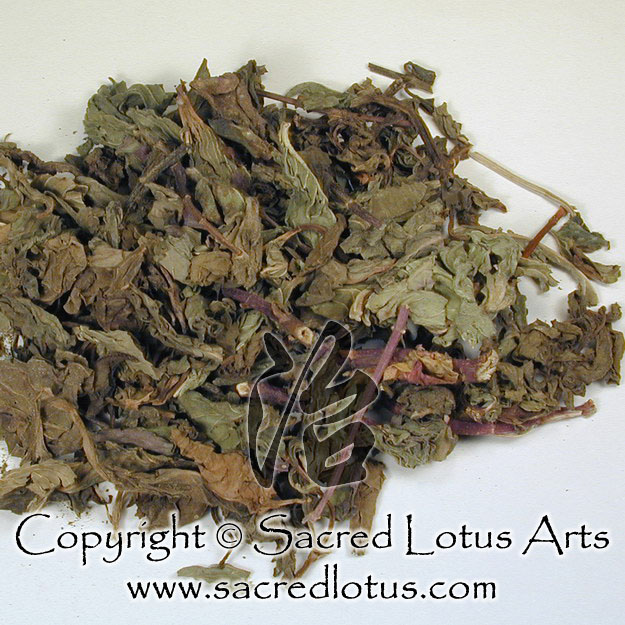
Materia Medica Data
- Temperature
- Cool
- Nature & Flavour
- Spicy, Aromatic, Cool
- Channels Entered
- LU, LIV
- Latin (pharmaceutical)
- Herba Menthae Haplocalycis
- Chinese
- 薄荷
- Tone Marks
- bò he
- Also Known As
- Su Bo He
Chinese Herb Actions
What is Bo He used for in Chinese medicine?
Bo He is an acrid, aromatic, cool herb that releases the exterior and dispels Wind-Heat — used for the early stage of a Wind-Heat cold with fever, headache, and sore throat, and prized for its ability to clear the head, eyes, and throat, vent rashes, and soothe constrained Liver qi.
- Releases the exterior, dispels Wind-Heat — common cold or early febrile disease due to Wind-Heat, with fever, headache, cough, and sore throat.
- Clears the head, eyes, and throat — red, painful eyes, headache, and sore/swollen throat from Wind-Heat rising to the upper body.
- Vents rashes — incomplete or sluggish eruption of rashes, historically including measles, helping the pathogen move outward through the skin.
- Soothes Liver qi (disperses Liver-qi constraint) — distension/discomfort in the chest and hypochondriac region, and other Liver-qi-constraint symptoms with an emotional component.
Source: Sacred Lotus sources & references, cross-referenced against multiple online sources and published materia medica (Bensky, Materia Medica, 3rd ed.; Chen & Chen, Chinese Herbal Medicine: Materia Medica). Traditional-use framing; not medical advice.
Chinese Herb Dosage
What is the typical dosage of Bo He, and why is it added late?
About 1.5–6 g, and it is added near the very end of the decoction — typically for only the last 3–5 minutes of simmering. Bo He’s therapeutic effect depends heavily on its volatile aromatic oils (chiefly menthol), which evaporate quickly under prolonged heat; boiling it with the rest of the herbs for the full cooking time would drive off much of what makes it effective.
- Part used — the above-ground leaves and stem, or the whole aerial herb.
- Preparation note — classically described as “后下” (hòu xià, “add later”), the same late-addition principle applied to other aromatic, volatile-oil-rich herbs.
Source: Sacred Lotus sources & references; cross-referenced against multiple online sources and Bensky/Chen & Chen dosage and preparation notes. Reference only — not a prescription.
Chinese Herb Contraindications & Cautions
Are there cautions for Bo He?
Bo He is contraindicated in exterior deficiency (spontaneous sweating from a weak exterior) and used cautiously with Yin-deficiency heat, since its acrid, dispersing nature can further tax an already-depleted surface. It is also traditionally cautioned in nursing mothers, as it may reduce milk supply.
- Exterior deficiency — avoid in patients prone to spontaneous sweating from a weak protective (Wei) qi.
- Yin-deficiency heat — use cautiously, as excessive dispersing action is not well suited to a Yin-deficient constitution.
- Nursing mothers — traditionally associated with insufficient lactation; used cautiously during breastfeeding.
Source: Sacred Lotus sources & references; cross-referenced against multiple online sources and standard materia medica cautions.
Chinese Herb Toxicity & Overdose
Low, at standard dietary and decoction doses. Bo He/mint is widely consumed as food and tea; adverse effects at ordinary herbal doses are uncommon. Concentrated menthol or essential-oil preparations are a different exposure context from the whole herb in decoction and are used far more cautiously (e.g., diluted topical or inhaled forms), which is a separate consideration from the traditional decocted herb discussed here.
Source: Sacred Lotus sources & references; materia medica consensus. Reference note, not a safety guarantee.
Herb-Drug Interactions
No well-established clinical herb–drug interactions are documented for Bo He at standard decoction doses. Concentrated menthol/peppermint-oil products (a different preparation from the whole herb) have their own separate literature on interactions with certain medications; that is not addressed here and should not be assumed to apply to Bo He decoction. (Flagged for practitioner confirmation where concentrated extracts are used.)
Western / Biomedical Research
Chinese Herb Clinical Studies & Research
Provided as research context — a summary of published biomedical study, not a therapeutic or medical claim.
Is there modern research on Bo He (Mentha haplocalyx)?
Yes — a comprehensive 2024 review and several mechanism-level studies on Mentha haplocalyx specifically support anti-inflammatory, antimicrobial, and antioxidant activity, though clinical trial evidence remains limited. It is worth distinguishing Bo He (Mentha haplocalyx, the Chinese field mint used in this herb) from the Western peppermint (Mentha piperita) studied in much of the popular IBS/digestive research — a related but different species, not directly interchangeable as an evidence base.
- Comprehensive review — a 2024 review in Chinese Medicine covers the botany, traditional uses (colds, cough, fever, indigestion, asthma), phytochemistry (terpenoids as the main bioactive class, plus flavonoids and phenolic acids), and reported preclinical health effects of Mentha haplocalyx, including neuroprotective, anti-inflammatory, antibacterial, antioxidant, and gut-health findings.
- Anti-inflammatory mechanism — a phenolic fraction of Mentha haplocalyx and its constituent linarin suppressed inflammatory signaling (NF-κB and MAPK pathways) in lipopolysaccharide-stimulated cells, offering a candidate mechanism for the herb’s traditional heat-clearing action; cell-based research, not a clinical outcome.
- Volatile-oil chemistry — laboratory work on Mentha haplocalyx essential oil documents menthol and menthone as major constituents and explores extraction/purification methods, consistent with the classical rationale for adding this herb only at the very end of decoction.
Overall, mechanistic and phytochemical research on Mentha haplocalyx is active, but robust human clinical trials specific to this species (as distinct from Western peppermint) are still limited.
Sources: PMID 39663516 (comprehensive review, Chinese Medicine); PMID 28509854 (phenolic fraction/linarin anti-inflammatory mechanism, Molecules); PMID 35597196 (menthol/menthone purification from Mentha haplocalyx, Journal of Chromatography A). Research context, not a therapeutic claim.
Chinese Herb Notes
What formulas commonly use Bo He?
Bo He appears in several classic Wind-Heat and Liver-qi formulas, each drawing on a different one of its actions. It is a core exterior-releasing herb in Yin Qiao San (Wind-Heat with heat toxins) and Sang Ju Yin (early-stage Wind-Heat cough), where it helps vent heat from the exterior and clear the head/throat. In Xiao Yao San (Liver-qi stagnation with blood deficiency), a small amount of Bo He is added specifically to help disperse constrained Liver qi rather than to release the exterior. It also appears in combinations addressing toxic-heat and epidemic patterns, such as Gan Lu Xiao Du Dan and Pu Ji Xiao Du Yin, and in head/eye-focused formulas such as Chuan Xiong Cha Tiao San and Cang Er Zi San. (Traditional formula context, not treatment advice.)
Source: Sacred Lotus formula data (Yin Qiao San, Sang Ju Yin, Xiao Yao San, and related formulas); Sacred Lotus sources & references cross-referenced against multiple online sources.
Sources & References
Compiled and edited by Thomas Dehli, Founder & Editor, Sacred Lotus Updated
The information here is referenced from numerous sources — teachers, practitioners, class notes from Five Branches University, the books below, and the published research literature, with citations given as resolvable PubMed identifiers. Where sources disagree, I have flagged the discrepancies directly. If facts couldn't be verified, I have left them out. How we source our content.
Reference information for students and practitioners — not medical advice. Consult a qualified practitioner. Terms of use.
Chinese Herbs Books & References
 https://amzn.to/3WfB3DK
 https://amzn.to/3DR1VUh
 https://amzn.to/42aMz73
 https://amzn.to/3PuD4bt